The Funny Papers: Surviving Holiday Mayhem


Surviving Holiday Mayhem
With These Ladies of Screwball Comedy

the awful truth movie poster


Dan (Ralph Bellamy): “I certainly learned about women from you.”
Aunt Patsy (Cecil Cunningham): “Here’s your diploma.” (As she hands him Lucy’s break-up letter)

In The Awful Truth (1937), Ralph Bellamy as wealthy cowpoke Dan does indeed learn a great deal about the risks and foibles of falling for a glamorous socialite (Irene Dunne), still in love with her soon-to-be-ex husband (Cary Grant). In the 1930s and 40s, the Screwball Comedy emerged as a uniquely delightful film subgenre caught in the crosshairs between slapstick and romantic comedy. Traversing the battle of the sexes, these charming romps spotlighted some of the most talented and beautiful actresses of that era.

As we enter the zany holiday season, it’s fun to be inspired by these Screwball dames and imagine how they would handle the chaos of the typical holiday mayhem. One of my favorite classic comedy subgenres, the Screwball Comedy, often possessed these specific characteristics…

– female-driven
– plots involving courtship, marriage or remarriage
– fast-paced repartee
– chase or escapist themes
– farcical, if not ridiculous, situations
– elements of slapstick, origins in physical comedy
– parody of the romantic comedy
– quirky character actors
– social class struggles/differences
– female is usually upper-class socialite or heiress
– male is less dominant, frustrated
– battle of the sexes
– both male and female in the couple are frequently eccentric

From my childhood days, I was drawn to the Screwball Comedy, thanks in large part to the leading ladies. The top Hollywood actresses rose to the challenges of madcap energy, rapid-fire dialogue, self-assured confidence, and unforgettable beauty. Here are my top picks for my favorite Ladies of Screwball Comedy classics.

…..

Katharine Hepburn

katherine-hepburn-with-tiger-bringing-up-babyKatharine Hepburn and ‘Baby’ in Bringing Up Baby

In Howard Hawks’ Bringing Up Baby (1938) Katharine Hepburn dominated the genre and the screen. Portraying Susan Vance the Connecticut socialite in pursuit of Dr. David Huxley the overwhelmed paleontologist (the king of screwball, Cary Grant), Hepburn masterfully combines eccentric sophistication and outright silliness. The plot in its absurdity includes hunting dinosaur bones and chasing leopards with a roller coaster pace. As another screwball signature, mixed up identities is exasperatingly present, from twin leopards to mixed up cars, to mistaken characters that result in jail time. For a hilarious dose of slapstick, Hepburn creates chaos for Grant in a club scene where each exit in a shredded gown and tux. To exemplify her life of high society leisure, Hepburn is frequently seen wearing stunning gowns and costumes by Howard Greer. Notable screwball sidekick: George, the dog (Skippy, aka “Mr. Smith”, aka “Asta”). George Cukor’s The Philadelphia Story was released two years later with Hepburn paired again with Grant with some of the screwball traits.

…..

IRENE DUNNE

Irene Dunne in The Awful TruthIrene Dunne in The Awful Truth

Leading the lady lunacy trend, Irene Dunne stars as Lucy Warriner in Leo McCarey’s screwball classic The Awful Truth (1937). Teamed up with Cary Grant as Jerry Warriner, their marriage is on the outs. Jealousy, misunderstandings, and too much upper class boredom creates division for this couple. The twosome are on the path to be a threesome, then a foursome with characters like Ralph Bellamy and Alexander D’Arcy vying for their affections. In divorce negotiations, their talented dog, Mr. Smith (yes, the same) becomes the point of contested custody. Dunne is exquisite as she lounges in Robert Kalloch designed gowns. Dunne exudes comfortably confident sophistication in these incredible fashions that practically steal every scene. Practically, because only the charm of Dunne can carry it off so the gowns drape like her natural skin. Although most of the physical comedy is executed brilliantly by Grant and Skippy, all the screwball ingredients are strong in The Awful Truth. Notable screwball sidekick: Cecil Cunningham as Aunt Patsy delivers some of the best lines.  The chemistry between Dunne and Grant is perfection. In my honest opinion, she was his best pairing for comedies. Another great example of this can be found in Garson Kanin’s My Favorite Wife (1940).

…..

ROSALIND RUSSELL

Cary Grant and Rosalind Russell in His Girl FridayCary Grant and Rosalind Russell in My Girl Friday

Less sophisticated than the country club set but leading the pack for rapid-fire delivery, Russell puts a new twist on the screwball lady. Shortly after her stand-out performance in a large, all-female cast, George Cukor’s The Women (1939), Russell starred in Howard Hawks’ His Girl Friday (1940). Russell was not Hawks’ first pick (he wanted Carol Lombard but she was already booked.) So, she worked diligently, practicing that lightning speed over-talking, to convince him he still made the right choice, even if she wasn’t his first pick. In the end, it’s hard-pressed to imagine anyone other Russell as the iconic Hildy.

Russell commanded a successful film career, including the ever-popular Auntie Mame. But as Screwball dames go, Hildy will always be a favorite.

…..

BARBARA STANWYCK

Barbara Stanwyck and Henry Fonda in The Lady EveBarbara Stanwyck and Henry Fonda in The Lady Eve

Goddess of the Pre-Codes, Stanwyck transitioned easily into the Screwball Comedy world as Jean in Preston Sturges’s The Lady Eve (1941). As a beautifully confident and savvy con artist, Jean falls for her mark, Henry Fonda as the sweet but gullible “Hopsy.” Irresistibly street-smart and sultry, Stanwyck charms even more men as Sugarpuss O’Shea when she educates a bookworm Gary Cooper and a group of bachelor professors while dodging her mobster lifestyle. Barbara Stanwyck flourished in decades of performances so it’s no surprise that she shines as a Screwball Comedy superstar.

…..

CAROLE LOMBARD

Carole Lombard and William Powell in My Man GodfreyCarole Lombard and William Powell in My Man Godfrey

Considered the ultimate queen of the Screwball Comedies, beautiful and talented Lombard masterfully embodied the many traits for this subgenre of the eccentric, chaotic socialite for the silver screen. Howard Hawks’ Twentieth Century (1934), Gregory La Cava’s My Man Godfrey (1936), Ernst Lubitsch’s To Be or Not To Be (1942), Alfred Hitchcock’s Mr. and Mrs. Smith (1941), and William A Wellman’s Nothing Sacred (1937) are examples of why she dominated the laughter and lunacy.

Other queens of the screwball screen include Claudette Colbert in It Happened One Night (1937), Midnight (1939) and The Palm Beach Story (1942), as well as Jean Arthur in Easy Living (1937) and The More the Merrier (1943).

…..

Carole Lombard with Christmas Tree
The beautiful Carole Lombard

If you could sit at the dinner table with Susan Vance and Dr. David Huxley for a holiday meal, what would you discuss besides leopard calls and dinosaur bones? I’m sure “Skippy” would be close by for table scraps. Or, would you rather Godfrey served dinner as you, and the rest of the Bullock family debate over who gets the wishbone?

So, as you’re busy battling the long grocery store lines, basting that turkey, entertaining family and friends, all while pretending to find Uncle Joe’s jokes funny as the dog chases cat underfoot, or whatever whacky traditions your family brings this holiday season… don’t be overwhelmed. Simply imagine how Carole Lombard, Kate Hepburn or Cary Grant would handle the chaotic humor of a battle of the sexes over a Butterball, and pull off your madcap holiday celebrations in grand Screwball style!

…..

–Kellee Pratt for Classic Movie Hub

When not performing marketing and social media as her day gig, Kellee Pratt writes for her own classic film blog, Outspoken & Freckled (kelleepratt.com). Kellee teaches classic film courses in her college town in Kansas (Screwball Comedy this Fall). Unapologetic social butterfly, she’s an active tweetaholic/original alum for #TCMParty, member of the CMBA, Social Producer for TCM (2015, 2016), and busy mom of four kids and 3 fur babies. You can follow Kellee on twitter at @IrishJayHawk66.

Posted in Posts by Kellee Pratt, The Funny Papers | Tagged | 18 Comments

Classic Movie Travels: Gower Champion, Geneva Illinois

Gower Champion, Geneva Illinois

gower champion

“I use dancing to embellish, extend or enlarge upon an existing emotion.”
–Gower Champion

When considering notable dance teams throughout film history, it is easy to come up with Fred Astaire and Ginger Rogers as a perfect example of one. However, the teaming of Marge and Gower Champion is also a fantastic pairing and is well documented in several classic films.

Gower was born in Geneva, Illinois, to Beatrice Carlisle and advertising executive John Champion. His mother was a descendant of Alfred Carlisle, a well-known Fox Valley realtor and Kane County deputy sheriff.

Gower Champion YoungA young Gower

When Gower was two years old, his parents divorced. Beatrice took Gower and his older brother, John, to California, where she worked as a dressmaker. Aside from attending school and working as a newspaper delivery boy, Gower also sang for his supper at Pig’n Whistle, next door to Grauman’s Egyptian Theater.

Gower studied dance at an early age and by 15, he was touring nightclubs with his friend Jeannie Tyler. The duo was billed “Gower and Jeanne, America’s Youngest Dance Team,” and can be seen dancing to the music of Larry Clinton and his Orchestra in the Vitaphone short, The Dipsy Doodler (1940).

In the late 1930s and early 1940s, Gower worked on Broadway as a solo dancer and choreographer. After serving in the U.S. Coast Guard during World War II, he met the woman who would become his wife and new dance partner — Marjorie Belcher. He and Marjorie partnered and formed the dance team “Gower and Bell.”  Upon their marriage, they were renamed “Marge and Gower Champion.” The two married in 1947 and made a total of seven film musicals: Mr. Music (1950), Show Boat (1951), Lovely to Look At (1952), Everything I Have is Yours (1952), Give a Girl a Break (1953), Jupiter’s Darling (1955), and Three for the Show (1955). The duo performed on several television variety shows and even starred in their own short-lived CBS sitcom, The Marge and Gower Champion Show, based upon their actual career experiences. Marge and Gower had two children, Blake and Gregg. They divorced in 1973.

marge and gower championMarge and Gower Champion

In 1948, Gower began to work in directing and won his first of eight Tony Awards — more than any other director or choreographer in Tony history — for Lend an Ear, which introduced Carol Channing to New York City audiences. He found success with 1960’s Bye Bye Birdie, earning Tony Awards for Best Musical as well as direction and choreography. One of his biggest accomplishments was Hello, Dolly!, which starred Carol Channing and won ten Tony awards.

After a string of flops, Gower made a comeback with 1980’s 42nd Street, which won Best Musical. Gower also won an award for his choreography. Tragically, Gower did not see the success of 42nd Street.  On opening night, the cast and audience was stunned when producer David Merrick came on stage during the closing applause and announced: “No, no. This is tragic. You don’t understand. Gower Champion died this morning.” Gower had been struggling with a rare form of blood cancer and had been advised not to take on more work. 42nd Street was one of his biggest successes and ran for nine years.

announcing the passing of gower champion on broadwayAnnouncing the passing of Gower Champion on Broadway

Today, there are few small tributes to Gower that exist in his hometown. The Geneva History Museum has one of his awards, while the Hemmens Cultural Center in Elgin has honored him on their Hall of Fame as an accomplished local talent.

Gower’s childhood home stood on 404 Peck Rd. in Geneva, Illinois. This is the property today:

Gower Champion childhood home stood on 404 Peck Rd in Geneva IllinoisGower’s childhood home

While the Geneva area has a few points of interest relating to Gower’s early life, I would strongly encourage you to try catching one of the shows Gower worked on. Interestingly, there have been several performances of 42nd Street throughout the Chicago area as of late, which are fitting tributes to Gower’s legacy and love of dance.

…..

–Annette Bochenek for Classic Movie Hub

Annette Bochenek of Chicago, Illinois, is a PhD student at Dominican University and an independent scholar of Hollywood’s Golden Age. She manages the Hometowns to Hollywood blog, in which she writes about her trips exploring the legacies and hometowns of Golden Age stars. Annette also hosts the “Hometowns to Hollywood” film series throughout the Chicago area. She has been featured on Turner Classic Movies and is the president of TCM Backlot’s Chicago chapter. In addition to writing for Classic Movie Hub, she also writes for Silent Film Quarterly, Nostalgia Digest, and Chicago Art Deco SocietyMagazine.

Posted in Classic Movie Travels, Posts by Annette Bochenek | Tagged , | 9 Comments

Film Noir Review: 10 Classic Films Noir for the Holidays

For many, the holidays are the happiest time of the year. It’s hard to match the euphoric feeling of being with loved ones, exchanging gifts, and doing so to the tune of any number of classic songs. That said, such a happy season can lead to some unforeseen pushback. Next to every department store window, it seems, is a dark alley where outcasts aim to exploit the yuletide spirit rather than celebrate it.

Said cases are at the heart of this list: the disenfranchised, the dejected, and just the plain demented. So if you’ve grown weary of watching the same five Christmas specials, and yearn for something a bit stronger than spiked eggnog, join me as I comb the darkest, and seediest, alleys in Hollywood. Here are 10 classic films noir to watch during the holiday season.

1. Christmas Holiday (1944)

Simon (Richard Whorf) hides out with Robert (Gene Kelly) and Abigail (Deanna Durbin).

Simon (Richard Whorf) hides out with Robert (Gene Kelly) and Abigail (Deanna Durbin).

Christmas Holiday is an oddly saccharine title, given how it tells the story of a bloodthirsty gangster and his long-suffering wife. Things get even odder when you discover that the gangster is played by none other than Gene Kelly (!?) and the wife is played by fellow song-and-dance star Deanna Durbin. If you saw these names on a marquee in 1944, you’d probably be expecting a romance picture with some glib seasonal tunes.

What we get instead is a terrific outing from noir director Robert Siodmak. Durbin plays the ultimate jilted dame, sitting alone at a nightclub on Christmas Eve, and recalling her sordid breakup (via flashback) to a kindly army officer. Both Kelly and Durbin do surprisingly well given their uncharacteristic material, but it’s the hazy, ethereal mood that Siodmak and cinematographer Woody Bredell pour over each frame like hot chocolate that allows the film go down so smoothly.

There are indelible moments and images throughout, like when Durbin attends a midnight mass, or when she croons an emotionally wrought rendition of “Always” towards the end of the picture. Few films noir better capture what it means to have the holiday blues.

2. Lady in the Lake (1947)

Adrienne Fromsett (Audrey Totter) recoils from Philip Marlowe (Robert Montgomery).

Adrienne Fromsett (Audrey Totter) recoils from Philip Marlowe (Robert Montgomery).

Lady in the Lake is a film noir that revels in gimmickry and novelty concepts. The most notable, and the main reason the film is still remembered today, is that the entire thing is shot from the perspective of its main character, private detective Philip Marlowe (Robert Montgomery). The only times we see his face is when he’s looking in a mirror, or addressing the viewer in narrated asides to the story.

The other, lesser known gimmick of Lady in the Lake is that it’s set during the holiday season, as opposed to the summertime heat of Raymond Chandler’s original novel. MGM and Montgomery (who also directs) felt that it would distinguish the film from other Chandler adaptations, as well as play to January audiences who were still reeling from the chilly remnants of winter.

Admittedly, the perspective gimmick begins to wear a bit thin, but the decision to set the film during the holidays still holds up as an ingenious choice. Lady in the Lake makes the most of its wintery setting, from choice dialogue (“I like your tan. That’s very Christmassy.”) and dead bodies in the snow to the darkly humorous title sequence, which pulls back a series of Frank Capra-esque postcards to reveal a smoking handgun. Not the type of gift one usually finds in their stocking.

3. I Wouldn’t Be in Your Shoes (1948)

Tom Quinn (Don Castle) awaits his Christmas Eve execution.

Tom Quinn (Don Castle) awaits his Christmas Eve execution.

The inescapable, inoperable condition that is fate is at the heart of nearly all Cornell Woolrich stories. The esteemed author didn’t care about private detectives or femme fatales, he cared about the everyman, who, by no fault of his own, gets drawn into the hellish wasteland that is urban crime. I Wouldn’t Be in Your Shoes presents these themes, rather sinisterly, against the backdrop of the holidays.

Don Castle and Elyse Knox star as Tom and Ann Quinn, a married song-and-dance team who’ve fallen on hard times. So hard, in fact, that Tom doesn’t hesitate to throw his tap shoes at a couple of noisy cats one night, confident he won’t be needing them anytime soon. Bad move. A twisted series of events later, and Tom is charged with murder– the pretense being that his shoes match the prints left at a nearby crime scene. As is customary in Woolrich’s stories, the female lead, Ann, takes to the streets in an effort to clear her husband’s name.

I Wouldn’t Be in Your Shoes is no classic, but its virtues are easy to spot, particularly in how willing screenwriter Steve Fisher is to indulge the cruel source material. Forcing Ann to rescue her husband is one thing, but to schedule his execution on Christmas Eve?! Only Woolrich could turn a beloved night into a sinister ticking clock.

4. I, the Jury (1953)

Mike Hammer (Biff Elliot) pulls a gun on the seductive Charlotte (Peggie Castle).

Mike Hammer (Biff Elliot) pulls a gun on the seductive Charlotte (Peggie Castle).

As the first adaptation of a Mike Hammer novel, 1953’s I, the Jury is a mixed bag of toys. On one hand, we have Biff Elliot playing the titular detective in a loud, uncouth manner that fails to translate to anything resembling charisma. He’s not the worst Hammer we’d ever see (looking at you, Robert Bray), but he’s certainly not the best either. On the other hand, we have the effortless style of cinematographer John Alton, who takes full advantage of the story’s wintery setting and uses it as a chilling counterpoint to the murder of Hammer’s war buddy.

But the main component that solidifies I, the Jury as an essential holiday film noir is the uncredited appearance of Elisha Cook, Jr. As Bobo, the simpleton who gives Hammer a hot tip, Cook is the walking embodiment of “holiday” and “film noir” becoming one. He’s shot down before the film’s climax, as is the case with most of his characters, though what he leaves behind proves well worth the sacrifice: a stark, lonely shot of him lying dead, dressed as a department store Santa Claus. There’s a fine image for a postcard.

P.S. I, the Jury is public domain and currently available to watch on YouTube.

5. Blast of Silence (1961)

Frankie Bono (Allen Baron) wanders through the streets of New York.

Frankie Bono (Allen Baron) wanders through the streets of New York.

1961’s Blast of Silence is for people who truly hate the holidays. Hate the insipid thought of being with friends and family, hate the crowded stores brimming with gifts, and most of all, hate themselves. It’s a nihilistic little knockout of a film, with director Allen Baron playing a hitman who comes to New York for an assignment. A few chance encounters lead to his cold exterior melting away, but he’s so far removed that the transformation fails to stick, and winds up doing more harm than good.

The film is impressive on many levels, from its bone-chilling location photography to its depiction of Christmas as a cruel reminder to those who are unwanted in the world. It’s as if every stocking and decorated tree in the store window peels back another layer of Baron’s already-fragile state. Capping it all off is the film’s bizarre narration, which runs through the character’s head like a kind of second person commentary.

The narrator’s voice, thought to represent Baron’s subconscious, belongs to blacklisted actor Lionel Stander, who offers perhaps the bleakest summation of the holidays ever put to screen: “You’re alone now, all alone. The scream is dead. There’s no pain. You’re home again, back in the cold black silence.”

6. Cash on Demand (1961)

Colonel Gore-Hepburn  (André Morell) and Harry Fordyce (Peter Cushing) form an uneasy understanding.

Colonel Gore-Hepburn (André Morell) and Harry Fordyce (Peter Cushing) form an uneasy understanding.

Another rarely seen film noir, 1961’s Cash on Demand is a very peculiar story, in that it is a riff on the seminal Charles Dickens novel A Christmas Carol. Peter Cushing plays a miserly bank owner who’s disliked and disdained and by all, a modern amalgamation of Scrooge minus the exclamations of “Bah Humbug!” His miserable existence is held together by routine, which is promptly thrown for a loop when an insurance agent, played by André Morell, reveals himself to be a bank robber.

Told in real time across 83 minutes, Cash on Demand constricts with so much inner-tension that your breath may start to go with it. Cushing admirably commits to the role of the prissy owner, proving himself a coward, and a selfish one at that, when faced with the threat of violence. His scenes with Morell who, in a neat twist, is more charismatic that our protagonist, filter Dickens’s original message through a meaner, and decidedly less fantastical view.

Of course, Cushing eventually regains his humanity, and by story’s end, he has learned, like Scrooge before him, that being a miser may not be all it’s cracked up to be. Quentin Lawrence does marvelous work here as director, and the script, written by David T. Chantler, is one of the finest in Hammer Films history.

7. The Silent Partner (1978)

Harry Reikle (Christopher Plummer) as the original "Bad Santa."

Harry Reikle (Christopher Plummer) as the original “Bad Santa.”

Have you ever seen Santa Claus commit robbery at gunpoint? Would you like to? If the answer is yes, than boy have we got the holiday film for you. 1978’s The Silent Partner stars Christopher Plummer as a department store Santa who holds up a bank, and Elliott Gould as a teller who concocts a scheme of his own while caught in the line of fire.

I’m going to err on the side on caution when discussing the plot, as the biggest draw to The Silent Partner is seeing Plummer and Gould engage in an unpredictable battle of wits. Both actors are at their respective peaks here, particularly Plummer, who terrifies as a nutcase with a hankering for murder and masochism. You never know what he’s going to do next, but it’s clear this isn’t the Saint Nick you want coming down the chimney on Christmas Eve. He makes Bad Santa look like a jolly old soul.

Given its largely unknown status, The Silent Partner does come with a content warning for language and moments of extreme violence. Beyond that, the grim mood and taut direction of Daryl Duke makes it a holiday noir prime for rediscovery.

8. L.A. Confidential (1997)

Bud White (Russell Crowe) holds back his partner Ed Exley (Guy Pearce).

Bud White (Russell Crowe) holds back his partner Ed Exley (Guy Pearce).

Most viewers don’t consider L.A. Confidential to be a holiday film, and technically speaking, they’re right; less than half of the story takes place during the winter. That it makes the list at all is less a result of quantity as it is quality, given that director Curtis Hanson ties many of the film’s most memorable scenes into the holidays.

Whether we’re seeing brute cop Bud White (Russell Crowe) beat an abusive husband with his own front yard decorations or showboat officer Jack Vincennes (Kevin Spacey) using a holiday party to fix a late night celebrity bust, it’s clear that both men are longtime residents of Santa’s naughty list. Instead of coast on the Christmas aesthetic as a backdrop, however, Hanson uses it a clever tool to hyperbolize a film that’s all about manipulating the truth.

White calls himself as “The Ghost of Christmas Past” when it comes to punishing abuse. He and Vincennes are among the cops involved in the precinct’s grisly “Bloody Christmas” scandal. And who can forget Danny DeVito as columnist Sid Hudgens, writing the greatest tabloid that never was: “It’s Christmas Eve in the City of Angels and while decent citizens sleep the sleep of the righteous…” L.A. Confidential spends the rest of its runtime finishing that lurid sentence.

9. Kiss Kiss Bang Bang (2005)

Harry (Robert Downey, Jr.) plays detective with Harmony (Michelle Monaghan) and Perry (Val KIlmer).

Harry (Robert Downey, Jr.) plays detective with Harmony (Michelle Monaghan) and Perry (Val KIlmer).

Shane Black has made a career out of combining explosive action with yuletide spirit, but none of his films have proven as explosive– or joyous, for that matter– as 2005’s neo-noir masterpiece Kiss Kiss Bang Bang.

Loosely adapted from a Brett Halliday novel, Kiss Kiss Bang Bang revolves around Harry Lockhart (Robert Downey, Jr.), a petty thief masquerading as an actor masquerading as a private detective. He partners with actual detective “Gay” Perry (Val Kilmer) on a sordid case involving various Los Angeles slayings and Harry’s childhood crush Harmony (Michelle Monaghan). Trying to explain more would take longer than actually watching the film.

Black really outdoes himself with this one, as the obscure references, film noir satirizing, and razor-sharp banter between Harry and Perry come so fast that even Quentin Tarantino would struggle to keep up. That both actors are skilled in the gift of gab certainly helps. Still, the director manages to imbue a real sense of holiday cheer amidst the murder and deceit, proving for some, seeing Monaghan shoot a gun while dressed as Santa is tantamount to a kiss under the mistletoe.

10. The Ice Harvest (2005)

Charlie Arglist (John Cusack) struggles to keep his cool after a botched robbery.

Charlie Arglist (John Cusack) struggles to keep his cool after a botched robbery.

Adapted from the novel of the same name by Scott Phillips, The Ice Harvest was released just one month after Kiss Kiss Bang Bang, and shares its penchant for comedic violence. John Cusack and Billy Bob Thornton play a couple of midwestern nitwits who attempt to rob a drug kingpin on Christmas Eve, only to get caught up in a snowstorm and the feminine wiles of fatale Connie Nielsen.

Like most great films noir set in the midwest, The Ice Harvest is an exercise in rotten coincidence, where the worst thing that could happen invariably does happen, and characters are left to deal well out of their league. What makes this film unique is the way director Harold Ramis is able to careen between criminal escapades and the hilariously bitter home lives that both characters have.

Just because they’ve stolen $2 million doesn’t mean they avoid having to deal with annual holiday guffaws like angry ex-wives and drunken friends who feel compelled to follow them around. Furthermore, Ramis gives The Ice Harvest a misleading sense of John Hughes-esque coziness, making the characters’ eventual descent into violence all the more unnerving. An underrated, icy black comedy.

…..

–Danilo Castro for Classic Movie Hub Danilo Castro is a film noir specialist and Contributing Writer for Classic Movie Hub. You can read more of Danilo’s articles and reviews at the Film Noir Archive, or you can follow Danilo on Twitter @DaniloSCastro.

Posted in Posts by Danilo Castro | Tagged | 15 Comments

Fritz Lang: The Silent Films Review and Giveaway (December) (12-disc Blu-Ray from Kino Lorber)

Fritz Lang: The Silent Films
12-Blu-Ray Set Review and Giveaway (below)

Yay! The contest is over and the winner is: Michael J Lyons! Congratulations!

I first became ‘acquainted’ with the silent films of Fritz Lang a few years back when I was lucky enough to see Metropolis on the Big Screen. I will never forget how intensely my heart was pounding throughout the film (I was literally on the edge of my seat) — and I just couldn’t stop talking about it to anyone who would listen. It left an indelible impression on me, and gave me a renewed and profound respect for the artistry of the classic Silents. So, imagine how happy I was when an unexpected package from Kino Lorber showed up at my door…Fritz Lang: The Silent Films… a 12-disc Blu-Ray set that contains all of Lang’s existing silent films, restored.

fritz lang: the silent films blu-ray set pack shot

Now, I am certainly no expert in German Expressionism, or for that matter, in silent films, but I am a fan, and I know what I like. And I am thoroughly enjoying, and immersed in,  this box set — these films are intense — riveting, heart-pounding, and thoroughly thought provoking, with lots of ‘aha’ and ‘oh no’ moments weaved in (what storytelling!). And – I almost have to laugh here – I became aware that, yes, once again I was literally sitting on the edge of my seat while watching (this time during Die Nibelungen, which I had never seen before). Wow.

Now in all honesty, I haven’t viewed all of the content in this set (yet), but it is certainly not from a lack of will. It is simply because, with over 30 hours of content, I just didn’t have enough time in a mere few days to do so, particularly because a number of these films are epic in scope. BUT, I really can’t wait to continue watching because these are exquisite and stinging films — with flawed characters and gripping themes — and they are visually beautiful with astonishing special effects.

This set is really quite beautiful in many respects, and I encourage you all to enter this contest, because this is a set of films worth owning!

That said, I want to thank my fine friends at Kino Lorber for sending me this incredible Set of films — and for also giving CMH a set to give away to one lucky winner!

And now for the giveaway contest…

fritz lang: the silent films blu-ray set

…..

In order to qualify to win this prize via this contest giveaway, you must complete the below entry task by Saturday, December 30 at 10PM EST. One lucky winner will be randomly selected and announced on twitter and/or this blog (depending how you entered) on Sunday Dec 31 at 10PM.

ENTRY TASK (2-parts) to be completed by Saturday, December 30 at 10PM EST…

1) Answer the below question via the comment section at the bottom of this blog post

2) Then TWEET (not DM) the following message:
Just entered to win the “Fritz Lang: The Silent Films” 12-blu-ray box set #Giveaway courtesy of @KinoLorber and @ClassicMovieHub #CMHContest link: http://ow.ly/ef8830gZ6sh

THE QUESTION:
What is your favorite Fritz Lang film and why? And, if you’re not familiar with his work, why would you like to win this Blu-Ray Set? 

*If you do not have a Twitter account, you can still enter the contest by simply answering the above question via the comment section at the bottom of this blog — BUT PLEASE ENSURE THAT YOU ADD THIS VERBIAGE TO YOUR ANSWER: I do not have a Twitter account, so I am posting here to enter but cannot tweet the message.

ALSO: Please allow us 48 hours to approve your comments. Sorry about that, but we are being overwhelmed with spam, and must sort through 100s of comments…

…..

Gustav Fröhlich in Metropolis (1927)Gustav Frohlich as Freder (Joh Fredersen’s Son) in Metropolis

You can visit Kino Lorber on their website, on Twitter at @KinoLorber or on Facebook.

Please note that only Continental United States (excluding Alaska, Hawaii, and the territory of Puerto Rico) entrants are eligible.

And — BlogHub members ARE eligible to win if they live within the Continental United States (as noted above).

fritz lang set die niebelungen BrunhildHanna Ralph as Brunhild in Die Nibelungen: Siegfried

About the Blu-Ray Set:

Fritz Lang made films for more than five decades in the two greatest film industries, Weimar Germany and Hollywood. Lang’s films drew on Expressionism, gritty semi-documentary realism, and mythical fantasy. He successfully moved from silent to sound film, producing acknowledged masterpieces in both forms, but his silent films forged his unique vision. This box set brings together all of Lang’s existing silent films in restored versions (including original tints), offering a chance to experience the unity of his work as never before possible. After WWI, silent cinema became a powerful narrative form and Lang was one of its key architects. During this ear Lang had unparalleled control over his films, engaged in every aspect from scripting, to design, to shooting, and editing. He gathered about him a talented team of collaborators, but Lang remained the authority and, by some accounts, the tyrant.

The Set includes 12 Blu-Rays in a beautiful digipak (nicely done), plus a 32 page booklet, and outer library case. There’s 30+ hours of content in all, including the 11 films (25+ hours), plus special features (about 4.5-5 hours from what I could count).

fritz lang woman in the moonWoman in the Moon

The Films:

Metropolis (1927), Die Nibelungen (1924), Spies (1928), Dr. Mabuse the Gambler (1922), Destiny (1921), The Spiders (1919), Woman in the Moon (1929), Four Around the Woman (1921), Harakiri (1919), The Wandering Shadow (1920), The Plague of Florence (1919, Lang did not direct, but wrote the screenplay which was based on Poe’s The Masque of the Red Death).

Special Features: 

  • Destiny:
    • audio commentary by film historian Tim Lucas
    • restoration demonstration footage
    • 2016 re-release trailer
  • Dr. Mabuse the Gambler:
    • The Story Behind Dr. Mabuse documentary (52 mins) exploring the musical score by Aljoscha Zimmermann, the career of novelist Norbert Jacques, and an analysis of the film
  • Die Nibelungen: 
    • The Legacy of the Nibelungen documentary (68 mins) on the making and restoration of the film by Guido Altendorf and Anke Wilkening
    • newsreel footage taken on the set
  • Metropolis:
    • Voyage to Metropolis documentary (50 mins) on the making and restoration of the film
    • Interview with Paula Felix-Didier, curator of the Museo del Cine, Buenos Aires, where previously missing footage was discovered
  • Spies:
    • Spies: A Small Film With Lots of Action (72 min.) a documentary by Guido Altendorf and Anke Wilkening
    • Original German theatrical trailer (5 min) courtesy of the Austrian Film Museum, Vienna
  • Woman in the Moon:
    • Woman in the Moon: The First Scientific Science Fiction Film documentary (14 mins) on the making of the film

…..

And if you can’t wait to win this Box Set click on the image below to purchase on amazon :)


fritz lang: the silent films blu-ray set pack shot 1 from kino lorber


Good Luck!

–Annmarie Gatti for Classic Movie Hub

Posted in Contests & Giveaways, Posts by Annmarie Gatti, Reviews | Tagged , , | 110 Comments

Barbara La Marr Book Giveaway (via Twitter in December)

“Barbara La Marr: The Girl who was Too Beautiful for Hollywood”
Book Giveaway via Twitter

“The silent film community as a whole should be thankful that Snyder was not only up to the task, but has created a work that will serve to define La Marr’s life and career for decades to come.” -Charles Epting, editor, Silent Film Quarterly.

Yay! The contest is over and the winners are: Carl, Gloria, Craig, Joan and Vickie! Congratulations!

It’s time for our next book giveaway, the last one for 2017! CMH is happy to say that we will be giving away FIVE COPIES of  “Barbara La Marr: The Girl Who Was Too Beautiful for Hollywood” by Sherri Snyder, courtesy of University Press of Kentucky, from now through Jan 6, 2018. (plus ONE more copy via Facebook and this Blog, details to follow in a few days).

barbara_la_marr_biography_250px

In order to qualify to win one of these prizes via this contest giveaway, you must complete the below entry task by Saturday, Jan 6 at 10PM EST. However, the sooner you enter, the better chance you have of winning, because we will pick a winner on five different days within the contest period, via random drawings, as listed below… So if you don’t win the first week that you enter, you will still be eligible to win during the following weeks until the contest is over.

  • Dec 9: One Winner
  • Dec 16: One Winner
  • Dec 23: One Winner
  • Dec 30: One Winner
  • Jan 6: One Winner

We will announce each week’s winner on Twitter @ClassicMovieHub, the day after each winner is picked at 10PM EST — for example, we will announce our first week’s winner on Sunday Dec 10 at 10PM EST on Twitter. And, please note that you don’t have to have a Twitter account to enter; just see below for the details…

If you’re also on Facebook, please feel free to visit us at Classic Movie Hub on Facebook for additional giveaways (or check back on this Blog in a few days) — because we’ll be giving away ONE MORE cop via Facebook/Blog as well!

Barbara La Marr James A. Woodbury portrait 1921Barbara La Marr (James A. Woodbury portrait 1921)

 …..

ENTRY TASK (2-parts) to be completed by Saturday, Jan 6 at 1oPM EST — BUT remember, the sooner you enter, the more chances you have to win…

1) Answer the below question via the comment section at the bottom of this blog post

THE QUESTION:
What is one of your favorite Barbara La Marr film and why? And, if you’re not familiar with the Barbara La Marr’s films, why do you want to win this book?

2) Then TWEET (not DM) the following message*:
Just entered to win the “Barbara La Marr: The Girl Who Was Too Beautiful for Hollywood” #BookGiveaway courtesy of @KentuckyPress author @_SherriSnyder & @ClassicMovieHub #CMHContest link: http://ow.ly/V19W30gZ5Oh

*If you do not have a Twitter account, you can still enter the contest by simply answering the above question via the comment section at the bottom of this blog — BUT PLEASE ENSURE THAT YOU ADD THIS VERBIAGE TO YOUR ANSWER: I do not have a Twitter account, so I am posting here to enter but cannot tweet the message.

NOTE: if for any reason you encounter a problem commenting here on this blog, please feel free to tweet or DM us, or send an email to clas@gmail.com and we will be happy to create the entry for you.

ALSO: Please allow us 48 hours to approve your comments. Sorry about that, but we are being overwhelmed with spam, and must sort through 100s of comments…

…..

Barbara La Marr, The Heart of the Siren, 1925Barbara La Marr, The Heart of the Siren, 1925

…..

About the Book:

In the first full-length biography of the woman known as the “girl who was too beautiful,” Sherri Snyder presents a complete portrait of one of the silent era’s most infamous screen sirens. In five short years, La Marr appeared in twenty-six films, including The Prisoner of Zenda (1922), Trifling Women (1922), The Eternal City (1923), The Shooting of Dan McGrew (1924), and Thy Name Is Woman (1924). Yet by 1925―finding herself beset by numerous scandals, several failed marriages, a hidden pregnancy, and personal prejudice based on her onscreen persona―she fell out of public favor. When she was diagnosed with a fatal lung condition, she continued to work, undeterred, until she collapsed on set. She died at the age of twenty-nine. Few stars have burned as brightly and as briefly as Barbara La Marr, and her extraordinary life story is one of tempestuous passions as well as perseverance in the face of adversity. Drawing on never-before-released diary entries, correspondence, and creative works, Snyder’s biography offers a valuable perspective on her contributions to silent-era Hollywood and the cinematic arts.

…..

Click here for the full contest rules. 

Please note that only Continental United States (excluding Alaska, Hawaii, and the territory of Puerto Rico) entrants are eligible.

And — BlogHub members ARE eligible to win if they live within the Continental United States (as noted above).

Good Luck!

And if you can’t wait to win the book, you can purchase the on amazon via the below link (click on image):

Good Luck!

…..

–Annmarie Gatti for Classic Movie Hub


Posted in Books, Contests & Giveaways, Posts by Annmarie Gatti | Tagged , | 40 Comments

Pre-Code Corner: To Pre-Code, or Not to Pre-Code: What Say You, Brief Moment?


To Pre-Code, or Not to Pre-Code: What Say You, Brief Moment?

Have you ever watched a pre-Code that you felt didn’t quite live up to, well, it’s pre-Code potential?

That was me with Brief Moment (1933).

Brief Moment movie poster Can someone please explain that tagline to me?

Now, I don’t expect every picture produced in Hollywood from 1930-1934 to operate on the same level of moral iniquity as The Story of Temple Drake (1933) or Baby Face (1933), or come anywhere near it for that matter. But I was struck by how tame Brief Moment seemed, and it bewildered me to discover how S.N. Behrman’s 1931 play of the same name actually sounded more evocative of the pre-Code period on paper than its silver screen counterpart. Sure, I’m aware that some of the era’s adaptations still required a subdued treatment, but from the synopsis I read, the play appeared a perfectly plausible pre-Code tale. So, what happened? (Spoiler: I can’t guarantee an answer, but  I can guarantee an exploration of the question.)

Brief Moment Carole LombardThis is Abby’s expression and stance for 95% of Brief Moment. Kidding, more like 88%.

First, an overview of the two versions:

In Hollywood’s Brief Moment, wedded bliss sours for cabaret singer Abby (Carole Lombard) when she discovers new hubby Rod’s (Gene Raymond) plans for their marriage: keep the drinks flowing and continue cashing his father’s $4,000 monthly allowance checks; meanwhile, Abby wants to settle down and enjoy a life of their own making. She implores Rod to find a job to earn a respectable living, but once he discovers the labor force is no leisurely walk around the polo field, he’s right back to his old haunts. It’s only when Abby walks out on him that he gives this employment business another go – without the help of his name this time.

Brief Moment Gene RaymondRod’s attempt at employment, part 1: Real work and Rod don’t mix well.
Brief Moment Gene RaymondRod’s attempt at employment, part 2: Welcome to the Great Depression Rod! Heading to an interview or the gallows?

Encapsulated on paper, Behrman’s play takes a more vivacious and comical route: following their nuptials, “young introvert” Rod feels unfulfilled, as experienced Abby (stress on the experienced), who agreed to marry Rod even though she didn’t love him, transforms into a happy society housewife. Abby’s loyalty is tested when her former lover Cass, who once spurned her, reenters the picture and a thirst for revenge overtakes her.  From there, the drawing room comedy accelerates as lovers are tossed back and forth: Rod, seeing Cass and Abby together and believing Abby loves her ex, insists she go to him – and Abby does. But it’s not long before Cass is the one feeling rebuffed when he finds out Abby’s sneaking around… with her husband!

Which one sounds more pre-Code to you? The latter, right? Supporting characters like Sig (Monroe Owsley), Rod’s functioning alcoholic BFF, and Steve (Arthur Hohl), Abby’s former boss/protector, remain largely unchanged from stage to screen, so what happened to Abby, Rod, and the story?

Brief Moment Carole Lombard and Gene RaymondRod doesn’t understand why Abby wants to leave the party. It’s only like 3pm.]
Brief Moment Carole LombardSig is prone to making cracks about working folk, which means he and Abby could never be friends.

As far as I can tell from the picture’s Production Code Administration (PCA) file, the first script submitted to the Studio Relations Committee (SRC), which was deemed “satisfactory” from a Production Code standpoint, most likely followed the source material’s plot. I say this with 95% certainty because December 1932 SRC feedback singled out lines and comments featuring Cass, who was dropped in the movie version, and other points more in line with the play. However, notes from the second draft presented around May 1933 indicate an overhaul of the story, resulting, I believe, in the tamer version captured on film. What transpired during those five months to merit such a revamp is a mystery to me, especially considering the first script didn’t raise substantial censorship concerns.

The funny thing is, before I even knew of Brief Moment‘s stage origins, I was surprised to find the only bawdy asides in the picture refer to sex within the scope of marriage, which takes some of the pre-Code edge off, don’t you think? Cases in point:

Rod’s brother Franklin: “Do you have to marry her to adore her?”

Rod: “Yes, does that answer your question?”

and:

Rod: “I think I’m entitled to a little grasping on our honeymoon, don’t you?”

When I read play reviews from various sources, I was further confused with the modifications made. For instance, pre-Code goodies that could have easily translated to the screen from the Great White Way were either stifled or curiously left unexplored, such as hints at Abby’s past and, you know, that whole potential adultery storyline.

Brief Moment Gene Raymond and Carole LombardOne pre-Code party favor the film boasts:  a decent amount of drinking and drunkenness, which the Code fought to lighten.

What does radiate stronger in the film, at least from what I gathered from the stage summary and reviews, is one idea very indicative of the pre-Code period: a strong woman. With substantial forces against her (Rod, Rod’s father, society), Abby works relentlessly to save her husband from becoming a wastrel – a quality Rod admires in idle lush Sig! – and, in turn, preserve their union. While I found her constant struggles rather exasperating, it’s hard not to commend her tireless efforts. Abby’s persistence in rendering her husband a better man, one who understands his worth and can make her proud, is a characteristic of a type of woman brought to the forefront during the pre-Code era.

All this said, I’m still mystified as to the impetus for the renovated story, especially during a time where Columbia could have gotten away with basically all the original content. Could it be that star Carole Lombard requested changes that resulted in the tamed May 1933 redraft? That seems unlikely, considering she ironically chose the property because she recognized the respected play’s title. (Not to mention, Columbia head Harry Cohn promised Lombard he could whip the production together quickly if she wanted the part – and the ensuing five month script revamp isn’t what I’d consider quick.) Did the studio aim to boost working class morale and their worth with more emphasis on a message? I don’t know, but I’d love to! Anyone out there have any insight?

…..

–Kim Luperi for Classic Movie Hub

You can read all of Kim’s Pre-Code Corner articles here.

Kim Luperi is a New Jersey transplant living in sunny Los Angeles. She counts her weekly research in the Academy’s Production Code Administration files as a hobby and has written for TCM, AFI Fest, the Pre-Code Companion, MovieMaker Magazine and the American Cinematheque. You can read more of Kim’s articles at I See A Dark Theater or by following her on twitter at @Kimbo3200.

Posted in Posts by Kim Luperi, Pre-Code Corner | 5 Comments

A Big Thank You from CMH: “Give a Gift, Get a Gift” Holiday Contest Promotion…


A Special Holiday Contest… Give A Gift, Get a Gift.

cmh-holiday-contest-miracle-on-34th-street

Greetings CMH Fans and Followers! 

THANKS to everyone for their wonderful participation. I personally appreciate it, and so do our Contributors!!! The contest is over and the winners are: 
Grand Prizes: Andres G, David H, Gloria E (in place of Vienna who was ineligible)
Runner Ups: Sara S, Brett D
Christmas in Connecticut DVDs: Andres G, Sara S, David H, Kassidy J 

And just for fun – the tally: Andres (52 comments/entries), David H (57 comments/entries), Gloria (49 comments/entries), Sara (14 comments/entries), Brett D (11 comments/entries), Kassidy (11 comments/entries)

As many of you know, Classic Movie Hub is a labor of love for me, one that I launched about five or so years ago… It started out as my final project for a web development course I took at NYU (it was just a one-page site at that time) – and has since grown quite a bit (may I say that’s an understatement?). For me, it’s been an extremely exciting adventure that has allowed me to pursue my passion, learn an awful lot — and (truly) meet wonderful like-minded fans and bloggers, many of which I now count among my friends! Not to mention the fact that it’s mind-boggling to think that we now have over 800K Facebook fans, 65K Twitter fans and 40K Pinterest fans — and that’s all thanks to you – the wonderful and passionate Classic Movie Community! (I know, I said ‘wonderful’ too many times, but that’s how I feel…)

That said, for this contest, I’d like to try something a little different… something to try show my gratitude to all our CMH fans and followers — and to celebrate our new featured columnists who are contributing monthly articles for the site…

Here’s how the giveaway will work:

This past summer, we added a new feature to CMH — new monthly columns, each with a niche classic film theme, authored by some of the best writers in the classic film community. To better acquaint you with these fabulous writers and to show them some fan love in return, this contest asks you to read as many of these featured posts as you can and leave a comment of feedback for each of those you’ve read. For every comment submitted, you get an entry into our contest. The more comments you give, the more chances you have to win!

We are calling the contest Give a Gift, Get a Gift… The gift you’re giving is the gift of time by reading and commenting on the post(s)… The gift you’re getting is an entry (or entries) into the contest… As for me, to show my appreciation for your participation, I have tried to put together some nice prize packages — and all of the DVDs have been purchased by me (they were not supplied by any outside company)…

…..

cmh-holiday-contest-Christmas-in-connecticutThis screen grab is from one of our prizes as noted below: Christmas in Connecticut 🙂

The weekly and Grand Prize drawings:

The contest will run from now through December 23, 2017, 8PM EST. In order to qualify to win one of these prizes via this contest giveaway, you must read and comment on as many of the featured posts as you want (links below). For each comment submitted, you will gain one entry into the contest. However, the sooner you get started, the more chances you will have to win – because in addition to the Grand Prizes awarded at the end of the contest, we will also be giving away one DVD a week (as listed below). And, if you win a DVD during one of the weekly drawings, you are STILL ELIGIBLE to win one of the Grand or Runner Up Prizes at the end of the contest! United States (all 50 states) and Canadian residents are eligible this time. All prizes will be awarded via random drawings. Prizes will be shipped to our winners in mid-January.

  • Dec 2: Christmas in Connecticut DVD (1 winner announced Dec 3 at 8PM)
  • Dec 9: Christmas in Connecticut DVD (1 winner announced Dec 10 at 8PM)
  • Dec 16: Christmas in Connecticut DVD (1 winner announced Dec 17 at 8PM)
  • Dec 23: Christmas in Connecticut DVD (1 winner announced Dec 24 at 8PM)
  • Dec 23: Grand Prize Packages (a total of 5 winners… each winner will be announced around midnight on Dec 24, aka early Christmas morning)
    • Grand Prize #1: winner’s choice of 3 DVDs (listed below) + one surprise gift
    • Grand Prize #2: winner’s choice of 3 DVDs (listed below) + one surprise gift
    • Grand Prize #3: winner’s choice of 3 DVDs (listed below) + one surprise gift
    • Runner Up Prize #1: winner’s choice of 2 DVDs (listed below)
    • Runner Up Prize #2: winner’s choice of 2 DVDs (listed below)

We will announce each week’s winner on Twitter @ClassicMovieHub or this blog, depending how you entered, as noted above.

See full rules below.

…..

cmh-holiday-contest-holiday-affair

Here are the DVDs up for grabs (winner’s choice of 2 or 3, as noted above, and while supplies last):

  1. An American in Paris
  2. The Adventures of Robin Hood
  3. The Adventures of Sherlock Holmes (39 episodes, 4 films) (includes TV episodes starring Ronald Howard, as well as films including The Woman in Green starring Basil Rathbone)
  4. The Apartment
  5. Breakfast at Tiffanys
  6. Bullitt
  7. Butch Cassidy and the Sundance Kid
  8. Cabaret
  9. Carousel
  10. Casablanca
  11. Cat on a Hot Tin Roof
  12. Chitty Chitty Bang Bang
  13. Father of the Bride
  14. Fiddler on the Roof
  15. Funny Face
  16. Gentlemen Prefer Blondes
  17. Hello Dolly
  18. Heroes of the Old West (20 TV episodes, 10 films) (includes McLintock and Santa Fe Trail, plus some episodes of The Lone Ranger)
  19. House Boat
  20. How to Marry a Millionaire
  21. John Wayne Tribute Collection (25 films plus documentary) (includes Angel and the Badman McLintock and Sagebrush Trail plus a documentary called The American West of John Ford)
  22. The King and I
  23. Life with Father / Father’s Little Dividend
  24. Ma and Pa Kettle, Vol 2.
  25. The Maltese Falcon
  26. The Music Man
  27. North by Northwest
  28. Oklahoma
  29. Paris When It Sizzles
  30. Penny Serenade
  31. Rebel Without a Cause
  32. Rio Bravo
  33. The Roaring Twenties
  34. Roman Holiday
  35. Sabrina
  36. Second Hand Lions
  37. Send Me No Flowers
  38. Singin’ in the Rain
  39. Some Like It Hot
  40. Spellbound
  41. The Treasure of the Sierra Madre
  42. True Grit
  43. West Side Story

…..

cmh-holiday-contest-bishops-wife

Here are the links to the blog articles…
(enter as many times as you like… 1 comment on 1 post = 1 entry):

NOTE: if for any reason you encounter a problem commenting on any of the blog posts, please feel free to tweet or DM us, or send an email to clas@gmail.com and we will be happy to create the entry for you.

ALSO: Please allow us 48 hours to approve your comments. Sorry about that, but we are overwhelmed with spam, and must sort through 100s of comments every day…

…..

its a wonderful life holiday contest

Last but not least, the Rules:

  • Contest will run from Nov 27, 2017 to Dec 23, 2017 at 8pm EST.
  • Limited to United States (yes, all 50 states can enter this time!) and Canadian residents only.
  • Every time you read a column article (from the list above) and leave an eligible feedback comment, you will receive one entry into the Contest.
  • Only one comment per post/article is counted as an entry.
  • Each comment must be positive, and must be more detailed than simply “great post!” Some good examples:
    • “Karen, I really enjoyed learning about the noir gem, WICKED WOMAN. Who knew the writing/directing duo behind that film created the story of Doris Day/Rock Hudson classic PILLOW TALK?? Thanks for teaching me something new about classic film!”
    • “Ron, I never thought about how early talkies would completely change movie concessions. That was a fascinating perspective. Thanks!”
  • Yes, you can win the weekly DVD giveaway, and still be eligible to win a Grand Prize or Runner Up Prize package.
  • Spammers (i.e. using bots to make generic comments) are ineligible.
  • Updates will be posted on CMH social media channels on a regular basis.
  • Each winner will be notified by email or Twitter and will have 48 hours to respond with their shipping information or a new winner may be chosen. If any Prize or Prize notification is returned as undeliverable, the winner may be disqualified, and an alternate winner may be selected.
  • Prizes will ship after the contest period is over. Please allow up to 2 to 4 weeks for prize delivery. Classic Movie Hub is not responsible for prizes lost or stolen.
  • Family of Classic Movie Hub is not eligible for entry……

The more feedback comments you give, the more chances to win. See? Give a Gift, Get a Gift! We hope you enjoy participating in our Holiday Contest to honor this season for giving.

A Big Thank your for participating! And a Happy and Healthy Holidays to All,

–Annmarie Gatti for Classic Movie Hub


Posted in Contests & Giveaways, Posts by Annmarie Gatti | 11 Comments

From Heavies to Heroes – Exclusive Post by Authors James Bawden and Ron Miller (You Ain’t Heard Nothin’ Yet)

From Heavies to Heroes
Interviews with Classic Stars from the Golden Age of Hollywood

Ever since Humphrey Bogart went from being a gangster-type heavy in the 1930s to being a tough guy anti-hero in the 1940s, actors have been able to argue that glamour boy looks aren’t necessary to being a movie leading man and playing a bad guy doesn’t always have to get you stuck in a nasty career rut.

Consider the record of Ernest Borgnine and Lee Marvin, two famous actors who went from ultra-mean villains to Oscar-winning leading men, or Jack Elam and Victor Buono, who managed to turn their villainous screen images around and re-shape them with comic results.

In our book You Ain’t Heard Nothin’ Yet: Interviews with Stars from Hollywood’s Golden Era, all four actors explain how they re-shaped their screen images and felt much better about it afterward.

ernest borgning from here to eternityErnest Borgnine in From Here to Eternity, 1953

Ernest Borgnine, for instance, was a nasty character in almost all his early screen appearances, most especially when he threatened Montgomery Clift with a knife and brutally murdered Frank Sinatra while playing “Fatso” Judson, the arch villain of From Here To Eternity (1953). If that wasn’t bad enough, he came back the following year to torment Spencer Tracy, who was playing a one-armed man, in Bad Day at Black Rock,

Even if Bornine secretly longed for leading man roles, he didn’t mind the way movie fans reacted to him in those days.

“People used to come up to me and say, ‘Oooh, how I hated you in that last picture” Borgnine said.  “I felt honored because that’s exactly what they were supposed to think. At night, I’ll go home and say to my wife, ‘Honey, am I really that bad?’”

Ernest Borgnine and Betsy Blair in MartyErnest Borgnine and Betsy Blair in Marty, 1955

Things changed dramatically for Borgnine in 1955 when he landed the title role of the shy butcher in Marty, which turned out to be the Oscar-winning Best Picture that year and earned him the Best Actor Academy Award. Though Marty was a homely, overweight fellow whose luck with women was nil, he was a decent, loving man and movie fans loved him.

“It broke a mold that was long in the making,” Borgnine said.  “Many character actors thanked me for breaking out of type and showing that actors like me could portray a number of things—not just villains.”
That’s when Borgnine realized he felt much better about being likeable on screen. Once he took the role of Lt. Cmdr. Quinton McHale in the TV comedy series McHale’s Navy, Borgnine’s conversion to a good guy was complete.

In retrospect, Borgnine felt much better about his career once movie-goers realized he was a competent character actor and not just a mean-spirited person.

“It hurts me when people describe me as a big burly brute with tremendous huge hands. I may be big. I may be burly, but I’m not a brute. I’m probably more sensitive than the ordinary person. I know how to sew. I know how to cook. I love beautiful things like ceramic pottery, antiques, good music, and sunsets. Does that sound like a brute, that I should be called a meanie?”

lee marvin the big heatLee Marvin in The Big Heat, 1952

Lee Marvin had a similar rise in movies as unsavory villains in westerns and crime stories like The Big Heat (1952) in which he threw hot coffee into the face of Gloria Grahame, scarring her permanently. Though he had played a hard-edged cop in the TV series M Squad, it only enhanced his image as a tough guy who liked to beat up on people.

Marvin made his movie debut in the war movie You’re in the Navy Now (1951) alongside another young actor who also lacked matinee idol looks — Charles Bronson, who like Marvin would work his way into leading roles after years of screen villainy.

“When Charlie and I made our first picture…, we looked at each other and knew: here are two guys who have to be heavies. I mean, we couldn’t wear an Arrow shirt in a magazine ad, right? They were still doing Tyrone Power and John Payne films then.”

Marvin believed World War II helped change Hollywood’s attitude about what heroes really looked like.

“Too many guys came home from the war and told their friends and families what it was really like, that all heroes weren’t good looking,” Marvin said. “Anyway, I didn’t have any idea about being a leading man. I was just going along with getting a job and keeping it. The bad guys were the more interesting parts anyway.”

Everything changed for Lee Marvin after he played the dual role of a much-feared gunfighter and his drunken adversary in Cat Ballou (1965). It proved he was a character actor with considerable range and it led to many roles as heroes, most notably as the leader of a bunch of heroic rogues in The Dirty Dozen (1967).

Lee Marvin The Dirty DozenLee Marvin in  The Dirty Dozen, 1967

Marvin believed the change in his career was rooted in a major change in our society that governed the way we perceive heroism.

“In love stories, both the boy and girl would have to live happily ever after in the old days,” Marvin explained.  “We did all that in the 1920s and 1930s. The real facts of life are much more evident to kids today.”

An entirely different kind of change came over the career of actor Jack Elam, whose original career was as an accountant for movie companies. A decline in his vision prompted him to follow his doctor’s orders and change his line of work. He chose acting, even though he was an unpleasant-looking guy with a shifty eye and unhandsome features. He made a deal with a film producer to do his taxes for him in return for a villain role in a western he was preparing.

“I’d been on the sets of movies like that for so long that the idea of going in front of the camera didn’t intimidate me,” said Elam. “Anyway, I think acting is nothing more than not being nervous while you’re working. I figured I could look mean and ugly on camera because I looked mean and ugly off camera.”

jack elam once upon a time in the westJack Elam in Once Upon a Time in the West, 1968

Elam was an immediate success and landed many small roles in westerns and crime pictures of the early 1950s where his sinister looks made him an ideal heavy. He especially remembered his villainy in the 1951 western Rawhide where he shot at a baby and tried to rape Susan Hayward.

His villainy went on for decades in both movies and television series, but Elam believes the natural aging process began to bring different kinds of roles to him — sometimes even more comic than they were villainous.

“It’s just the natural osmosis of getting old,” said Elam. “I don’t know that I have that much choice. And I’m not so sure I haven’t done some of those psychotic heavies in a way that turned out to be comedy when I got through with them.”

Elam’s career ultimately had him playing major roles in TV situation comedies like CBS’ Struck by Lightning and NBC’s Easy Street. He remembered three-time Oscar winning character actor Walter Brennan actually predicting that turn in Elam’s career when they worked together in Support Your Local Sheriff. By then, Brennan was mainly playing comic old guys.

“One day he took me aside and said, ‘I’m getting old. One of these days I’m gonna kick off and you’re going to start working steady.’”

victor buono and bette davis what ever happened to baby janeVictor Buono and Bette Davis in Whatever Happened to Baby Jane, 1962

For actor Victor Buono, the dye for his career was cast once he was cast in a supporting role in the thriller Whatever Happened to Baby Jane? A large man of nearly 300 pounds, he was never offered hero roles in movies or TV shows.

“If you weigh more than 280 pounds, you better get out the black hat and forget about getting the girl at the end of the picture,” Buono explained. “I’ve been shot, stabbed, run over, and been pushed off of, out of, under, and over more things than you can imagine. I never get the girl. In fact, I’m not even allowed to have a friend.”

Buono didn’t worry too much about that, though he did try to diet every once in a while in hopes of losing his extra-heavy look. His efforts were genuinely fruitless.

“I can’t tell you how many times I’ve tried to lose weight in order to change the direction of my career,” Buono said. “But I always give up and shoot back up to 350 pounds or so. My tailors don’t measure me, they survey me.“

But Buono managed to add a special distinction to his work by doing everything he could to bring his own native sense of humor to his screen characters. Even when playing an arch villain like Mr. Schubert on TV’s 1977 TV series The Man From Atlantis, Buono did it with tongue in cheek.

As a result, Buono kept busy playing such comic-tinged villain roles and was in great demand as a late night talk show guest because of his easy-going persona and self-deprecatory humor.

“What else can I do but joke about it all the time?” Buono said when asked to sum up the direction of his acting career.

…..

–James Bawden and Ron Miller for Classic Movie Hub

Retired journalists James Bawden and Ron Miller are the authors of You Ain’t Heard Nothin’ Yet, and  Conversations with Classic Film Starstwo astonishing collections of rare interviews with the greatest celebrities of Hollywood’s golden age. Conducted over the course of more than fifty years, they recount intimate conversations with some of the most famous leading men and women of the era, including Douglas Fairbanks Jr., Joseph Cotten, Cary Grant, Gloria Swanson, Joan Fontaine, Loretta Young, Kirk Douglas, and many more.

You can purchase the books on amazon by clicking here:


Posted in Books, Guest Posts | Tagged , | 6 Comments

Mini Tribute: Garson Kanin at work

Born November 24, in 1912, Director/Writer
Garson Kanin

Garson Kanin started his show biz career as a musician, comedian and stage actor, making his Broadway debut in 1933 in the drama Little Ol’Boy. He became assistant to Broadway director George Abbot, and in a few short years, Kanin was writing and directing for Broadway. In 1946, Kanin’s play, Born Yesterday (written and directed/staged by Kanin), premiered at the Lyceum Theatre on Broadway starring none other than Judy Holliday as Billie Dawn. It had a hugely successful run through the end of 1949 (first at the Lyceum, then at the Henry Miller Theater). Other notable Broadway shows directed by Kanin include The Diary of Anne Frank (1955-1957), A Hole in the Head (1957), Do Re Mi (1960-1962), Sunday in New York (1961-1962), and Funny Girl (1964-1967) (starring Barbra Streisand of course!).

But that’s not all…

Kanin also had a successful film career as both a writer and director! He directed Tom, Dick and Harry, Bachelor Mother, They Knew What They Wanted — and my personal favorite, My Favorite Wife… He wrote the screenplay for It Should Happen to You, and co-wrote the screenplays, with wife Ruth Gordon, for Adam’s Rib, Pat and Mike, The Marrying Kind and A Double Life

So, without further adieu, here are some pictures of Garson Kanin ‘at work’…

David Niven with Garson Kanin and Ginger Rogers on the set of Bachelor MotherDavid Niven with Garson Kanin (director and uncredited writer) and Ginger Rogers on the set of Bachelor Mother, 1939

…..

Ginger Rogers, Garson Kanin (director) and Pandro S Berman on the set of Bachelor MotherGinger Rogers, Garson Kanin and Pandro S Berman (production manager) on the set of Bachelor Mother

…..

Director Garson Kanin, Cary Grant, Irene Dunne and Granville Bates in a game of jacks in between takes of My Favorite Wife, 1940 600pxCary Grant, Garson Kanin (director and uncredited writer), Irene Dunne and Granville Bates in a game of jacks in between takes of My Favorite Wife, 1940

…..

 Dir. Garson Kanin (L) w. anxious actors Carole Lombard & Charles Laughton as they view a screening of their movie They Knew What They Wanted at RKO Studios.Garson Kanin (director) with Carole Lombard and Charles Laughton as they view a screening of  They Knew What They Wanted, 1940, at RKO Studios

"We were all great pals": MGM publicity photo, at the time of  Pat and Mike,  with (from left) Spencer Tracy, Ruth Gordon, Garson Kanin, and Katharine Hepburn. (Photo: British Film Institute)Spencer Tracy, Ruth Gordon, Garson Kanin (writer), and Katharine Hepburn, MGM publicity photo during the time of Pat and Mike, 1952.

…..

Some of my favorite movies! How about you?

…..

–Annmarie Gatti for Classic Movie Hub

Posted in Directors, Mini Tributes, Posts by Annmarie Gatti, Uncategorized | Tagged | Leave a comment

Hollywood at Play: The History and Use of Publicity Stills, Exclusive Guest Post by Author Mary Mallory


The History and Use of Publicity Stills

In the early decades of the Twentieth Century before the invention of television and the internet, the Hollywood motion picture industry sold itself and its products to the general public through the use of still photographs distributed to magazines and newspapers to entice consumers into buying movie tickets. As film studio photographers Elmer Fryer and Fred Archer described it in a 1928 article about still photography, “The still sells the movies.” Hollywood’s motion picture still photography defined sophisticated style, shaped personas, and created the iconic image of “a movie star” as we know it today.

As a fledgling medium in the early 1900s, the film industry developed all necessary practices as they went along, inventing the hows and whys of each step in the process of motion pictures from production through exhibition and distribution, including publicity. In the beginning, producers merely copied earlier forms of entertainment like the circus, devising eye-catching, colorful posters selling mostly company brand names and offering a bare hint of a story. By the end of the decade, scene stills further elaborated plots and action.

Mabel Normand Hartsook

Three events around 1910 ushered in the age of publicity photographs and the beginnings of celebrity culture. Newspapers established departments to review films in 1909. After years of moviegoers asking the name of stars appearing on the silver screen, studios finally began crediting actors playing the roles in their films in 1910, with Universal’s Inependent Motion Pictures Company (IMP) the first to name Florence Lawrence as a star. Most importantly, film producer J. Stuart Blackton published the first fan magazine devoted strictly to the art of moving pictures, Motion Picture Story, in 1911.

To take advantage of these new publicity avenues, stars visited important portrait photographers frequented by theatrical performers, such as Albert Witzel, Fred Hartsook, and Nelson Evans in Los Angeles, for portrait sittings. They ordered vast quantities of prints to send to magazines and newspapers for reproduction and in so doing, create name recognition, greater popularity, bountiful box office receipts, all leading to higher salaries.

Classic Movie Posters as PublicityClassic Movie Posters as Publicity

Studios themselves employed portrait stills to build name and studio recognition and hopefully attract movie lovers to theatres. They shot star portraits to be employed as personality posters at film theatres or to sell or give away as fan photos, as well as occasionally making specialty shots requested by fan magazines. They also increased the shooting of scene stills, so that sets of eight images per film title could be employed as window or lobby displays in local movie palaces.

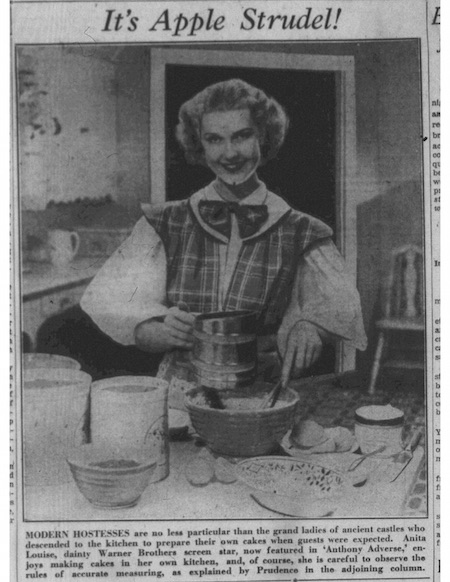
Anita Louise Makes Apple Strudel

Photos acted as a recognizable and attractive product appealing to consumers and hopefully therefore to box office revenues. Renowned stillsmen Fred Archer and Elmer Fryer described these uses in an article entitled “Still Photography in Motion Picture Work” in the 1928 issue of Transactions of the Society of Motion Picture Engineers. “In the advertising field the still picture is used to illustrate and help plant the articles broadcast by the publicity department throughout the periodical world and it is used for lobby displays.”

Betty Furness Shooting Pose
Betty Furness Shooting Pose 

By the late teens, magazines and newspapers became the primary avenue for advertisers to reach consumers, as virtually every person read a daily paper or perused journals. Print outlets searched for photographs to illustrate stories and to fill extra space and pages required to fit in all this advertising, helped by the low cost to reproduce these images. In Still: American Silent Motion Picture Photography, Dr. David Shields quotes from the 1938 book Photography and the American Scene regarding their usage. “The half-tone, more than any other factor, has been held responsible for the tremendous circulation of the modern periodical and newspaper. It has, indeed, revolutionized the mechanics of journalism, for it has completed changed methods of advertising.” Motion picture studios quickly recognized the opportunity to fulfill print media’s demands and obtain free publicity in the process, creating a quid pro quo system to fulfill each other’s needs.

To satisfy the heavy demand for publicity stills, studios established full photography departments in the early 1920s to shoot and produce the images. Stillsman Donald Biddle Keyes established the first film photography gallery/studio in the early 1920s at Famous Players Lasky, and virtually every other production company quickly followed. Most photography department heads focused on portraits, while one photographer shot scene stills, another off-camera, candids or special shoots, and the like.

Greta Garbo Stills in Silver Screen 1930Greta Garbo Stills in Silver Screen 1930

Historian John Kobal describes how studio portraiture “was not merely to photograph established celebrities…but to help create something entirely new…a breed of celebrity with the extraordinary power to transfix.” The photographers’ dramatic lighting, dynamic compositions, artful negative retouching, and artistic eyes influenced the American public’s perceptions of celebrities and their personalities. Stars were defined as sexy, glamorous, thoughtful, foreboding, all through the scintillating camerawork of these often unsung and forgotten men.

Studios shot millions of photographs of actors, executives, scenes, and behind-the- scenes action, which they then freely distributed to magazines and newspapers, usually with a snipe (caption) typed on or glued to the back of the print describing the person, film, or event. A letter often accompanied these images, giving further detail on the person or film pictured and even suggesting usage in the edition. The studios required no payment or permission to run the images, just asking for a credit line if they were employed, and none of the images were ever sent to the United States Copyright Office.

Men Stars Cook 1930Men Stars Cook 1930

These images covered the gamut of subjects and departments found in newspapers and magazines so they could easily be plugged into an empty page or section. To hit women’s areas of interest, photos of fashion, home decoration, cooking, pets, religion, and even children were shot. Images of sports, travel, automobiles, and the like catered to men’s interests.

Cheesecake and beefcake images of stars in swimsuits always seemed popular. In an article about short films benefiting local exhibitors in the December 26, 1925 issue of Exhibitors Trade Review, Universal Studios President Carl Laemmle stated, “Editors know their readers like to see pictures of attractive young girls; the next time you submit a publicity still from your feature, include one or two scenes from a Century Comedy with its dozens of cuties – you’ll find the editor not only publishes it, but also gives it preferential space.”

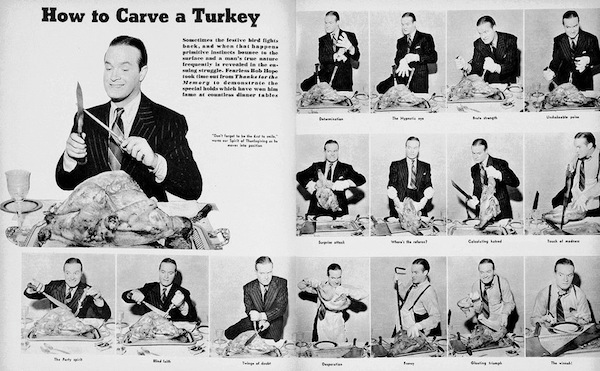
Bob Hope how to carve a turkeyBob Hope, How to Carve a Turkey

Humorous photographs remained a steady staple, while prints illustrating Easter, July 4, Halloween, Christmas, and the like could fill out holiday pages. Karie Bible and I found enough of these stills that we wrote the book Hollywood Celebrates the Holidays just two years ago. Most print editions ran single images, but they could mix and match prints from different studios on the same subject and fill out a full page if so needed.

Over the next 50 years, photographic stills remained the most potent publicity tool of film studios in promoting their new productions and stars. Variety even reported in 1953 that Twentieth Century-Fox distributed 50,000 free stills promoting the blockbuster filmThe Robe shot in the outstanding new Cinemascope format before it opened in theatres.

The House I Live In Frank Sinatra
The House I Live In, Frank Sinatra

As trailers and then television became the main outlets for movie publicity in the 1950s and 1960s, the usage of still photography began declining at film studios. Just like the industry’s early days, stars began hiring their own photographers to shoot portraits or images for periodicals. Marilyn Monroe even formed a company with her favorite photographer Milton Greene.

Gradually new forms of media like TV and later the world wide web served as the main publicity outlets for studios and production companies. The development of social media allowed actors to bypass studio control and directly speak to their fans or promote their own projects. Stars themselves began fashioning their own publicity materials through selfies and promotional items shared on Twitter, Facebook, Instagram, and other social media outlets, often cutting the studio or production company completely out of the process. in an ironic way, contemporary publicity is returning to the self-promoting days of the early motion picture industry.

…..

–Mary Mallory for Classic Movie Hub

Mary Mallory is a film historian, photograph archivist, and researcher, focusing on Los Angeles and early film history. She is co-author of the book Hollywood at Play: The Lives of the Stars Between Takes (with Stephen X. Sylvester and Donovan Brandt) and writes theatre reviews for The Tolucan Times and blogs for the LA Daily Mirror. Mallory served on Hollywood Heritage, Inc.’s Board of Directors, and acts as a docent for the Hollywood Heritage Museum. You can follow her on twitter at @mallory_mary.

Books by Mary Mallory:


Posted in Books, Guest Posts | Tagged , | 8 Comments