Our August picks for the Classic Movie Hub Channel More than 40 Titles Streaming Free All Month Long!
As we announced in June, we are thrilled to have partnered with Best Classics Ever (BCE), a mega streaming channel dedicated to classic films and TV shows! And, we are proud to have our own Classic Movie Hub Channel there, where CMH fans can stream lots of classic movies and TV shows for free each month!
That said, here are just some of our August picks (40+ in all) available for free streaming on the CMH Channel. All you need to do is click on the movie/show of your choice, then click ‘play’ — you do not have to opt for a 7-day trial.
We really hope that you enjoy these films, and please feel free to explore the entire BCE channel. If you click to the BCE Home Page, you can watch even more free classic movies and shows. BCE is able to provide this content for free to you because it includes some commercials – so it’s kind of like watching ‘regular’ TV. There is no sign-up necessary to enjoy this free content, and there are hundreds of movies and TV episodes available with this option. If, instead, you prefer to enjoy your classic movie content ‘straight’ aka commercial-free or if you want access to LOTs more movies and shows, please feel free to check out a 7-day free trial.
You can read more about Best Classics Ever and our partnership here.
Marilyn: Behind the Icon – The Seven Year Itch Delivers Monroe’s Immortal Iconic Image
In 1955, after Marilyn Monroe left Hollywood to study at The Actor’s Studio in Manhattan, she sat in a booth in a diner facing Lowe’s State Theatre on Broadway. Friend and actor Eli Wallach sat across from her. Monroe stared out the window and gazed at the recently unveiled four-story cutout of her in a billowing skirt erected above the marquee of the marquee to promote The Seven Year Itch. “That’s all they think of me,” she said ruefully, appalled by the indelible representation of the very image she was battling to escape. Monroe’s character didn’t even have a name.
The Seven Year Itch gave Monroe an iconic image that would grant her immortality. Her character innocently stands over a subway grate as a train passes beneath, generating a gust of wind that raises her pleated skirt above her waist, revealing her lace panties. The iconic image contributed to the end of her marriage and defined her public persona for future generations.
The trailer for The Seven
Year Itch opened with a wolf whistle. “It’s coming at last!” read the
titles. “The howling stage hit that kept Broadway roaring for three great
years. It tickles! It tantalizes! Now it will sweep the nation with an epidemic
of laughs!”
George Axelrod’s 1952 adultery-themed comedy ran for 1,141 performances. The play starred Tom Ewell as Richard Sherman, a middle-aged Manhattan book editor whose wife and son depart for the country for a summer vacation, leaving him alone in their apartment with a beautiful model subletting the apartment upstairs. The model is every red-blooded heterosexual man’s fantasy — albeit an objectified woman — a character who Axelrod does not give a name. In the script, she is simply “The Girl.” After a protracted comedic internal struggle, summer-bachelor Sherman has an affair with the model.
“You’re married!”
The play’s title refers to a documented 1950s statistic regarding when a married couple is likely to divorce. Social scientists theorized that after seven years of monogamy, an average couple has raised an average of one to two children through infancy, grown apart, and feel an “itch” to seek out another sexual partner.
The role of the tempting model
in the film adaptation seemed ideal for Marilyn Monroe. Her screen persona
embodied the character. The script might well have spelled out that Monroe herself
was subletting the apartment upstairs from Richard Sherman. She was the public
figure with whom many married men fantasized about having an affair. Zanuck
recognized this, as evidenced by a memo dictated early in the production’s
development: “She is an absolute must for this story.”
Censorship threatened to reduce
The Seven Year Itch to an unrecognizable story. The strict Production
Code Administration enforced the forbiddance of adultery as the subject of a
comedy. Much of Axelrod’s funniest dialogue would be eliminated for its racy
tone, but Wilder was a master at repartee that had already passed the censors.
The play derives laughs from Sherman’s consequent guilty feelings and
farfetched imagined repercussions for having metaphorically scratched his itch.
Director and screenwriter lost
the battle with censorship but won Marilyn Monroe. Without her, the film would
simply have not made sense. Monroe’s sexy screen presence communicated visually
much of what could not be implied by plot or verbalized through lines. Her
unparalleled sizzle compensated for all dialogue and plot turns the censors had
excised.
The Girl describes her “artistic” pose having been published in US Camera. To prevent the audience from imagining a nude pose, censors insisted upon flashing to an image in the book of Monroe in a bathing suit.
Actor Walter Matthau was Wilder’s original choice for the role of Richard Sherman, but Zanuck agreed on casting Tom Ewell. “Marilyn was a fighter,” Ewell said of his co-star, honoring an overlooked attribute. “I was extremely fond of her. I grew to admire her because I knew she put up a terrific battle to do what she did. Oh, boy she was a street fighter. She had to be. She had a miserable, miserable early life. Everything she got, she fought for. She really was a wonderful person. There’s never been anyone like her.”
William Travilla’s sunburst-pleated ivory summer dress of rayon-acetate crepe with halter-top was aerodynamically designed to catch a gust of wind from a subway sidewalk grating and became the globally iconic and most recognizable motion picture costume in the history of cinema. Travilla created a dress to make Marilyn’s character “clean and adorable.” The dress sold for $5.6M at auction in 2011.
Whose idea was the skirt-blowing scene? Travilla’s pleated white summer frock itself was not revealing; it was the special effects crew’s manipulation of the aerodynamically designed garment that would expose Monroe’s flesh. The idea is credited to photographer Sam Shaw, based upon his image at Steeplechase Park in Coney Island, taken for a 1941 cover of Our Navy magazine. Shaw suggested that Fox include a scene like his striking shot of a sailor and his girlfriend whose skirt was raised a draft of wind.
On a hot summer night, Sherman and the Girl go to the cinema together and see The Creature from the Black Lagoon (1954), Universal Studio’s 3-D film featuring a menacing amphibious monster that abducts a beautiful girl. Exiting the theater, the Girl spontaneously straddles a sidewalk subway grate to feel a blast of cool air generated by a train speeding under the city, and her pleated skirt rises above her knees. With girlish delight, she holds her dress down and squeals, “Do you feel the breeze from the subway? Isn’t it delicious?” In the preceding dialogue, the Girl expresses empathy for the monster. Although “scary-looking,” it wasn’t “all bad.” The Girl theorizes the monster merely craved affection and “a sense of being loved and needed and wanted.”
The subway grate scene filmed outside the New York’s Trans-Lux Theatre on Lexington Avenue — and inside a soundstage at Fox — captures the Girl in a spontaneous, nonsexual moment of joy—at least this is how Monroe played it. Richard becomes the aroused voyeuristic male. The crowd of onlookers and the audience become voyeuristic as well. Still, what was going through Monroe’s head? She clearly knew the sexual implication. In true Monroe fashion, she played the scene like an innocent child, seemingly unaware of the sexual allure she creates.
The scene can also be argued as
both an example of objectification of a woman; exactly what Monroe battled against,
or a woman exercising her own sexual power. Monroe’s complicity is often
labeled as an act of exhibitionism or self-abasement. But was she really
colluding in her own objectification? Monroe was a hard worker who tried her
best to bring reality and art to any project in which she was involved. She
never expressed shame in portraying the Girl and may have justified the scene
as the price of working with the esteemed Billy Wilder.
Wilder admitted the spectacle could have been offensive and distasteful, but Monroe performed with naïveté. He asserted the act was “the finest instance of a Monroe’s character’s ability to suggest simultaneously both childlike pleasure and sexual delight.” In fact, her casting had been a calculated effort to include tasteful sexuality over obscenity. “She had a natural instinct for how to read a comic line and how to give it something extra, something special,” Wilder said in tribute to Monroe. “She was never vulgar in a role that could have become vulgar, and somehow you felt good when you saw her on the screen. To put it briefly, she had a quality no one else ever had on the screen except Garbo. No one.”
From every angle on Lexington
Avenue, a mob of photographers snapped what Irving Hoffman called “the shot
seen around the world,” referencing a line in Ralph Waldo Emerson’s poem about
the cannon blast that began the American Revolutionary War in 1775, the “shot heard
around the world.”
What scenes were deleted? Wilder reshot Monroe and Ewell’s entire scene when censors objected to Monroe’s “short” shorts; the costume was replaced with matador slacks. A fantasy sequence was also eliminated in which Sherman’s guilty conscience triggers suspicion that the girl is blackmailing him for his adulterous impulses.
Divorced, Monroe and DiMaggio attend the premiere on her 29th birthday in 1955.
During the production, the Monroe-DiMaggio marriage was marked by turbulence and alleged domestic violence. Fox hairdresser Gladys Rasmussen later claimed DiMaggio “beat [Marilyn] up” and left bruises on her shoulders that required extensive coverage with makeup. Before the film wrapped, the couple separated.
Delightful and effervescent
onscreen, Monroe presents no indication of the stress occurring in her personal
life. She was later bashed for requiring numerous retakes during the production.
Producer Charles
Feldman’s memo to Zanuck on Monroe’s challenges refutes this: “There have been
tough days…the 18-takes have only happened on rare occasions with the girl…for
the last two weeks this girl has worked as hard as anyone I have known in my
life.”
Monroe’s pivotal scene in the film appears close to the end, when Sherman tells the Girl no attractive woman would want him. Monroe delivers a heartfelt response. Since it was a long speech, Wilder and the crew assumed it would require multiple takes and many hours to film. Surprising to all, Monroe completed it in a single take and everyone on set applauded. “She told me later she was able to do the scene because she believed every word of what she was saying,” George Axelrod recalled. In the end, the Girl reminds Sherman of what matters, his wife and son. He rushes off to them as she waves from the window.
“Billy’s a wonderful director,” Monroe said. “I want him to direct me again but he’s doing the Lindbergh story next and he won’t let me play Lindbergh.” They collaborated again in Monroe’s greatest professional and commercial success Some Like It Hot (1959).
The recurring musical theme borrows from Brief Encounter starring Celia Johnson and Trevor Howard
Sammy Cahn and Jule Styne wrote a title song for Monroe to sing over the closing titles. However, she left LA for New York shortly after production and didn’t record it. Rachmaninoff ’s dramatic Piano Concerto No. 2 was used in the seduction scene and in dream sequences of Sherman’s lustful fantasies of the Girl. This classical piece, with its low, rhythmic piano and lush strings was used in the British drama Brief Encounter (1945), with a familiar theme of a woman tempted to cheat on her husband with a stranger she meets at a railway station.
Dolores Rosedale and Ewell’s parody of From Here to Eternity
The Seven Year Itch also contains numerous inside jokes, derivatives, and parodies evoking other popular films in its various fantasy sequences. In the first, Helen tells Richard that he imagines things “in CinemaScope with stereophonic sound.” Richard kisses a blonde on the beach in a manner like swimsuit-clad Burt Lancaster and Deborah Kerr passionately necking in the surf in From Here to Eternity. Later, the Girl interrupts her toothpaste live-television commercial by warning the nation of Sherman’s lecherous behavior and compares him to the monster in The Creature from the Black Lagoon. Finally, after being kissed by his secretary, whose unbridled desire results in her ripping open his shirt, Sherman runs off half-dressed like William Holden in Picnic.
Axelrod and Wilder also blurred
Monroe with her nameless screen character. When the Girl recites her lines in
the Dazzledent toothpaste commercial to Sherman, Monroe strikes a pose remarkably
like her own studio publicity photos in an obvious self-parody. Near the end,
when Sherman brags about having a blonde in his kitchen, Tom McKenzie asks,
“What blonde in the kitchen?” Sherman snaps, “Wouldn’t you like to know? Maybe
it’s Marilyn Monroe!”
In the film, Monroe looks like she arrived from the future. She is luminous. She makes co-stars seem obsolete. Her vocal delivery is unlike stagelike staccato of the era. Her comic timing is flawless. Monroe’s reviews were generally positive — with few exceptions by conservative critics seemingly jaded by the sexualized nature of her role rather than her actual performance.
“[Monroe] was
an absolute genius as a comic actress, with an extraordinary sense of comic
dialogue,” Billy Wilder asserted. “Nobody else is in that orbit; everyone is
earthbound by comparison.” Seven years after the film’s release, Monroe would
be dead.
Richard Sherman fantasizes about inviting the Girl to his apartment for a romantic evening.
When Sherman does invite her, the evening doesn’t go as planned; they play “Chopsticks” on the piano and eat potato chips.
When Sherman makes a pass, they fall off the piano bench. “Nothing like this has ever happened to me in all my life,” he says apologetically. “Honest?” the Girl replies. “Happens to me all the time.”
Movie audiences going to see House on Haunted Hill in 1959 knew they were in for a treat. They didn’t know much more than that – only that it was something called “Emergo” and it had never before been seen.
The fact that it came from director William Castle set high expectations for audiences looking for a good fright. On his previous film Macabre(1958), he gave each moviegoer a $1,000 life insurance certificate from Lloyd’s of London in case they died of fright watching the movie.
Besides Emergo, his new film also had the bonus of starring Vincent Price as a millionaire who promises a group of strangers that he’ll give $10,000 to each one who stays the night in a haunted house.
Vincent Price is the charming party host at the House on Haunted Hill.
Audiences must have been so excited to experience Emergo when they took their seats for the movie. But it would be more than an hour – about 69 minutes into the slim 75-minute film – before Emergo would reveal itself. It makes me wonder how they felt sitting all that time. Did the delay work by building a growing anticipation and tension? Or did people forget about Emergo and settle into the film?
With only minutes to spare before the fade to black, it finally came. As moviegoers watched a climactic scene on screen, the same image came to life in theaters as a 12-foot glow-in-the-dark skeleton with red flowing eyes flew over the audience. Emergo turned out to be a skeleton emerging from the darkness and it was over in about a minute.
Audiences
were startled. Screams (and laughter) ensued.
Audiences react to Emergo (AKA a flying skeleton) during a showing of House on Haunted Hill.
It was a success
– to a point. As exciting as it was for first-time watchers, word quickly
spread about the flying skeleton and ruined the Emergo surprise. Kids started
going just to pelt the skeleton with candy and marbles. Theater owners weren’t
happy.
That was it
for Emergo. And that should have been the end of the story.
But here we are, more than 60 years later and still talking about – and watching – House on Haunted Hill. The film has earned the distinction of being a classic in the classic horror genre while remaining a staple on networks like Turner Classic Movies, at repertory theaters and in classic film series, and for Halloween viewing. It’s also one of the choices on the new streaming service Best Classics Ever under the Classic Movie Hub Channel, appropriately found under the theme of “Friday Night.”
While Emergo
helped make the film a box office success, it has only been used in a handful
of screenings since the original release. So how do we explain the lasting
appeal of House on Haunted Hill?
Director William Castle effectively uses shadows to show that characters like Lance (Richard Long) are trapped in House on Haunted Hill.
It’s the combination of a few things. Vincent Price, of course, but also Castle. Though it’s easy for Castle the director to be overshadowed by his showmanship, he had a good eye for directing. He knew how to use camera angles to add tension and suspense, utilizing low and overhead shots to convey fear, fate and feelings of being watched. Shadows of bars on walls trapped the characters, a visualization of how they are imprisoned in the house, too.
That’s not to say he didn’t bring that Castle flair for gimmicks into the film – it’s there in a scene where guests arrive in hearses and another where little coffins are given to guests as “party favors” (they each hold a pistol).
Because the caretakers aren’t creepy enough, small coffins holding pistols were party favors in House on Haunted Hill.
It’s most apparent in the film’s crazy opening that borders on genius (a word I use lightly) in its simplicity and effectiveness.
It’s showtime
Imagine
sitting in a theater – not just in 1959 but in 2020, too – and you’re waiting
for the movie to start.
The studio’s
name appears without fanfare in the screen’s lower left corner – Allied Artists
Pictures Corporation Presents.
Cut to darkness.
More darkness.
Then a
piercing scream. (It’s OK if you jump – everyone does.)
Moaning.
More
screaming. Doors creaking and chains rattling through the darkness.
Finally, we see … something. It’s … a floating head?
It’s creepy and comical at the same time – and it’s vintage Castle.
That talking, floating head is Watson Pritchard (played with perfect jittery anxiety by Elisha Cook Jr.) who is latest owner of the house of the title.
“The ghosts are moving tonight, restless, hungry,” he says, before explaining how his brother was one of seven people murdered in the house he calls “the only really haunted house in the world.”
Enter floating (and talking) head No. 2, millionaire Frederick Loren (Price) who is renting the house to throw a “haunted house party” for his fourth wife, the beguiling Annabelle (Carole Ohmart). He has carefully curated the guest list, offering $10,000 to all who spend the night – 12 hours – locked in the house.
Look closely at the center to see the floating head of Vincent Price start to appear in House on Haunted Hill. The house exterior is the famous Ennis House, designed by Frank Lloyd Wright.
There will be “food and drink and ghosts and maybe a few murders,” he promises.
It’s a startling way to open the film and is still effective today. (I get into it no matter how many times I see the film).
Meet the guests
Like any film worth including in the “strangers in an old house” genre, House on Haunted Hill provides an eclectic array of guests.
These strangers share one trait: they’re all in need of money and that makes them capable of doing anything for $10,000.
Dr. Trent (Alan Marshal), left, Ruth (Julie Mitchum), Frederick (Vincent Price), Lance (Richard Long) and Nora (Carolyn Craig) are taken on a house tour by Watson (Elisha Cook Jr.).
Meet Nora Manning (Carolyn Craig), a sweet young secretary who is supporting her family; handsome pilot Lance Schroeder (Richard Long); columnist Ruth Bridgers (Julie Mitchum) who has a gambling problem; and Dr. David Trent (Alan Marshal) who specializes in hysteria.
We’ve also got Watson who, despite being terrified of the house and its “inhabitants,” can’t stay away (as long as he can fortify himself with liquid courage).
Let’s not forget Annabelle and Frederick, the not-so-loving couple. She’s in her room acting like a spoiled brat who didn’t get to invite her own party guests, but he insists she join the festivities. Calmly and quietly they exchange verbal sparring that is understated yet vicious. It is delightful to watch. (This scene is enough to make them one of my favorite movie couples.)
They may not be in love, but they are definitely entertaining. Frederick Loren (Vincent Price) and his wife, Annabelle (Carole Ohmart), play a loving couple in front of their guests.
He offers her $1 million – tax free – to leave him, but she says she deserves his entire fortune. He’s jealous and possessive, she insists. He reminds her that she’s tried to kill him multiple times. (“Remember the fun we had when you poisoned me?”) Still, he’s no better judging by the fates of his three previous wives.
When he tells her not to be afraid of the ghosts and ghouls, she responds “Darling, the only ghoul in the house is you.”
A grim party theme
Sadly, that humorous scene ends, and Frederick joins the party where killjoy Watson is spinning his “spook talk” of horrific tales of murder and decapitated heads lost “inside” the house. To add to the party atmosphere, Watson takes the guests on a house tour. There’s the spot on the ceiling that shows blood from one grisly murder. (“Whatever got her wasn’t human,” he says of the victim.) In the basement, Watson shows them the vat of acid where a wine maker threw his wife after she criticized his vino.
The group is a mix of skeptics and believers but even as strange things start to happen – look out for that falling chandelier – the money is too good to pass up. Then it’s too late and they’re locked in the house behind a steel door and windows with bars “a jail would be proud of.” There’s no phone, no electricity, no way to call for help. And things are getting really strange now.
Nora (Carolyn Craig) belts out a scream at a terrifying sight in House on Haunted Hill.
Doors open,
close and lock on their own. Blood drips from the ceiling. There are ghostly apparitions,
heads in boxes, secret rooms and a hairy hand. Gas lights have a habit of
flickering in sequence and burning out. Poor Nora will annoyingly scream her lungs
out from one frightful experience after another, giving the doctor something to
do by diagnosing her hysteria.
Others start to unravel as well. They gather multiple times in the drawing room, skulk around hallways, explore the creepy house and hide behind locked bedroom doors where they still aren’t safe. (How is that rope coming through the window and what does it want?) Oh, and someone will die
Let’s leave the plot there – to say more would involve spoilers. Plus, this movie is about the journey, not the destination and that fits in nicely with the cinematic world of William Castle.
From that offbeat opening – clearly inspiration for countless haunted house attractions since – to all the banging doors, hands reaching out from the darkness and crazy effects that look deliberately phony – Castle is taking us on a ride he calls House on Haunted Hill.
Laugh, scream, sigh – react any way you want. Castle – the showman and the filmmaker – would be proud.
Other tricks from William Castle
In his second film for William Castle, Vincent Price starred in The Tingler. He’s pictured with Daryl Hickman, Patricia Cutts and the title creature.
The Tingler/ “Percepto.” (1959). The title character is a large, long insect-like creature that, once activated by fright, attaches to a person’s spinal cord and can only be released by screaming. For “Percepto,” Castle had seat buzzers set to to go off just as the creature gets loose during a scene in a movie theater. “Scream, scream for your lives,” Price tells audiences. And they did.
13 Ghosts / “Illusion-O” (1960). Moviegoers were handed a ghost viewer/remover to use during the movie. In certain segments of the film, if they looked through the red cellophane they could see ghosts; but if they looked through the blue, the ghosts were hidden.
Homicidal/ “Fright Break” (1961). Before the movie’s climax involving a sadistic killer, a 45-second timer went off to give scared moviegoers time to leave. They could collect a refund, but only if they went to the “Coward’s Corner.”
Toni Ruberto, born and raised in Buffalo, N.Y., is an editor and writer at The Buffalo News. She shares her love for classic movies in her blog, Watching Forever. Toni was the president of the former Buffalo chapter of TCM Backlot and now leads the offshoot group, Buffalo Classic Movie Buffs. She is proud to have put Buffalo and its glorious old movie palaces in the spotlight as the inaugural winner of the TCM in Your Hometown contest. You can find Toni on Twitter at @toniruberto.
Marilyn: Behind the Icon – Monroe is Forlorn Perfection in The Misfits
Marilyn Monroe, playwright Arthur Miller
Producer Frank Taylor announced that The Misfits, an independent film, would be the “ultimate motion picture,” the joint vision of a leading American playwright and an internationally prominent actress. The concept originated as a short story, titled “The Misfits or Chicken Feed: The Last Frontier of the Quixotic Cowboy,” published in Esquire in 1957. Arthur Miller later adapted it into a screenplay — a “Valentine” for Monroe and a vehicle intended to advance her dramatic acting career. The character of Roslyn was Miller’s idealized representation of his wife. He documented elements of Monroe’s personality into monologues she had spoken and incorporated into the script personal and painful situations excised from her life; art would imitate life. Numerous obstacles delayed the couple’s film project, so by the time the production began, the marriage was disintegrating.
Miller obtained his 1956 divorce by establishing residency outside of Reno. There he met three aging cowboys who explained to him how they made a living capturing wild Mustangs and selling them to dealers who in turn sold them as riding horses; but now the dealers had begun to sell the Mustangs to companies that used them as meat in the production of dog food. The once large population of wild Mustangs dwindled to a few scattered family units. The misfit cowboys, like the misfit horses, were vanishing along with their way of life. The cowboys inspired Miller’s short story and its screenplay adaptation. In apparent western genre, the script lacks a hero, usually a staple in true westerns.
Clark Gable and Monroe
“It’s supposed to be a Western, but it’s not, is it?” leading man Clark Gable asked Miller.
“It’s sort of an Eastern Western,” Miller explained. “It’s about our lives’ meaninglessness and maybe how we got to where we are.” Despite rodeo scenes, The Misfits was not a contemporary western in the way John Wayne’s films were historic period westerns. Miller’s cowboys are metaphors for those wishing to roam free and resist societal changes. Modern urbanization had eroded their masculine roles much in the same way suburbanization had changed the role of the American male.
Eli Wallach, Thelma Ritter, Clark Gable, Marilyn Monroe
Roslyn (Monroe) is an interpretive jazz dancer from Chicago divorcing her estranged husband (Kevin McCarthy). She meets Guido (Eli Wallach) , a widower and pilot who dropped bombs in the war. Through Guido, Roslyn meets Gay (Clark Gable) , an aging, strong-willed cowboy coming to terms with the vanishing old frontier who avoids working for the man. He is divorced and estranged from his adult children. Gay is immediately attracted to Roslyn, but she is reticent to start a relationship so soon after her divorce. Eventually, they partner and live together in the unfinished home Guido had been building for his wife before her death. The three attend a Rodeo in Dayton along with Roslyn’s older friend and landlady, Isabelle (Thelma Ritter), a divorcee who long ago arrived in Reno when she divorced. At the rodeo, the group connects with Perce (Montgomery Clift), a sensitive cowboy estranged from his mother. The three men mount a plan to capture wild Mustangs and sell them for dog food meat.
Eli Wallach and Monroe
The shallow plot only serves as a canvas for the four leading characters’ exploration of their inner conflicts and attempt to connect and relate to each other. Each exposes emotional and searches for meaning.
Thelma Ritter and Monroe
Roslyn is the center of film. As an outsider to their world, she impacts each of the men by questioning their long-held and unchallenged beliefs. Monroe was determined to deliver a performance that would give the role a darker side and complex backstory absent from the script. In the character, Miller referenced biographical parallels to Monroe’s life: Roslyn’s abandonment by her parents, her continuous search for security; her perceived image by others as the essence of femininity, sensitivity.
Gay represents the idealized masculine role. He is afforded freedom and independence by his trade as an itinerant cowboy but now faces revolution. “He’s the same man,” director John Huston explained, “but the world has changed. Then he was noble. Now he is ignoble.”
Widowed Guido, the most intelligent and educated of the cowboys, is also bitter and cynical. He feels alienated from others and guilty about his violent acts as a soldier in war. With a blending of masculine and feminine traits, Perce yearns for mothering and nurturing after having had experienced rejection by his mother. She remarried after the death of his father and gave her new husband the family farm. Isabelle, Roslyn’s older divorced landlady, represents survival and female resiliency. She is adaptive and thick-skinned. She accepts life as it is without trying to change it.
Throughout the film, Roslyn is a source of light and a point of reference. Whatever happens to someone in Roslyn’s life, Guido says, happens to her. She ministers to each misfit man and is herself a misfit. Gay tells Roslyn that she is the saddest girl he ever met; a line Miller uttered when he first met Monroe. “You have the gift of life, Roslyn,” Guido says. “The rest of us, we’re just looking for a place to hide and watch it all go by.” Perce wonders aloud how she retains the trust of a newly born child.
Roslyn: “We’re all dying, aren’t we? All the husbands and all the wives. And we’re not teaching each other what we really know, are we?”
In Roslyn’s voice, we hear a new morality signaling an emerging counterculture later exemplified by the protest of the Vietnam War and Feminist Movement. She confronts the killing of the Mustangs as barbaric, something the cowboys never pondered, and identifies with the horses as victims of the men’s brutality. Ultimately, Gay—a man of an older generation—finds a way to embrace the new morality and transforms without losing himself.
Miller’s highly cerebral themes are clearly literary and akin to a book rather than to a motion picture. Monroe recognized this upon early review of the screenplay and expressed serious doubts about its cinematic merit. Her opinion mattered. After all, Marilyn Monroe Productions, although uncredited onscreen, partnered with Seven Arts Productions, a subsidiary of United Artists, to produce The Misfits and distribute it globally.
Robert Mitchum turned down the role as Monroe’s leading man based upon his assessment of the script as incomprehensible. Again, art imitated life when the Millers cast Clark Gable as Gaylord Langland. He had been Monroe’s childhood idol and fantasy father figure, and Gable (at 59) was the undisputed King of Hollywood.
Montgomery Clift and Monroe
Monroe urged Huston to cast her friend Montgomery Clift as man-child Perce Howland. He had recently completed Wild River, a film originally intended for Monroe as his co-star. “He’s the only person I know who’s in worse shape than I am,” Monroe said of Clift. “I look at him and see the brother I never had and feel brave and get protective.” Clift said of her: “I have the same problem as Marilyn. We attract people the way honey does bees, but they’re generally the wrong kind of people.”
Monroe also cast her friend from the Actor’s Studio, Eli Wallach, as Guido. As Isabelle, Thelma Ritter had been Monroe’s co-star in two other films. Square-jawed actor Kevin McCarthy, best-know for Invasion of the Body Snatchers (1956), plays Roslyn’s husband.
Designer Dorothy Jeakins suggested the use of several wigs on location due to the wind, dirt, and dryness of the desert and to reduce the time required each morning for hairdressing. The film’s hair stylist Sydney Guilaroff concurred. When Jeakins and Monroe had a falling out, Jean Louis stepped in as designer. Instead of stopping a scene to straighten or curl Monroe’s hair, the hairdresser merely removed her wig and applied another one already styled. Monroe’s appearance starkly diverged from her signature look with an emphasis on weariness over glamour.
Huston’s atypical style of production for The Misfits involved no rehearsals and filming the script in chronological sequence so that the actors developed their characters as the plot unfolded. “When she was herself, she could be marvelously effective,” Huston recalled of Monroe. “She was not pretending to an emotion. It was the real thing. She would go deep down within herself and find it and bring it up into consciousness. But maybe that’s what truly good acting consists of.”
Rear: Frank Taylor and Miller. Middle: Wallach and Huston. Front: Clift, Monroe and Gable
The production moved to Quail Canon Ranch to film scenes at Guido’s ranch. Miller had spent time with the original cowboys who inspire his script in a house on the ranch. Art imitated life when the production used the same house. Necessitating more space for the cameras, the crew sawed through the corners of the house to make them removable by turning a few bolts. Miller later wrote about feeling disturbed by the fact that the walls of the same house where he had visited with the real cowboy and his girlfriend could now be unbolted and repositioned to bring in the light of the open sky.
One of the most difficult scenes in The Misfits involved lengthy dialogue between Marilyn and Clift. Huston wanted to shoot the scene in one take; the longest single take in his entire directorial career. It takes place behind the saloon, where Roslyn sits on a decayed seat from an old automobile, and Perce lays on the ground with his head resting in her lap. Surrounded symbolically by a mound of assorted trash, the characters reflect upon betrayal in their lives. When the 10,000-watt lights were switched on, the flies smarmed, and the trash emitted a vile stench. The crew sprayed fly repellent as Monroe shielded Clift’s eyes with her hand. None of the crew believed the two actors, notorious for their problems in remembering lines, could get through the scene. To everyone’s amazement, they completed the scene in a mere six takes, producing two perfect takes.
Clift escorted Monroe to the film’s premiere in New York in 1961 as she and Miller had already divorced.
“Working with [Monroe] was fantastic…like an escalator,” Clift said. “You would meet her on one level and then she would rise higher and you would rise to that point, and then you would both go higher.”
Monroe’s triumphant climatic scene was filmed on an overcast
day. The cowboys wrestle the mare to the ground and tie its legs together.
Roslyn watches, her heart breaking as the mare’s colt stands helplessly beside
its mother. She erupts in a raw emotional outburst. “Butchers! Killers!
Murderers!” she shrieks. “You liars. All of you, liars! You’re only happy
when you can see something die! Why don’t you kill yourselves and be happy? You
and your God’s country. Freedom! I pity you. You’re three dear, sweet dead men.
Butchers! Murderers! I pity you! You’re three dead men!” Expecting Miller
to allow Roslyn to intelligently articulate her cause, Monroe resented the
speech. Nevertheless, the histrionic explosion presents a more suitable
dramatic climax.
Having captured close-ups of Monroe emoting pain while watching the roping, Huston chose to film her speech from a considerable distance. The volume of her voice and her body motions would carry the performance, as the camera would not read facial expressions. Miller disagreed with the camera set-up, but Huston argued her voice would be a cry from the wilderness. They compromised by filming the scene from both a medium shot and from fifty yards away.
When Huston yelled, “Action,” Monroe began screaming in a
voice never heard by her fans in a powerful performance unlike any of her
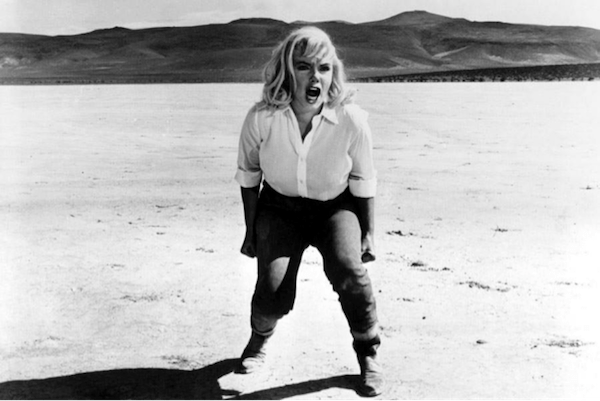
previous roles. In a still photograph by Inge Morath, Monroe stands with her
legs spread apart, her torso leaning forward in rage, her fists clenched at her
side. Her head is thrust forward with her mouth open. Her forehead is furrowed,
her hair hangs limp with perspiration. No longer is she the sex symbol pin-up; instead,
she is a serious, dramatic actress. This photograph evokes the impact Huston
could have achieved through a close-up. The extreme distance of Huston’s camera
minimizes Monroe’s effect by recording a fraction of her intensity; had Huston
filmed this powerful performance in a close-up or used the alternate medium
shot, Monroe arguably may have been nominated for an acting award.
Journalist W. J. Weatherby observed Monroe filming the scene
several times as she was “jumping in and out of a state of high emotion without
any preparatory passages.” He wrote that the “wear and tear” on her psyche
“must have been savage.” Between takes, Weatherby described Monroe as a boxer
in the corner of the ring, waiting to come out fighting when the bell sounded.
On a Paramount soundstage in New York, Monroe filmed a critical scene with Wallach. Believing Roslyn’s relationship with Gay has ended, Guido asks her to give him a reason to double-cross his friend and release the roped horses. Monroe’s speech is poignant as she confronts Wallach’s selfishness with disgust and acrimony:
You, a sensitive fellow…so sad for his wife.
Crying to me about the bombs you dropped and the people you killed. You have to
get something to be human? You never felt anything for anybody in your life.
All you know is the sad words. You could blow up the world and all you’d feel
is sorry for yourself.
“Gable has never done anything better on screen, nor has
Miss Monroe,” heralded the New York Daily News. “It is a poignant
conflict between a man and a woman in love, with each trying to maintain
individual characteristics and preserve a fundamental way of life.” Saturday
Review lauded The Misfits as a “powerful experience…” with
“characters at once more lifelike and larger-than life than we are ordinarily
accustomed to in American movies…[Monroe] gets pathos into the role, and a very
winning sweet charm into a great many of her scenes. She shows range, too, and
it can be plainly announced that acting has by no means spoiled Marilyn Monroe.”
“A picture that I can only call superb…” proclaimed New
York Herald Tribune. “There is evidence in the picture that much of it has
a personal relationship to Miss Monroe, but even so her performance ought to
make those dubious of her acting ability reverse their opinions. Here is a
dramatic, serious, accurate performance; and Gable’s is little less than great.
Can anyone deny that in this film these performers are at their best? You
forget they are performing and feel that they ‘are.’”
In his column for The Village Voice, Jonas Mekas penned a review in the rhythm of a Beat poem. It remains one of Monroe’s best critiques and insinuates the film’s appeal to the counterculture:
Marilyn Monroe, the Saint of Nevada Desert…A woman that has known love, has known life, has known men, has been betrayed by all three, but has retained her dream of man, and love, and life…She finds love everywhere, and she cries for everyone, when everybody is so tough, when toughness is everything. It’s MM that is the only beautiful thing in the whole ugly desert, in the whole world, in this whole dump of toughness, atom bomb, death…All the tough men of the world have become cynics, except MM. And she fights for her dream, for the beautiful, innocent, and free…It is MM that tells the truth in this movie, who accuses, judges, reveals. And it is MM who runs into the middle of the desert and in her helplessness shouts…in the most powerful image of the film.
Arguably, the film’s failure stemmed from the fact that Miller and Huston did not deliver the product audiences expected. The Misfits appeared as a Western at face value but did not follow the formula of the genre. The dialogue and theme more closely resembled the French New Wave of filmmaking exemplified by Jean-Luc Godard’s Breathless (1959), Alain Resnais’ Hiroshima, Mon Amour (1959), and the Italian style perfected by Federico Felini in films such as La Dolce Vita (1960). Ultimately, as iconic figures, the leading stars and their repertoire of films following the Hollywood studio formula drew an audience with a high expectation for entertainment congruent with those iconic images and their previous work.
Rock Hudson presents the Golden Globe to Monroe in March 1962.
The Misfits earned increased acclaim over time as the film industry evolved. Today it seems an outlier in 1960s cinema and representative of films made during the 1970s and 1980s. In evaluations by modern critics, the film embodies the advent of the “indie” film, now commonplace. Although Gable and Monroe’s performances did not garner award nominations, Gable’s is posthumously hailed as his best, and Monroe received the Golden Globe for Female Film Favorite of 1961.
The last scene of each star’s last completed film. Roslyn: How do you find your way back in the dark? Gay: Just head for that big star straight on. The highway is under it. It’ll take us right home.
In order to qualify to win one of these paperback books via this contest giveaway, you must complete the below entry task by Saturday, August 29, 2020 at 6PMEST. However, the sooner you enter, the better chance you have of winning, because we will pick a winner on four different days within the contest period, via random drawings, as listed below. So if you don’t win the first week that you enter, you will still be eligible to win during the following weeks until the contest is over.
Aug 8: Volume 1 (one winner)
Aug 15: Volume 1 (one winner)
Aug 22: Volume 2 (one winner)
Aug 29: Volume 2 (one winner)
We will announce each week’s winner on Twitter @ClassicMovieHub and/or right here on this Blog in the comment section below (depending on how you entered), the day after each winner is picked around 9PM EST — for example, we will announce our first week’s winner at 9PM EST on Sunday Aug 9.
…..
Marilyn as Rose Loomis in Niagara
And now on to the contest!
ENTRY TASK (2-parts) to be completed by Saturday, Aug 29 at 6PM EST — BUT remember, the sooner you enter, the more chances you have to win…
1) Answer the below question via the comment section at the bottom of this blog post
2) *ThenTWEET (not DM) the following message (if you don’t have twitter, see below): Just entered to win the “ICON: The Life, Times and Films of Marilyn Monroe” #BookGiveaway courtesy of @BearManorMedia , you can enter too at: http://www.classicmoviehub.com/blog/icon-the-life-times-and-films-of-marilyn-monroe-book-giveaway-august/
THE QUESTION: What is one of your favorite Marilyn Monroe roles/movies and why?
NOTE: if for any reason you encounter a problem commenting here on this blog, please feel free to tweet or DM us, or send an email to clas…@gmail.com and we will be happy to create the entry for you.
*If you do not have a Twitter account, you can still enter the contest by simply answering the above question via the comment section at the bottom of this blog — BUT PLEASE ENSURE THAT YOU ADD THIS VERBIAGE TO YOUR ANSWER: “I do not have a Twitter account, so I am posting here to enter but cannot tweet the message.”
Please note that only Continental United States (excluding Alaska, Hawaii, and the territory of Puerto Rico) are eligible.
…..
Tony Curtis, Jack Lemmon and Marilyn Monroe in Some Like It Hot
About the books:
Volume 1: Psychotherapist & author Gary Vitacco-Robles reframes & redefines the fascinating woman behind the iconic image through an analysis of her psyche and an appreciation of her film & stage performances in Volume One of this definitive biography. After a decade of meticulous research, Vitacco-Robles offers a treasure trove of facts comprehensively documenting each year of Monroe’s inspiring life within the context of her tumultuous times & through her relationships with literary, entertainment, & political figures. Monroe is resurrected a half-century after her tragic death in this detailed & sensitive biography that intelligently explores her passionate desires: to be loved, become a serious actress, & have a family. Volume One examines the first thirty years of Monroe’s life and her impact on the culture, providing a deeper understanding of the remarkable woman and the lasting impression she left behind. Based upon interviews, diaries, & personal files-void of sensationalism-Icon: The Life, Times, & Films of Marilyn Monroe dispels many myths & reveals the ultimate truth about Hollywood’s most charismatic, beloved, & enduring star.
Volume 2: Psychotherapist & author Gary Vitacco-Robles reframes and redefines the fascinating woman behind the iconic image through an analysis of her psyche and an appreciation of her film and stage performances in Volume 2 of this definitive biography. After a decade of meticulous research, Vitacco-Robles offers a treasure trove of facts comprehensively documenting each year of Monroe’s inspiring life within the context of her tumultuous times, and through her relationships with literary, entertainment, and political figures. Monroe is resurrected a half-century after her tragic death in this detailed and sensitive biography that intelligently explores her passionate desires: to be loved, become a serious actress, and have a family. Volume 2 examines the last six years of Marilyn’s life and her impact on our culture in the five decades following her early tragic death. Its pages provide a deeper understanding of this remarkable woman and the lasting impression she left behind. Based upon interviews, diaries, and personal files-void of sensationalism-Icon: The Life, Times, & Films of Marilyn Monroe Vol. 2 dispels many myths and reveals the ultimate truth about Hollywood’s most charismatic, beloved, and enduring star.
…..
If you don’t want to wait to win, you can purchase the books on amazon by clicking the images below:
“THE MAN WHO KNEW TOO MUCH” ( 1956 ) ~
QUE SERA SERA
“Why would he pick me out to tell?”
Why? Because you’re the affable, all-American James Stewart, that’s why. I’ve no real clue why Stewart’s picked, other than he’s a great foil to get pushed around by Hitchcock and international forces beyond his control.
“The Muslim religion allows for few mistakes.”
How prescient of Hitch to give us a glimpse of North Africa and its Muslim culture as a preamble to the intrigue that follows. Could this film even be made today? (Current Middle East tensions and all…) Hitchcock also gives us a glimpse into the marriage of Stewart and Doris Day. I really like Day in this, one of the better roles of her career. My motto: It doesn’t hurt playing a Hitchcock Blonde.
Doris Day, James Stewart and the wonderful Brenda de Banzie
And any leading man is better off being “married” to Doris Day in the movies (i.e. Rock Hudson, James Garner, David Niven and now Jimmy Stewart, to name a few.) She’s a smart gal here, picks up social cues her husband misses, as wives do. She tamps down her sophistication, but she’s no rube. Day plays an ex-singing star who has given up her career for marriage to a doctor and a nice home, little boy and life in the Mid-west. There might be just the slightest bit of tension in that trade-off. But whaddya want, it’s 1956; a girl’s gotta get married. I like Hitch giving Day’s character a moment in the spotlight as the couple’s plane lands in London and fans call out for her. Don’t worry…it’s just a plot device and not a commentary on women having had ‘ka-rears’.
The Plot: They have to stop a political assassination and find their
kidnapped son…in that order. Nothing like a little blackmail to spur
one’s civic duty. Their silence bought, Stewart’s and Day’s
teamwork has them decipher clues, leaving law enforcement pretty
much out of this so they won’t muck up finding their couple.
Usually when we hear the great film scores of the Hitchcock-Bernard Hermann collaboration (Psycho, Vertigo, North By Northwest, etc.) the music serves as a beautiful observer of events. In “The Man Who Knew Too Much” Hitchcock puts Music and Hermann front and center. What a neat touch as the movie starts, we see Hermann and his orchestra PLAY the movie’s actual score under the movie’s opening credits. Has any director done THAT before? (We’re usually not supposed to know the music’s there.) Later on in the film, Hitch intersperses Hermann and his orchestra… instruments, music sheets, close-ups of musical notes with Day and Stewart trying to figure out the last piece of the puzzle. Music is a character in this movie. Tension and suspense are as taut as a violin string as Hitch shows Day’s tear-stained face looking up at the muzzle of an assassin’s gun.
No one expresses hysteria, full-blown or repressed, like Doris Day.
In fact, my favorite scene in the movie is, perhaps, the most
disturbing, where Stewart gives Day sleeping pills just before he
tells her their son has been kidnapped. She simultaneously plays out
several emotions: anger, despair and helplessness as the pills take
effect in a scene worthy of Ingrid Bergman’s talents.
The behind-the-scene story is Hitchcock said very little to Ms. Day
during filming, having no notes of direction for her. It wasn’t that he
didn’t like her. He was pleased with her natural and “pitch perfect”
performance.
Very very few directors had the chance to remake their own movie. I can only think of Wyler. This is Hitchcock’s second time doing “The Man Who Knew Too Much.” I think he improved on his own work. But you be the judge…see ‘em both.
Theresa Brown is a native New Yorker, a Capricorn and a biker chick (rider as well as passenger). When she’s not on her motorcycle, you can find her on her couch blogging about classic films for CineMaven’s Essays from the Couch. Classic films are her passion. You can find her on Twitter at @CineMava.
Canadian-born actress Yvonne De Carlo is remembered by many classic film fans as one of Hollywood’s most glamorous women.
Born Margaret “Peggy” Yvonne Middleton in Vancouver in 1922, De Carlo began her film career in bit parts in 1941, working her way up to leading roles in the 1945 films Salome, Where She Danced and Frontier Gal, which was her first starring Western.
Many viewers associate De Carlo with desert adventures and epics such as The Desert Hawk (1950) or The Ten Commandments (1956), while others think of her film noir classics Brute Force (1947) and Criss Cross (1949). And some TV fans, of course, best remember De Carlo’s decidedly unglamorous role as Lily Munster on TV’s The Munsters (1964-66).
When I think of Yvonne De Carlo, she comes to mind first and foremost as a Western star! From the mid-’40s through the late ’60s she was the leading lady in more than a dozen Westerns.
Viewers may
not be aware that De Carlo’s roles in the Western genre were perhaps the
closest fit for what the actress described in her autobiography as “the
Peggy Middleton behind the facade of Yvonne De Carlo.”
In De Carlo’s
free time she loved nothing more than leaving Hollywood and heading up
California’s Highway 395 to spend time in the great outdoors; she frequently
stayed in Lone Pine, which she called “my haven in the High Sierra.”
She hiked, rode horses, and took her two sons fishing and camping.
It’s thus perhaps not surprising that she was so at home in Westerns. A couple of my favorite candid photos of her are on Western sets, standing in rivers laughing alongside Joel McCrea or Rory Calhoun. She looks like she’s having fun!
Border River (1954) Joel McCrea and Yvonne De Carlo
Raw Edge (1956) Rory Calhoun and Yvonne De Carlo
Here’s an overview of some of the De Carlo Westerns I’ve enjoyed. The list includes a couple of titles that might be remembered from my 2018 Western RoundUp column on “Universal Gems.”
Frontier Gal (1945) Yvonne De Carlo and Rod Cameron
Frontier Gal (Charles Lamont, 1945) – I think of this film from De Carlo’s breakout year of 1945 as sort of a Western Taming of the Shrew, depicting the highly tempestuous relationship between a saloon gal named Lorena (De Carlo) and Jonathan (Rod Cameron), a man on the run who was framed for murder. Lorena and Jonathan marry but are parted the next morning when the law catches up with Jonathan; when he returns six years later, he’s quite surprised to find he’s the father of little Mary Ann (Beverly Sue Simmons). De Carlo is funny and touching, desperately attracted to Jonathan but reluctant to show it, hurt she may not measure up as the “real lady” of his dreams. De Carlo also has the chance to do some musical numbers.
Black Bart (1948) Dan Duryea and Yvonne De Carlo
Black Bart (George Sherman, 1948) – This is one of my favorite De Carlo Westerns, in which she’s the love interest of rancher Charlie Boles (Dan Duryea), who has a secret life as a stagecoach robber. A friendly enemy (Jeffrey Lynn) and a Wells Fargo man (Frank Lovejoy) complicate Boles’ secret career. De Carlo and Duryea are terrific together, the year before they made Criss Cross, and the film has a fun, fast-paced story and gorgeous candy box Technicolor, not to mention a couple of dances by De Carlo. Although some filming was done in Utah, I suspect the principal actors didn’t leave California.
Dan Duryea, Yvonne De Carlo and Rod Cameron in River Lady (1948)
River Lady (George Sherman, 1948) – In this film De Carlo reunited with past costars, Rod Cameron and Dan Duryea. She plays Sequin, owner of the River Lady, a floating gambling palace. Frustrated when her love Dan (Cameron) won’t give up logging to help her build a business empire, Sequin conspires with Beauvais (Duryea) against Dan; she essentially becomes the villainess of the piece, with Dan turning to sweet Stephanie (Helena Carter) for true love. While, like Black Bart, it’s pretty obvious that second unit photography was done with stand-ins, the film’s logging scenes nonetheless give it a nice “fresh air” feel.
The Gal Who Took the West (1949) movie poster
The Gal Who Took the West (Frederick De Cordova, 1949) – This one might be my favorite of De Carlo’s Westerns. She plays sassy, spunky Lily, an entertainer who arrives in a frontier town to perform at an opera house. A pair of handsome cousins (John Russell and Scott Brady) are soon fighting for her hand; I love the quips she trades with their grandfather (Charles Coburn). This is such a fun movie, it’s the perfect diversion for our challenging times. Hoping for a DVD release someday!
Van Heflin and Yvonne De Carlo in Tomahawk (1951)
Tomahawk (George Sherman, 1951) – This is one of several films De Carlo made with director George Sherman. De Carlo once again plays a traveling frontier entertainer; she’s attracted to Jim Bridger (Van Heflin) but matters grow complicated when she mistakenly thinks an Indian girl (Susan Cabot) he’s traveling with is his wife. This film has some excellent location photography in the Black Hills and is notable for its even-handed treatment of Indians. With a terrific cast including Preston Foster, Rock Hudson, Alex Nicol, Jack Oakie, and Tom Tully, it’s a solid exemplar of what makes Universal Westerns so enjoyable.
De Carlo and Edmond O’Brien in Silver City (1951)
Silver City (Byron Haskin, 1951) – This enjoyable Paramount Pictures Western costarred Edmond O’Brien as Larkin Moffatt, a man who once made a mistake and considered stealing some money; he had second thoughts and returned it, but is hounded out of jobs by resentful Charles Storrs (Richard Arlen) all over the West. Moffatt finally catches a break as a foreman working for De Carlo and Edgar Buchanan, playing her father. De Carlo is at her best when her characters have a chance to show a humorous side, and a sequence where she’s flustered when she believes O’Brien might be interested in her is delightful. There’s also some attractive location filming in Sonora, California. This film was based on a story by Luke Short, whose writing inspired many a good Western.
Yvonne in The San Francisco Story (1952)
The San Francisco Story (Robert Parrish, 1952) – This film set during the California Gold Rush is relatively modest, including black and white cinematography, but it does have its pleasures, starting with the teaming of De Carlo and Western favorite Joel McCrea. Yvonne is exquisitely beautiful in this one — though wasn’t she always?! — gowned by Yvonne Wood. There are terrific supporting performances by Richard Erdman as McCrea’s wry sidekick and Florence Bates as the eyepatch-wearing proprietor of a waterfront dive who shanghais sailors on the side. Worth a look for anyone who likes the cast.
Border River (1954)
Border River (George Sherman, 1954) – De Carlo’s second teaming with Joel McCrea has better production values than their first film, with beautiful Technicolor filming on the Colorado River and other locations. McCrea plays a Confederate soldier attempting to purchase Army supplies in Mexico. There are some good action scenes along with romance and espionage, and all in all, it’s a likable Western. Pedro Armendariz costars.
Shotgun (1955) movie poster
Shotgun (Lesley Selander, 1955) – This Allied Artists Western co-starring Sterling Hayden and Zachary Scott is one of De Carlo’s best films of the genre. Hayden plays a lawman with a wild past who’s on the trail of the man who murdered his boss (Lane Chandler). He meets up on the trail with a saloon gal (De Carlo) and a bounty hunter (Scott). This is what some might call a “chamber Western,” with its main focus on the relationships among the trio of lead characters. Most of the movie was shot on location, including Sedona, and the film has a tough, gritty look, with the actors in realistically dirty clothes! Some particularly interesting background is that the film was co-written by actor Rory Calhoun. De Carlo tells a story in her memoirs of a disastrous date with Calhoun in the ’40s when he didn’t talk to her all night; despite that, in the ’50s they became good friends, to the point that he was one of the only people invited to her 1955 wedding to stuntman Bob Morgan.
Raw Edge (1956) movie poster
Raw Edge (John Sherwood, 1956) – De Carlo worked with Calhoun in front of the camera in this oddball yet entertaining Universal Pictures film set in the 1840s Oregon territory. There’s an…unusual!…law in the area that any woman who is widowed is up for grabs by the first man who claims her. Calhoun arrives to avenge the death of his brother (John Gavin) at the hands of DeCarlo’s husband (Herbert Rudley), and he ends up also protecting her from the vultures who begin circling in anticipation of her hubby’s death. I give the story points for originality, even if it’s rather bizarre! DeCarlo and Calhoun are fun to watch together, and the filming in San Bernardino National Forest is an added plus.
Viewers who enjoy the above films will find that there are even more De Carlo Westerns to seek out, including Calamity Jane and Sam Bass (1949); her supporting role in John Wayne‘s McLintock! (Andrew V. McLaglen, 1963); and her lead roles in multiple ’60s Westerns produced by A.C. Lyles.
…
– Laura Grieve for Classic Movie Hub
Laura can be found at her blog, Laura’s Miscellaneous Musings, where she’s been writing about movies since 2005, and on Twitter at @LaurasMiscMovie. A lifelong film fan, Laura loves the classics including Disney, Film Noir, Musicals, and Westerns. She regularly covers Southern California classic film festivals. Laura will scribe on all things western at the ‘Western RoundUp’ for CMH.
Marilyn: Behind the Icon – A Comedic and Pregnant Monroe Triumphs in Some Like It Hot and Wins the Golden Globe
In 2000, the American Film Institute honored Some Like It Hot as the “Best Comedy of All Time.” In the six decades after its release, the film achieved acclaim worldwide as one of the greatest movie comedies ever made, ranking number fourteen on the America Film Institute’s list of the 100 Best American Films of All Time. It has also been deemed “culturally significant” by the United States Library of Congress and selected for preservation in the National Film Registry. However, the road to such greatness was paved with pain and frustration. Leading lady Marilyn Monroe struggled with mental illness and a high-risk pregnancy throughout the production.
Tony Curtis, Jack Lemmon and Marilyn Monroe
To avoid censorship, collaborators Billy Wilder and I.A.L. Diamond scripted the two unemployed jazz musicians in drag out of necessity rather than choice. Chased by mobsters after witnessing a gangster massacre in Prohibition-era Chicago, the characters join an all-female band, Sweet Sue and Her Society Syncopaters, and escape to Florida.
Wilder and Diamond’s fast-paced, satirical story romanticized the Mack Sennett and Marx Brothers screwball comedies of the 1920s and ‘30s. Rich in double-entendre and risqué dialogue, the script bravely and precariously wobbled from a cliff with the censors. Because the male leading characters masquerade as women, their sexualized dialogue passed Production Code censorship. The brilliant script’s complex, multiple layers included witty sexual innuendo and themes of homosexuality, bisexuality, transvestism, androgyny, and impotence. Amid all the outrageous humor, the underlying plot addressed serious issues of alcoholism, gangland murder, and sexual harassment of women.
Some Like It Hot satirizes the stereotyping of female and male roles by reversing them throughout the plot, a radical statement during the conservative 1950s, an era of rigid gender roles. Joe (Tony Curtis), a saxophone-playing womanizer, becomes attracted to the band’s lead singer, Sugar Kane (Monroe), and devises a way to court her while out of his female disguise and in the disguise of a male millionaire. He creates a male identity, Junior, based on Sugar’s ideal, by employing a vocal imitation of actor Cary Grant, a male sex symbol.
Junior and Sugar
Junior, an intellectual millionaire who wears corrective lenses, complies with Sugar’s theory that “men who wear glasses are so much more gentle and sweet and helpless.” As Junior, Joe fakes impotence to lower Sugar’s defenses and further his romance with her. He takes a passive role — literally on his back — in the seduction scene, and Sugar becomes the dominant aggressor to “cure” his bogus sexual dysfunction.
Both Joe and his sidekick, Jerry (Jack Lemmon), transform during the gender-reversal. Moved by Sugar, after he becomes her friend and confidante as Josephine, Joe eventually commits to her, shedding his pattern of notorious womanizing. Jerry enjoys being feminine to the point of accepting the proposal of a rich, old millionaire. Having originally re-named himself Geraldine, bass-fiddle-player Jerry changes the name of his drag identity from Geraldine to Daphne as he begins to identify with his new feminine persona. For Jerry, his feminine side deserves humanity because as he experiences it, he sees it as more than a mere disguise. As Jerry befriends Sugar, he acquires many of her qualities and grows interested in her as more than a sexual object. This blending of male and female roles and perspectives would not occur in the culture until the last decades of the 20th century.
Marilyn and Jack, and Joe E. Brown doing the Tango with Jack Lemmon
Jack Lemmon was always Wilder’s first choice for the role of Jerry, but the Mirisch Company desired a bigger name such as Frank Sinatra or Danny Kaye. Frank Sinatra lost his opportunity to participate in the project when he failed to meet Wilder for a scheduled lunch date. Wilder turned to Tony Curtis who thirsted to work with one of the industry’s best and most talented directors.
Mitzi Gaynor, Marilyn Monroe
Mitzi Gaynor was originally considered as the leading lady, a supporting role as “straight man” to Lemmon and Curtis’s wild comic antics, but Gaynor was completing the musical film South Pacific. The script describes the female lead, Sugar Kane, as “the dream girl of every red-blooded American male who ever read College Humor.” It was the weakest part, according to Wilder, so the trick was to give it the strongest casting. For Wilder, only Marilyn Monroe projected the mixture of innocence and provocation crucial for the film’s success. Monroe’s involvement would also assure the fiscally focused producers of star power.
Joe E. Brown came out of retirement to work with Monroe and to dance on the screen in the role of the aging millionaire, Osgood Fielding III. Known for his infectious grin and cavernous mouth, Brown delivers the film’s final, hilarious line, “Nobody’s perfect.”
George Raft and Pat O’Brien
Wilder paid tribute to the great gangster movies of the 1930s with subtle gags in the movie’s script and the casting of the Mobsters. The name of the crime lord, Little Bonaparte, is borrowed from Little Caesar (1931). George Raft, cast as Spats Columbo, threatens to smash a grapefruit in the face of one of his henchmen, a reference to James Cagney’s famous scene in The Public Enemy (1931). He later grabs a coin from the air when another gangster repeatedly flips it, a gesture from the actor’s role in Scarface (1932). The cast also included Edward G. Robinson Jr. (whose father portrayed gangsters in the 1930s and 40’s), Pat O’Brien as the Irish Police Sergeant, and George E. Stone as Toothpick Charlie.
Monroe accepted the role to offset her husband Arthur Miller’s mounting legal expenses incurred from his contempt charges for not naming names in his testimony to the House Un-American Activities Committee. Her initial reluctance stemmed from confusion about her character’s motivation. “I’ve got a real problem, Lee,” Monroe confided to her mentor Lee Strasberg. “I just can’t believe in the central situation. I’m supposed to be real cozy with these two newcomers, who are really men in drag. How can I possibly feel a thing like that without just being too stupid? After all, I know the two men.”
Strasberg offered Monroe an
insight into her own life to apply to the role. He reminded her of her
challenges in having relationships with other women because of their jealousy
over the attention men gave her. “You’ve never really had a girlfriend,”
Strasberg said. “Now here suddenly are two women and they want to be your
friend. They like you. For the first time in your life, you have two
girlfriends.” Monroe discovered the motivation for her character.
Monroe shimmers in cinematographer Charles Lang Jr.’s textured black & white photography. Lang may have used a double Obie lighting technique to halo Monroe who virtually glows on film in her glittering Jazz Age costumes by Jack Orry-Kelly. Orry-Kelly would win his third Oscar for Some Like It Hot.
Monroe’s most luminous costume was a cocktail dress of tulle adorned with sequins and silver fringing with a heart shape embroidered on the derrière. It clung to her breasts, appearing diaphanous if not for strategically placed sequins. A similar frock in black tulle was spotlighted at the end of the film. Monroe’s other Orry-Kelly creations included a long-sleeve, V-neck black silk dress with fringe at the hemline (now displayed in a museum in London, it shows evidence of having been altered to accommodate the bulge of Monroe’s pregnancy).
The film also highlights Monroe singing three 1920s songs: “Runnin’ Wild,” “I Wanna Be Loved By You,” and “I’m Through With Love.” She also recorded an original piece, “Some Like It Hot,” intended for the main titles, but the number was deleted and replaced with a snappy instrumental medley. “I Wanna Be Loved By You” was first performed by Helen Kane, dubbed the “Boop-Boop-a-Doop Girl” who inspired the Betty Boop animated character.
“[Monroe] had a tremendous sense of a joke, as good a delivery as Judy Holliday, and that’s saying a lot,” said Wilder. “She had a kind of inner sense of what will play, what will work. She called me after the first daily rushes because she did not like her introductory scene.”
In the revision, at Monroe’s suggestion, Sugar clips down the train platform, carrying a valise and a ukulele case and accompanied by the soundtrack’s raucous jazz tune played by a muted trumpet. As she wiggles on her high-heeled pumps past the two men in drag, the train emits a puff of steam toward Sugar’s swinging buttocks. She quickens her pace. Lemmon’s character turns to Curtis’ and observes that she moves like “Jell-O on springs.” With its allusion to the subway breeze lifting her skirt in The Seven Year Itch, this reworked scene is one of Monroe’s most memorable entrances.
Monroe’s pregnancy becomes more visible over the course of the film
Usually tardy and unpredictable, Monroe was letter-perfect while filming long, mentally demanding scenes but had trouble remembering three words in shorter scenes. Of course, this fits the profile of a woman battling Bipolar Disorder while struggling with a high-risk pregnancy throughout the production. Chemically, hormonally, and emotionally, Monroe must have been completely unregulated, but in 1958, she was perceived as neurotic, unprofessional, and temperamental.
Sugar: “That’ll put hair on your chest.” Jerry: “No fair guessing.”
Monroe and Lemmon completed the hilarious upper berth bed scene on the Pullman train on the first take. Having learned to pace himself with his co-star, Lemmon was prepared to shoot the entire day. At 9:05 in the morning, the day’s work was done. However, the previous day, Monroe required 37 takes for her two lines.
Monroe was determined to combat Wilder’s interpretation of Sugar Kane as a “Betty Boop” cartoon. If she were reduced to playing a dumb blonde role, there would be none of Wilder’s broad gags. Instead, she would create the portrayal of a three-dimensional character with a heart and soul; a textured performance that would provide the glue to make this farce a cohesive film. Her legendary flubbing and freezing were part of Monroe’s exhaustive process until Wilder conceded. By the 20th take, Monroe’s interpretation looked good to the frustrated director.
Lemmon seemed to empathize most with Monroe’s inner torment while honoring her ability to create a characterization separate from the turmoil the actress was experiencing in her personal and professional life. “I saw she was suffering,” he said. “Suffering and still producing that magic on film. It was a courageous performance, really courageous. Most actors only occasionally use all their talent, but Marilyn was using hers constantly, giving everything she had till it hurt, struggling to be better. I was really fascinated to watch her work. She had a certain intelligence in and about her work, and she was smart enough to use herself to make Sugar come alive.”
Paul Frees stepped in to dub a higher voice for Curtis as “Josephine”
Tony Curtis also experienced considerable difficulty in his performance, but his challenges remained secret. Curtis could not reach a high registered voice as Josephine. Paul Frees, known as the “Man of a Thousand Voices,” dubbed all of Curtis’ feminine lines as Josephine, most of his performance.
Filming on location at the historic Hotel Del Coronado threatened to replace Monroe as the source of delays and disruption during the production of a scene with lengthy dialogue between Sugar and Joe posing as Junior. Every ten minutes, a jet from nearby Naval Air Station North Island flew over the beach. “I thought it would take about four days to shoot that scene,” Wilder said. “I tried to film between take-offs, but then on the second take everything was there; every sentence of two pages. Not one letter, not one comma was left out. We were finished in less than twenty minutes.”
“[Monroe] has become a better
actress, even a deeper actress, since Strasberg,” Wilder said .“But I still
believe she was developing herself naturally and would have become greater as
she matured, even without him….Before, she was like a tightrope walker who
doesn’t know there’s a big pit down there she could fall into. Now she knows
about the pit and she’s more careful on the tightrope. She’s more
self-conscious. The greatest thing about Monroe is not her chest, it is her
ear. She is a master of delivery. She can read comedy better than anyone else
in the world.”
Take forty-seven: “Where’s that bourbon?”
Stories about the film’s production rose to a mythic level and have become folklore in Hollywood history and apocrypha in the Monroe legend. One anecdote surrounds the scene in which a jilted Sugar enters Daphne and Geraldine’s hotel room and searches the dresser drawers for the liquor she had sworn off in happier times. “Where’s the bourbon?” is her famous line. Its delivery, depending upon the source, took Monroe anywhere from 30, 47, 59 or even 83 takes. Wilder pasted the line in each of the dresser drawers to compensate for Monroe memory and concentration deficits.
The scene was filmed with Monroe’s
back to the camera, enabling her to easily dub the line in postproduction.
Wilder’s demand for repeated takes suggests an overt power struggle between
director and star. Allegedly, Monroe staged the repeated takes to control the
interpretation of her character and to defy Wilder’s direction.
Monroe was admitted to Cedars of Lebanon Hospital for “nervous exhaustion” before Wilder and Diamond had written the film’s ending. In the final scene, Wilder’s camera focuses on a close-up of Lemmon and Brown in the front seat of the motorboat. Monroe and Curtis are not visible behind them, although they were shown kissing in the boat’s rear seat in the previous sequence. This lack of continuity is due to Monroe’s absence during the filming of Lemmon and Brown’s exchange. Monroe was later rushed to Polyclinic Hospital where she lost the baby. Wilder acknowledged Monroe as a trouper: “She insisted on going on until we were ready to finish.” The actress saved the film at the expense of her losing her baby; but her anguish was inconsolable.
In her last interview for LIFE,
Monroe expressed lingering hurt over Curtis’s insult. “You’ve read there was
some actor that once said about me that kissing me was like kissing Hitler?” Monroe
asked with a sad laugh. “If I have to do intimate love scenes with somebody who
really has these kinds of feelings toward me, then my fantasy can come into
play. In other words, out with him, in with my fantasy. He was never there.”
Joe: “I think you’re on the right track.” Sugar: “I must be. Your glasses are beginning to steam up.”
Perhaps critic Roger Ebert said it best when commenting about Curtis’s remark: “When you watch that scene, all you can think is that Hitler must have been a terrific kisser.”
Billy Wilder and Monroe
“Never a week passes when I don’t wish she was still around,” Wilder said after Monroe’s death. “Because that whole category of films is lost. Her kind of genius is a lost art.” The celebrated director’s definitive analysis of Monroe is a loving tribute: “She was an absolute genius as a comic actress, with an extraordinary sense for comic dialogue. It was a God-given gift. Believe me, in the last fifteen years there were ten projects that came to me, and I’d start working on them and I’d think, ‘It’s not going to work, it needs Marilyn Monroe.’ Nobody else is in that orbit; everyone else is earthbound by comparison.”
The critics unanimously praised Monroe’s performance. “To get down to cases, Marilyn does herself proud,” announced the New York Post, “giving a performance of such intrinsic quality that you begin to believe she’s only being herself and it is herself who fits into that distant period and this picture so well.”
LIFE’s April 20, 1959 cover: “A comic Marilyn sets movie aglow.”
“As the band’s somewhat simple singer-ukulele player, Miss Monroe, contributes more assets than the obvious ones to this mad-cap romp,” opined the New York Times. “As a pushover for gin and the tonic effect of saxophone players, she sings a couple of whispery old numbers…and also proves to be the epitome of a dumb blonde and a talented comedienne.” Persnickety critic Bosley Crowther referred to Monroe as “superb.”
On the arm of husband, playwright Arthur Miller, Monroe attends the film’s premiere at the newly remodeled Lowe’s Capitol Theatre, March 1959.
Some Like It Hot grossed $20 million upon the initial release and came in third behind Auntie Mame and The Shaggy Dog as biggest films of 1959 — a time when the average admission cost fifty-one cents. In 2014, the average admission price was $8.35; in today’s prices, the film grossed over $327 million.
The moment of reveal: when Sugar discovers Josephine & Junior are Joe.
“Monroe steals [the film],” wrote contemporary film critic Roger Ebert, “as she walked away with every movie she was in. It is an act of will to watch anyone else.”
Monroe is awarded the Golden Globe as Best Actress in a Musical or Comedy, March 1960
Some Like It Hot garnered six nominations by the Academy of Motion Picture Arts and Sciences in the categories of Best Director (Billy Wilder), Best Actor (Jack Lemmon), Best Adapted Screenplay (Wilder & I.A.L. Diamond), Best Black & White Cinematography (Charles Lang, Jr.), Best Black & White Art Direction/Set Decoration (Ted Haworth), and Best Black & White Costume Design (Orry-Kelly). It would win only one for its costumes. The Hollywood Foreign Press Association honored the film with three Golden Globe Awards in all the categories in which it was nominated: Best Comedy Film, Best Actor (Lemmon), & Best Actress (Monroe).
Marilyn: Behind the Icon As Producer and Star, Monroe Dazzles in The Prince and the Showgirl
Sir Laurence Olivier and Monroe
Director Joshua Logan considered the collaboration of Marilyn Monroe and Sir Laurence Olivier “the best combination since black & white.” After renegotiating her contract with 20th Century Fox, Monroe hoped to gain legitimacy as a serious artist by producing her independent film, an adaptation of Terrance Rattigan’s The Sleeping Prince, and playing opposite a distinguished British thespian. In turn, she offered Olivier an opportunity to rejuvenate his dimming career with her youth, vibrancy, and commercial appeal. Olivier accepted the proposition on the condition that he co-produce and direct the film.
Although the production was
fraught with turbulence, this preposterous pairing was an artistic success. Monroe
received both the Italian David Di Donatello Prize and the French Crystal Star
Award for Best Foreign Actress for her performance as Elsie Marina. “When you
look at the film,” observed Arthur Miller’s sister, Joan Copeland, “it is
apparent who won the battle, & it wasn’t Olivier.”
Distributed by Warner Brothers and re-titled, The Prince and the Showgirl (1957), the film sounded like a third-rate Edwardian musical, but the film’s trailer called it a “spicy adventure” with Monroe “in her happiest role.” The film’s premiere at Radio City Music Hall (a charity event hosted by Marilyn Monroe Productions to benefit The Milk Fund for Babies) featured two rows of Honor Guards dressed in period British uniforms flanking both sides of the red carpet.
As her first completely
independent production, Monroe portrays the sweet and diplomatic showgirl — an
innate sage — who reconciles members of a royal family and prevents a world
war. Monroe herself was amused by the casting of Olivier as the pompous,
arrogant Balkan Regent of Carpathia whose cold heart the showgirl thaws. With
serious ambition, Monroe — aided by photographer and business partner Milton
Greene — took Rattigan’s three-act drawing-room comedy out of the drawing room
but essentially kept the plot intact.
The story takes place in London in 1911, where American actress Elsie Marina is performing. The play’s cast is introduced to the Regent of Carpathia. When the strap of her dress snaps as she curtsies upon their meeting, Elsie makes an impression on the Regent and soon receives a formal invitation to a reception at the Carpathian embassy. Upon arrival, she realizes it is a private affair and suspects the Regent is trying to seduce her. She outlines the steps the Regent will use in his seduction attempt to Mr. Northbrook (Richard Wattis), the British liaison coordinating the affair.
Monroe and Richard Wattis
As Northbrook chases Elsie down
the stairs and tries to convince her to stay, she indicates that she has fought
her way out of many tête-à-têtes and is familiar with the moves of seduction.
“‘It-will-be-more-fun-serving-ourselves-don’t-you-think?’” she recites,
predicting the words of the Regent. “And then after supper,
‘Miss-Marina-you-must-be-very-tired-why-don’t-you-put-your-feet-up-on-this-nice-sofa?’”
Elsie is offended when she
discovers she has been invited for a tryst. She tries to flee, informing
Northbrook, “There’s a word for what you are, and it’s not Deputy Head of the
Far Eastern Department!”
Before Elsie exits, the Regent
arrives and convinces her to stay. The stiff and irritable sovereign alternates
between delight and consternation with his beautiful guest who rebuffs his
sexual advances and displays no tolerance for the vodka he serves.
Driven by her open emotions and
American ideals, Elsie challenges his beliefs about love and politics. With his plan for a sex-filled
evening cast aside, the Regent becomes exasperated by Elsie’s confrontation of
his repressive politics and difficulties with intimacy.
Monroe shines in a charming
scene during which Elsie serves herself from the buffet while the prince takes
an urgent telephone call, a masterpiece of improvisation. Bored with the
evening, she begins talking to herself and drinking champagne, slowly becoming
intoxicated. Monroe was required to eat caviar and chicken salad in the
multiple takes, so Olivier suggested she mime eating. Monroe insisted on the
reality of consuming the food but requested apple juice as a substitute for
champagne. Elaine Schreyeck, responsible for script continuity, assisted Monroe
in directing the scene while Olivier acted in the background. Once again,
Monroe stole the scene from Olivier.
When Elsie overhears the Regent criticizing American democracy, she toasts, “To President Taft!”
Jeremy Spenser and Monroe
When the Regent attempts to take Elsie into his arms with a corny line, she bursts into laughter and pushes him across the room. “That’s just terrible!” she cries. “Don’t pull the ‘Grand Duke’ with me.” His attempts to send her home are delayed by King Nicolas, the Regent’s teen son (Jeremy Spenser) with reformist principals, and the Queen dowager (Sybil Thorndike), the hard-of-hearing mother of the Regent’s deceased wife.
Monroe and Sybil Thorndike
Both are entirely enchanted
with Elsie’s warm and child-like charm. The dowager speaks French to Elsie who
fakes understanding and inadvertently leads the elderly lady into believing
Elsie is the friend of the great actress Sarah Bernhardt.
The next morning, Elsie greets
the Duke with a declaration of having fallen madly in love with him. “You do
need more love in your life, so now you’ve got it,” she says adoringly. Elsie
accepts the dowager’s invitation to accompany the royal family to the
coronation of King George V and later accepts the young king’s invitation to
the coronation ball. Gradually softened by Elsie’s blunt honesty and democratic
values, the Duke falls in love with her.
Originally from Milwaukee,
Elsie is fluent in German and overhears the young King’s plans to overthrow his
father’s government. This grants her the inadvertent role of preventing a World
War, reconciling a royal family, and softening of the Duke’s hardened heart.
Elements of the plot paralleled Monroe’s relationship with her audience. The
public, like the Regent, initially saw her as merely a sex symbol; and Monroe,
like Elsie, is humanized when she reveals intelligence and soulfulness beneath an attractive surface.
Elsie scripts the young king’s manifesto.
At the coronation ball. Elsie and Nicolas sit on the grand staircase where they are composing a manifesto to present to his father. The Duke invites Elsie to dance, and as they waltz, she negotiates reconciliation by relaying Nicholas’ conditions, including a general election. When the Duke balks, Elsie promotes the advantages of a democracy.
Of the two songs Richard Addinsell composed for Monroe to sing, only “I Found a Dream” survived to the final cut.
Elsie presents Nicholas’ manifesto to the Duke. It proclaims support of his father contingent upon several conditions. While the Duke considers a response, Elsie turns the tables and trumps him with a beautifully staged seduction scene; employing the same manipulation he used the previous evening. She pours him vodka and asks if he would be more comfortable reclined on the sofa. Elsie has also arranged for the valet to be accompanied by an orchestra of servants playing romantic music out in the hall.
Alone with Elsie, the Duke
arrives at a solution to the conflict with his son. He will release the jailed
dissenter, gain public favor, and win the general election. Serving as a
diplomat, Elsie successfully averted war.
The Duke outlines his plan to abdicate
his throne to Nicholas in eighteen months, and Elsie replies that her contract
with the theatrical troupe will also end in eighteen months. Alas, only the
ending of their respective responsibilities will allow them to finally be
together. In a sad realization, Elsie reckons, “So there we are.” The Duke
alludes to the potential for unexpected events to keep them apart.
“This is goodbye,” the Duke sadly
concludes. “Au revoir,” Elsie whispers, tears filling her eyes. As the Duke
presents Elsie with the parting gift, she bites on the medal with her teeth to
distinguish it from the others presented to her by his family. The Dowager bids
a final farewell to Elsie, giving her a medallion, an autographed photograph,
and a suggestion of “an occasional change of dress.”
Elsie and the Duke exchange a
final farewell from a distance. Forlorn, she leans against the doorframe and
watches the royal family’s departure. She collects her parting gifts and takes
a final look at the embassy, her mind filled with memories of the past two
days. With a borrowed raincoat over her gown, Elsie retreats through the long
reception hall and exits the front doors. Jack Cardiff’s camera focuses on the
rear of her body walking away; however, unlike in Niagara, the camera’s
focus in not on sexualizing the character, but instead on her sadness.
Monroe’s
co-stars were primarily classically trained actors of the British stage with
scant motion picture experience. With twenty-six films behind her, Marilyn
found herself the most polished film veteran among her troupe. Dame Sybil
Thorndike (1886-1976) portrayed the sagacious, near-deaf Queen Dowager.
At Pinewood Studios, the
greatest combination since black & white was embroiled in a bitter battle
between classical and Method acting — the established school versus the new
school, the pre-war acting generation versus the post-war generation. Olivier believed
in a technical approach: delivering a line and executing a movement. As a
devout Method actress, Monroe explored her own sense-memories to discover her
character’s motivation and flesh out character development. She searched for
realism in her performance while Olivier was trained in memorizing lines
verbatim. Monroe questioned Olivier’s resistance to allowing her to develop the
character with her own nuances and mannerisms instead of re-creating the
performance his wife, Vivien Leigh, had interpreted in the stage version.
The dowager to Elsie: “When one is young one should wear mascara; & when one is old, one must wear much, much more!”
During a televised interview for the BBC, the commentator asked Dame Sybil if Monroe was difficult. “No, not at all,” she vehemently protested. “She’s a dear, and she’s a most charming person. She’s got a wonderful instinct. She is married to the camera. I never found any difficulties with her.” During an early screening, Dame Sybil turned to Olivier and said, “Larry, you did well in that scene but with Marilyn up there, nobody will be watching you. Her manner and timing are just too delicious. We need her desperately. She’s really the only one of us who knows how to act in front of a camera.”
The Prince and the Showgirl was
completed in less time than scheduled, came in under budget, and required only two
days of reshoots, Oliver and Monroe reshot only two scenes in two days with no
need for multiple takes. Olivier struggled to infuse wit and sparkle into the
scene of their meeting and eventually conceded that Monroe’s Method inspiration
of thinking of Coca Cola and Frank Sinatra to motivate her acting was the best
approach. “God! Needless to say, it worked,” Olivier wrote. “Enough to make a
man cut his throat, enough for this man, anyway.”
Monroe preferred the film’s first
edited edition and voiced serious concerns about the final version. In memos, she
objected to the slow pacing of the first third of the film and believed the comedic
scenes had been “flattened out” by a substitution of “inferior” takes with
“flatter performances lacking the energy and brightness that you saw in New
York.” Monroe also took exception with the editing: “Jump cutting kills the
points, as in the fainting scene.” She added, “The story gets lost in the
coronation scene” and that “American audiences are not as moved by stained
glass windows as the British are, and we threaten them with boredom.” Warner
Brothers Studios stood firm with no major editing changes.
None of the on-set tension
between the co-stars transcended to film. The Prince & the Showgirl ranked
tenth in the year’s top moneymakers and garnered many awards in Europe and
Great Britain. Monroe was nominated for Best Foreign Actress by the British Academy
Awards, and the film received nominations for the British Academy Award in the
categories of Best British Actor, Best British Film, Best British screenplay, and
Best Film from any source.
Monroe’s character fumbles with correct titles in addressing the Regent: “Your Grand Ducal Highness…your Serene Highness…” At one point, she says, “Oh, the hell with it!”
“Marilyn Monroe…has never seemed more in command of herself as a person and comedienne,” lauded the New York Post. “She manages to make her laughs without sacrificing the real Marilyn to play-acting. This, of course, is something one can expect from great, talented and practiced performers.”
“Marilyn Monroe’s acting
promise soars to a triumphant peak in The Prince and the Showgirl…”
announced the New York World Telegram and Sun. “The movie is also a
comic delight, matching the surprise bestowed upon us by Marilyn. She is
captivatingly kittenish in her infectious mirth. Her love scenes are played as
a girlish game. She romps through slapstick and turns solemn moments into part
of her fun.” Critics finally saw beyond her body and celebrated the skills she
had mastered at the Actor’s Studio.
“I just don’t think I tried
terribly hard to get on with [Marilyn],” Olivier explained with honesty near
the end of his life. “Her personality was strong on the screen. She gave a star
performance. Maybe I was tetchy with Marilyn and with myself because I felt my
career was in a rut.” In the end, Olivier concisely and accurately assessed
their performances: “I was good as could be; and Marilyn! Marilyn was quite
wonderful, the best of all. So. What do you know?”
Accompanied by husband Arthur Miller, Monroe receives Italy’s David DiDonatello Award in 1958 for her performance and graciously speaks in Italian with assitance from Anna Magnani.
Monroe receives the France’s Crystal Star Award as Best Foreign Actress in 1958
“It’s making money, but that’s the crazy thing,” Monroe told photographer George Barris about the film a few weeks before her death. “I’ve been asked to sell it to TV, but I’ve refused. I feel it’s one of my financial assets and I want to hold onto it…it did very well in Europe; I got the French and Italian awards.”
The President of Marilyn Monroe Productions, Inc., with her cast and crew at Pinewood Studios, 1956.
Silents are Golden: Beyond “The Big Three”: Some Silent Comedy Suggestions
If you’re a fan of silent comedy, I’m willing to bet you fell for it one of three ways: by watching Buster Keaton’s films, by watching Charlie Chaplin’s films, or by watching the films of Harold Lloyd. And honestly, you can’t go wrong with any of the lauded “Big Three” – they’re legends for a reason, and each of their filmographies can be happily explored for a lifetime. Heck, Charlie alone was in dozens of films, equalling hours of silent comedy enjoyment.
While these three geniuses were certainly some of the most influential artists of their generation, they were surrounded by a vast world of talented men and women (and even animals). Exploring that zany, creative genre is endlessly rewarding, so if you’re interested, here are eight suggestions to add to your film-watching lists! (And believe me, this list could’ve had at least 75 entries!)
8. The Waiter’s Ball (1916)
The Waiter’s Ball (1916)
This was one of Roscoe Arbuckle’s last Keystones before leaving to helm his own series (which would involve a certain young vaudevillian named Buster Keaton). The action revolves around an ineptly-run restaurant where Roscoe is the cook and the gangly Al St. John (his real-life nephew, by the way) plays a waiter. Both plan on attending a “waiters’ ball,” but Al doesn’t have a tuxedo–and Roscoe does. Schemes ensue! Roscoe was at the height of his popularity here, and he pulls out many signature gags such as pancake-flipping and running around in drag. It’s a silly, breezy delight, and keep an eye out for those touches of magical realism.
7. The Policemen’s Little Run (1907)
The Policemen’s Little Run (1907)
You’ve all heard of the Keystone Kops, but ever wonder what inspired Mack Sennett to create them? Why charming little comedies like this one from the early days of cinema. Made in France, it revolves around a dog that steals a leg of lamb from a butcher shop–sacre bleu!–and an entire police force that ends up pursuing him through the streets of Paris. It’s simple but irresistible if you ask me, and I dare you not to smile during the scenes of the dog and officers “climbing” a trompe-l’œil building.
6. The Picture Idol (1912)
The Picture Idol (1912)
If you fancy comedy a little more on the genteel side than the slapstick, look no further than the Vitagraph studio’s appealing work. Famous for stars like tubby John Bunny and rail-thin Flora Finch, they did a wide variety of light comedy that still packs plenty of charm. A favorite of mine is this one-reeler starring Clara Kimball Young. A girl who has a huge crush on a “film idol” gets to meet him when her father invites him over for dinner–in those more informal days of early cinema. (Wide-eyed Clara reminds me of a Pixar character–just a bit!)
This comedy feature stars the always-lovable Mabel Normand in the familiar story of “small-town girl goes to Hollywood to become a star”–made way back in 1923! It’s always nice to spend time with Mabel, and I also love all the period touches such as the furnishings in the old-fashioned family home and the shots of early Hollywood. And there’s a surprisingly intense comedy sequence involving a lion. Yes, a lion.
4. Saturday Afternoon (1925)
Saturday Afternoon (1925)
You can’t say you’ve explored silent comedy without getting to know Harry Langdon, the baby-faced comedian who was eternally slow on the uptake. Some folks say his style of humor can be hard to get into at first, but I say that if you have a keen sense of humor you should have no problem at all. A huge influence on other comedians at the time (Stan Laurel likely wouldn’t have been the same without him), Langdon first made his mark in shorts and Saturday Afternoon–about two friends’ bumbling attempts to score a double date–is one of his best.
3. Egged On (1926)
Egged On (1926)
This is one of my favorite shorts that no one’s ever heard of, starring a comedian who was only recently saved from being completely forgotten. The former head of the animation studio that made Mutt and Jeff cartoons, Charley Bowers was an eccentric dreamer who appeared in a series called “Whirlwind Comedies.” These whimsical shorts featured surreal stop motion animation which he dubbed his “Bowers Process.” In Egged On Charley is an inventor who creates a machine that can make eggs unbreakable, with unexpected results. You probably never dreamed you’d see Model Ts hatch from eggs, but thanks to the wonders of the Bowers Process, now you can!
You likely know and love Laurel and Hardy, but how often do you watch silent Laurel and Hardy? The boys made a number of silent shorts before Unaccustomed As We Are(1929) came along, and many are every bit as funny as their talkies. Liberty is regarded as a classic, involving a run from the law, a trousers mix up, and a shriek-worthy sequence in the high girders of a construction site. It’s simply one of the funniest films the two ever made.
Silent comedy fans often argue which comedian should be on the Mount Rushmore of silent comedy alongside Keaton, Chaplin, and Lloyd. Many argue Langdon, a few (such as myself) push for Arbuckle, but others think multi-talented actor/director Charley Chase fits the bill. His delightfully well-crafted Mighty Like a Moose tells the story of an unattractive couple who both decide to secretly get cosmetic surgery. Post-surgery, they meet by chance but don’t recognize each other–and embark on an affair. A wonderful screwball comedy years before the genre became official.
Many of these films are readily available on YouTube or Archive.org, and others can be sought out on DVD. Seek them out if you can, enjoy, and consider them just a few jumping-off points for even more explorations into the rich era of silent comedy. There’s truly something for everyone!
Lea Stans is a born-and-raised Minnesotan with a degree in English and an obsessive interest in the silent film era (which she largely blames on Buster Keaton). In addition to blogging about her passion at her site Silent-ology, she is a columnist for the Silent Film Quarterlyand has also written for The Keaton Chronicle.