Silent Chicago: The Diamond from the Sky: American’s Crown Jewel: The Chicago Silent Era (Part 7)


The Diamond from the Sky: American’s Crown Jewel

diamond 1

The serial film was nothing new when the American Film Manufacturing Company released “The Diamond from the Sky” in 1915. In fact, just months before, the Thanhouser Film Corporation had wrapped up their hugely successful 23-part serial “The Million Dollar Mystery.” With a $10,000 reward offered to the movie fan who could offer up the best solution to the serial, “Mystery” left large shoes for “Diamond” to fill. But by the time the final installment in the 30-chapter serial aired, “Diamond” had out-earned “Mystery” at the box office, and a sequel was in the works.

Built off of a story suggestion submitted by an experienced newspaper man, Roy McCardell, “The Diamond from the Sky” represented a huge risk for American. The company, which was known for its promotions, ran a contest looking for scenarios. They promised that the winning storyline would not only be made into a film, it would net the writer a check for $10,000. Taking such suggestions from regular moviegoers would be enough to make any studio nervous, but McCardell’s suggestion for the “Diamond” storyline convinced the company that they had made a safe bet.

diamond cast 2

Meet the cast.

The story was a “picturized romantic novel” that followed the exploits of the feuding Stanley family, and starred Charlotte Burton, Irving Cummings and William Russell. The star of the serial, and the major selling point for American’s publicity department, however, was Charlotte Smith aka Lottie Pickford, the younger sister of America’s sweetheart, Mary Pickford. With a budget of $800,000, with veteran characters actors, romance, thrills, suspense and a Pickford in tow, “Diamond” couldn’t miss.

lottie pickfordLittle Lottie Pickford

When it was released on May 3, 1915, American was confident it would perform well, and it didn’t disappoint. Critics cheered and audiences flocked to the theater. During its initial day of release, it surpassed the money “The Million Dollar Mystery” had earned in its first day of release, and as the weeks and the story progressed, it continued to outearn its predecessor. It was American’s biggest success of 1915, and remains one of the highest earning serials of the silent era.

The success of “Diamond” was so great that it inspired American to run a $10,000 promotion for a storyline for a “Diamond” sequel. It even helped push studios who had previously shied away from the serial, namely American’s Chicago rival Essanay, to try their hand at the genre. It also helped usher in a new age of scenario writing. Previously, scenario writers could expect $10 to $50 for their storyline suggestions. With $10,000 prizes up for grabs, though, not only was the art of scenario writing elevated, so, too, was the position of the scenario writer.

 diamond still 5

Although the film had a great impact on contemporary film, and holds a special place in silent film history, it’s a lost film. If only audiences today could see Roy McCardell’s $10,000 idea in action.

 …..

Janelle Vreeland for Classic Movie Hub

Thank you to Janelle for this wonderful Silent Film Series.  You can read more of Janelle’s articles about Silent Film and Chicago history-related topics at Chicago Nitrate or Curtains, or you can follow Janelle on Twitter at @SpookyJanelle .

Posted in Posts by Janelle Vreeland, Silent Chicago, Silent Films | Tagged , , , , , , , | Leave a comment

All in the Family: Character Actor Grant Mitchell, Civil War General John Grant Mitchell and President Rutherford B. Hayes

Grant Mitchell’s Family: a Quick American History Lesson

Veteran Character Actor Grant Mitchell appeared in over 120 films throughout the 1930s and 1940s playing his share of husbands, dads, businessmen, bank clerks and school principals. Some of his most memorable ‘A-film’ roles include Senator MacPherson in Mr. Smith Goes to Washington, Mr. Stanley in The Man Who Came to Dinner, and Reverend Harper in Arsenic and Old Lace.

Mitchell (born John Grant Mitchell, Jr.) was the only son of Civil War Union Army General John Grant Mitchell. Union Army General John G. Mitchell and his son Character Actor Grant Mitchell

Grant Mitchell (born John Grant Mitchell, Jr.) was the only son of American Civil War Union Army General John Grant Mitchell.  General Mitchell participated in several important Civil War campaigns including the Battle of Chickamauga, the Battle of Nashville and The Carolinas Campaign (the final campaign in the Western Theater).

…..

President Rutherford B. HayesPresident Rutherford B. Hayes, Grant Mitchell’s Great Uncle

And if that’s not enough of an American History connection, Grant Mitchell’s Great Uncle was President Rutherford B. Hayes (Mitchell’s paternal grandmother Fanny Arabella Hayes was President Hayes’ sister). And Grant Mitchell’s Great Great Great Grandfather was  Ezekiel Hayes, a Connecticut militia captain during the American Revolutionary War (Ezekiel Hayes was President Rutherford B. Hayes and Arabella Hayes’ Great Grandfather).

…..

–Annmarie Gatti for Classic Movie Hub


Posted in All in the Family (Family Connections), Posts by Annmarie Gatti, Trivia | Tagged , , , | 1 Comment

Classic Movie Quotables: In Celebration of Dads on Father’s Day


In Celebration of Dads on this Wonderful Day…

For many of us that grew up in traditional households, our Moms may have been the hearts of our home, but our Dads were our heroes — working all day long to provide for us, giving us their undivided attention when they came home from work, and generally setting a strong example of how to live life with integrity.

That said, we here at CMH want to share some of our favorite Classic Movie quotes about Dads in celebration of Father’s Day… some profound and some just plain fun…

 …..

How Green Was My Valley, Donald Crisp and Roddy McDowall

“Everything I ever learned as a small boy came from my father and I never found anything he ever told me to be wrong or worthless. The simple lessons he taught me are as sharp and clear in my mind as if I had heard them only yesterday.”
Irving Pichel (narrating) as Huw Morgan in How Green Was My Valley

…..

Father of the Bride, Spencer Tracy and Elizabeth Taylor

“You fathers will understand. You have a little girl. She looks up to you. You’re her oracle. You’re her hero. And then the day comes when she gets her first permanent wave and goes to her first real party, and from that day on, you’re in a constant state of panic.”
Spencer Tracy as Stanley Banks in Father of the Bride

…..

James Stewart in Mr. Smith Goes to Washington

“Dad always used to say the only causes worth fighting for were the lost causes.”
James Stewart as Jefferson Smith in Mr. Smith Goes to Washington

…..

It Happened One Night, Clark Gable and Claudette Colbert, piggyback ride

“Your father didn’t know beans about piggy-back riding.”
Clark Gable as Peter Warne in It Happened One Night

…..

james stewart and lionel barrymore, it's a wonderful life

“Just remember this, Mr. Potter, that this rabble you’re talking about… they do most of the working and paying and living and dying in this community. Well, is it too much to have them work and pay and live and die in a couple of decent rooms and a bath? Anyway, my father didn’t think so. People were human beings to him. But to you, a warped, frustrated old man, they’re cattle. Well in my book, my father died a much richer man than you’ll ever be!”
James Stewart as George Bailey in It’s a Wonderful Life

…..

to kill a mockingbird, gregory peck atticus finch mary badham scout swing

“If you just learn a single trick, Scout, you’ll get along a lot better with all kinds of folks. You never really understand a person until you consider things from his point of view…until you climb inside of his skin and walk around in it.”
Gregory Peck as Atticus Finch in To Kill a Mockingbird

…..

Frank Sinatra and Eddie Hodges, A Hole in the Head

Tony: Okay, once more, who’s the greatest champ of all time?
Ally: For one million dollars?
Tony: For one million dollars!
Ally: That’s easy! You are!
Frank Sinatra as Tony and Eddie Hodges as Ally in A Hole in the Head

…..

how green was my valley, donald crisp roddy mcdowall

“Men like my father cannot die. They are with me still, real in memory as they were in flesh, loving and beloved forever. How green was my valley then.”
Irving Pichel (narrating) as Huw Morgan in How Green Was My Valley

…..

 –Annmarie Gatti for Classic Movie Hub

Posted in Father's Day Tribute, Posts by Annmarie Gatti, Quotes | Tagged , | 2 Comments

Happy Father’s Day: A Celebration of Classic Movie Father’s


A Celebration of Classic Movie Fathers

In terms of days dedicated to parents, Father’s Day is the one that pretty much gets the shaft. With Mother’s Day we are consistently inundated with content on our TVs, laptops, tablets, smart phones and every other omnipresent screen available reminding us that the day dedicated to our moms is coming. Of course this is usually followed by some kitschy advertisement selling flowers, cards, household appliances, or even groupon offers for a spa getaway. Sure, Father’s Day gets some attention, like a watch advertisement here and there, but for the most part it simply just doesn’t get the same lovin’ that Mother’s Day does. Well, we here at CMH are feeling a little rebellious today and want to change that. So, to celebrate the Day of the Dad,  here is a mixed bag of some of the more interesting Fathers that classic Hollywood has to offer.

Spencer Tracy as Stanley Banks in for Father of the Bride

Spencer Tracy in Father of the Bride

Spencer Tracy and Elizabeth Taylor in Father of the Bride (1950, Vincente Minnelli director)

One of the hardest things a person can do is be a parent. Well, if Father of the Bride taught me one thing it’s that yes, raising a child is hard but letting go of your child is even harder. In the film, Spencer Tracy plays the cool, calm, and usually collected Stanley Banks, who is caught off guard when his only daughter Kay (Elizabeth Taylor) announces that she is going to get married. The rest of the film follows Banks as he traverses the challenges of wedding planning with all the kookiness and compromise that comes with such affairs. And by the end of the film, Banks does what every good father must do: Watch his child grow and blossom into adulthood with the knowledge that he has been there for his child every step of they way.

…..

Charles Coburn as Colonel Harrington in The Lady Eve

The Lady Eve (1941)

Charles Coburn and Barbara Stanwyck conning their mark, Henry Fonda in The Lady Eve (1941, Preston Sturges director)

To say all dads are perfect is a lie. Heck, to say that any dad is perfect is also a lie. Dads are simply humans and humans have flaws. In The Lady Eve, Charles Coburn’s Colonel Harrington has deeply involved his daughter (Barbara Stanwyck) in his con-artistry. A flaw, maybe, but at least the two completely understand what they are doing and simply enjoy doing so. And, indeed, they are a great father/daughter team. And part of that is what I find so good about Harrington. Not once does he ever try to hide or even try to change his true nature from his daughter. However, when the time comes, Harrington is able to separate his love for his daughter from the vices that bring him his daily bread. So, even if he is flawed, it is his hard truths and well-intentioned priorities that make Harrington a good dad.

…..

James Stewart as George Bailey in It’s a Wonderful Life

Sunday, December 19 (8-11 p.m. ETJames Stewart in It's a Wonderful Life

James Stewart with his wife, Donna Reed, and kids in It’s a Wonderful Life (1947, Frank Capra director)

Jimmy Stewart’s portrayal of George Bailey is one of the most iconic film roles in all of film history – and with good reason. Throughout his life, Bailey has been a man of grand dreams and grander ambitions. However, each and every time he is on the verge of realizing them, he sacrifices his own well-being and immediate personal happiness for the sake of his friends, family and community. In fact, it is this willingness to create community stability and the trust he has in his own family that almost causes his personal ruin. His reason for possibly ending it all is even noble: he realizes that he is, money-wise, worth more to his kids dead than alive. But, as we all know, by the end of the film all is well and the community that George spent his life building comes together to help the man that dedicated his life to helping them.

…..

Fredric March as Al Stephenson in The Best Years of Our Lives

Fredric March The Best Years of Our LivesFredric March with his family, Myrna Loy, Teresa Wright, and Michael Hall in The Best Years of Our Lives. (1946, William Wyler director)

Al Stephenson (Fredric March) is man who is a bit out of touch with his children. Absent through much of their adolescent years due to his time spent at war, he doesn’t really understand them. And as a man of war, he has seen things and done things that his children probably can’t even imagine.  This, however, doesn’t stop him from loving them or having their best interests in mind. Despite the hardships he faced defending his country, he still thinks of his children first. This is clearly evident when Stephenson tells his fellow war veteran and comrade-in-arms, played by Dana Andrews, to break up with is daughter because Andrews is married to another woman. Although he is well aware the two clearly have feelings for one another, Stephenson refuses to allow his daughter to be caught in the scandal of becoming the “other woman.” While the conversation isn’t an easy one and he knows his daughter will be furious with him, he is willing to make the hard decisions to ensure the well-being of the child he loves.

…..

Gregory Peck as Atticus Finch in To Kill a Mockingbird

Gregory Peck To Kill a Mockingbird

Gregory Peck in the role he was born to play, Atticus Finch in To Kill a Mockingbird (1962, Robert Mulligan director)

Let’s be honest here, who else in classic film history could possibly top Gregory Peck’s pitch-perfect portrayal of Atticus Finch? As a pillar of moral integrity, fighter of racial injustice, and genuine voice of the mistreated/oppressed, there is no other father quite as great as Atticus. He is an incredibly devoted father, as passionate about his children as he is about social justice. Both kind and understanding while also being productive and patient, Atticus does the most important thing a parent can do: teach by example. He taught his children the meaning of courage, equality, empathy, and honor while bestowing on them the freedom of individual growth. Atticus Finch: ultimate role-model, ultimate advocate and ultimate Dad.

Some ‘Honorable Mentions’ also go to:

Gregory Peck as Penny Baxter in The Yearling

Gregory Peck and The YearlingGregory Peck, Jane Wyman, and Claude Jarman JR. in The Yearling (1946, Clarence Brown director)

…..

Lionel Barrymore as Grandpa Vanderhof in You Can’t Take it with You

lionel barrymore you can't take it with youLionel Barrymore with Jean Arthur in You Can’t Take it With You (1938, Frank Capra director)

…..

Leon Ames as Alonza Smith in Meet Me in St. Louis

Alonzo Smith meet-me-in-st-louisLeon Ames and Mary Astor in Meet Me in St. Louis (1944, Vincente Minnelli director)

…..

Lamberto Maggiorani as Antonio Ricci in The Bicycle Thief 

Lamberto Maggiorani bicycle thiefLamberto Maggiorani and Enzo Staiola in The Bicycle Thieves (1948, Vittorio De Sica director)

…..

Minoo Allen for Classic Movie Hub

Posted in Father's Day Tribute, Posts by Minoo Allen | Tagged , , , , , , , , , , , , , | 2 Comments

Silent Chicago: Flying High With Flying A in the Windy City -The American Film Manufacturing Company: The Chicago Silent Era (Part 6)


Flying High With Flying A in the Windy City: The American Film Manufacturing Company

Formed by Samuel Hutchinson and Charles Hite, the American Film Manufacturing Company was incorporated in 1910 and held the distinction of being the only independent film company in Chicago. Hite had years of film experience already behind him, as the owner of the C.J. Hite Moving Picture Company, the C.J. Hite Film Rental Company and co-owner (with Hutchinson) of the H&H Film Service Company, so he brought a knowledge of the film industry with him that would prove invaluable.

hutchinson 2 Samuel Hutchinson

When the American name was announced in the fall of 1910, the company already had several recognizable names as part of its stock. Allan Dwan, Charles Ziebarth, J. Warren Kerrigan, G.P. Hamilton and Aubrey M. Kennedy were all raided from Essanay’s Chicago-based cast and crew, while Adrienne Kroell came from the Chicago branch of Selig Polyscope. So extensive was the raid on the Essanay lot, that Essanay co-founder George K. Spoor filed an injunction against the company to prevent further raids.

Initially, productions were staged and filmed at the leased studio of the defunct Phoenix Company at 1425 Orleans St., but by 1911 American’s own studios had been erected at the 312 Ashland block. It was at this time that Hite turned his attention to Thanhouser studios in New York. Though he retained interest in American, American was no longer a major concern for Hite, and it mostly fell to Hutchinson to oversee.

 american cHICAGO

American Film Manufacturing

The studio consisted of three acting companies; two were based locally and shot in the American studios and in local locations, while the third was sent out west to film Westerns. Eventually, that company set up shop in California, first in La Mesa and then in Santa Barbara, forming the western Flying A branch.  By 1913, filming had ceased in Chicago itself. While the acting company was out on the west coast, the day-to-day business operations, promotions and film printing continued to take place in Chicago. Hutchinson himself continued to live and spend the majority of his time in the Windy City. By 1916, the American offices had once again relocated, moving to 6227-35 Broadway in Chicago.

 american front entrance

American Studios location number two

The company saw success as it added the likes of Mary Miles Minter and Marshall Neilan to its stock, and its serials, like “The Diamond from the Sky,” and three- and four-reel productions consistently drew crowds and favorable reviews from critics. When it began to feel pressure from its distributor (Mutual Film Corporation) to make more features, though, it began to fall apart. Personnel who were once gainfully employed working on several smaller, shorter projects were suddenly underworked. Desperate, they began to move to Los Angeles where most of the other studios were located. The exodus of underworked crews, the first World War, the Flu Epidemic of 1918, and the dissolution of Mutual all contributed to American’s downfall and by the early ‘20s Flying A was no more.

american ad

All American ad. See what I did there?

Although, like competitors Essanay and Selig Polyscope, American is often forgotten when discussing early days of film, it remains a major part of film and silent film history. The influential writers, directors and players who walked through American’s doors have forever left a mark on the world of film, even without a major mogul like Louis B. Mayer at the helm.

…..

Janelle Vreeland for Classic Movie Hub

Thank you to Janelle for this wonderful Silent Film Series.  You can read more of Janelle’s articles about Silent Film and Chicago history-related topics at Chicago Nitrate or Curtains, or you can follow Janelle on Twitter at @SpookyJanelle .

Posted in Posts by Janelle Vreeland, Silent Chicago, Silent Films | Tagged , , , , , | Leave a comment

Classic Movie Legend Tribute: Sessue Hayakawa


Happy Birthday to Classic Movie Legend, Sessue Hayakawa, born on June 10th, 1889!

Some stars, long after they are gone, manage to stay front and center in the scope of pop-culture. People like Audrey Hepburn, James Dean, and Marlon Brando remain prominent figures in American life, even if their own lives have sadly ended. Other stars, however, seem to fade away into the background, their accomplishments forgotten as they remain trapped in the time period that made them. One such star is the multi-talented, groundbreaking Japanese silent film mega-star, Sessue Hayakawa.

Sessue Hayakawa TyphoonSessue Hayakawa in his film debut The Typhoon (1914, Reginald Barker director)

Hayakawa’s entrance into the world of acting was an interesting one: he just kind of stumbled into it. While traveling back to his homeland of Japan from Chicago, he got stuck in transit in Los Angeles for a short time. He then explored the area and ended up in Little Tokyo. It was there that he a discovered a Japanese Theater, quickly becoming fascinated with the stage and performance. After some time toiling around in the theatre, he eventually was noticed by Hollywood, who immediately cast him in the 1914 film The Typhoon and by the next year, Hayakawa was once of Hollywood’s most popular leading men. Unfortunately for Hayakawa, being one of the biggest box-office draws in Hollywood doesn’t always mean getting the choice roles, especially for a person of color. Yes, although the ladies loved him, he never seemed to get the ladies. Although he was extremely popular, institutional racism within Hollywood and anti-miscegenation laws would limit what roles he was offered. For the first few years of his career he was constantly typecast as either the shifty, foreign villain or the exotic lover who would also lose the girl to the Caucasian hero by the end of the film.

The Cheat (1915) Sessue HayakawaSessue Hayakawa in his star-making role, The Cheat (1915, Cecil B. DeMille director)

Rather then sit by idly and watch his career be shaped by the fear of “yellow peril,” Hayakawa decided to create his own production company, Hayworth Films. Now with complete creative control over his films and his image, Hayakawa made it his goal to create a more fair and diversified view of Asians. He immediately dove head first into his new project, wearing multiple hats such as producer, director, actor, writer, editor, and even set designer of the pictures his company produced. Over the next few years the company released over 20 films, all depicting the many different aspects of Asian and Asian American life, thus giving voice and fair representation to an often-marginalized group. The venture proved not only to be socially relevant but a major success as well. By 1921 his company had made over two million dollars, thus making Hayakawa not only one of the most popular matinee idols, but also one of the highest paid as well. Not bad for someone who legally couldn’t kiss a white women on camera.

…..

Minoo Allen for Classic Movie Hub
Posted in Birthday Legends, Legends Tribute, Posts by Minoo Allen | Tagged , , , , , , , , | Leave a comment

In Celebration of National Best Friends Day! BFFs: The Best Friends of Classic Hollywood


BFFs: The Best Friends (Forever) of Classic Hollywood

Everybody needs a friend. It’s true, where would we be without our friends, especially our Best ones? BFFs (or Best Friends Forever) are so important, so necessary to life that they even get their own day dedicated to them: Today! So, to celebrate National Best Friends Day, we here at CMH are honoring some of classic Hollywood’s real life BFFs.

…..

Cary Grant and Randolph Scott, Best FriendsBFFs Randolph Scott and Cary Grant enjoying the very BFF activity – swimming.

…..

Henry Fonda and James Stewart, Best FriendsBFFs Henry Fonda and James Stewart playing the ‘Call of Duty’ of their time: Table Tennis

…..

Elizabeth Taylor and Montgomery Clift, Best Friends BFF’s Elizabeth Taylor and Montgomery Clift, just hanging out.

…..

MAUREEN O'HARA JOHN WAYNE, Best Friends, Supplied by Globe Photos, inc.BFFs John Wayne and Maureen O’ Hara enjoying a laugh together.

…..

Dean Martin, Sammy Davis JR, Frank Sinatra, Best Friends

Dean Martin, Sammy Davis JR, Frank Sinatra, Best Friends

The BFF trifecta, Dean Martin, Sammy Davis JR., and Frank Sinatra, enjoying the finer points of live: Smokin’, drinkin’, and laughin’.

…..

Errol Flynn and John Barrymore, Best FriendsCross generational BFFs Errol Flynn and John Barrymore.

…..

Joan Crawford and Barbara Stanwyck, Best FriendsBFFs Barbara Stanwyck and Joan Crawford: still fabulous, still fierce, and still friends.

…..

Bette Davis and Olivia de Havilland, Best Friends

Bette Davis and Olivia de Havilland, Best Friends

BFFs Bette Davis and Olivia de Havilland doing the best BFF activity together: Eating .

…..

Minoo Allen for Classic Movie Hub

Posted in Holiday Tributes, Posts by Minoo Allen | Tagged , , , , , , , , , , , , , | 2 Comments

Father’s Day Book Giveaway! Enter to Win “John Wayne: The Life and the Legend”

Happy Father’s Day from CMH and Simon and Schuster!

A Big Thank You to Simon and Schuster for providing CMH with TWO more John Wayne biographies to giveaway — in celebration of Father’s Day — and this time, the books are signed by the author, Scott Eyman!  Here’s how you can enter:

Complete the entry task below by Thursday, June 12 at 5PM EST. TWO winners will then be selected at random and announced via Twitter on Friday, June 13.

That said, it’s easy to enter and win — so Good Luck to All!

John Wayne

ENTRY TASK (2-parts):

1) Answer the below question via the comment section at the bottom of this blog post 

2) Then TWEET (not DM) the following message:
TO: @classicmoviehub
MESSAGE:  Just entered to win “John Wayne: The Life and The Legend” courtesy of CMH & @SimonBooks @TCM
BY Thursday, June 12, 5PM EST

THE QUESTION:
What is your favorite John Wayne movie and why?

*Here’s my twitter handle @classicmoviehub

If you have any questions, please feel free to DM me on Twitter @classicmoviehub.

Or read about it via our Exclusive Interview with Scott Eyman here.

And if you can’t wait to win the book, you can buy it right now on amazon:

…..

–Annmarie Gatti for Classic Movie Hub

Posted in Contests & Giveaways, Posts by Annmarie Gatti | Tagged , , | 47 Comments

Just for Fun: The ‘Seven Year Itch’ Subway Grate

One of Marilyn Monroe’s most iconic photos…

The famous ‘Seven Year Itch Subway Grate’ scene — where Marilyn Monroe’s dress billows up into the air — was shot in two locations, the first being on the northwest corner of 52nd St. and Lexington Ave. in New York City, and the second being a sound stage…

Marilyn Monroe, Seven Year Itch Subway GrateHow many people walk past this subway grate every day in Manhattan without ever even giving it a second thought???

…..

Forever Marilyn statue by Seward Johnson celebrates Marilyn Monroe's Seven Year Itch subway grate pose

The “Forever Marilyn” statue by artist Seward Johnson celebrates Marilyn Monroe’s Seven Year Itch subway scene. Made of stainless steel and aluminum, it stands at 26-feet tall and weighs 34K pounds. It was built in New Jersey and shipped to Chicago where it stood in Pioneer Court from July 2011 until May 2012.  It was then re-located to Palm Springs, CA where it stood at the corner of Palm Canyon Drive and Tahquitz Canyon Way.  On April 8, 2014, the statue made a cross-country trek back to New Jersey where it is on loan until September 2014 at the Grounds for Sculpture, a 42-acre sculpture park and museum in Hamilton Township.

Click here for info on the Grounds for Sculpture Seward Johnson Retrospective that includes “Forever Marilyn”.

…..

–Annmarie Gatti for Classic Movie Hub

Posted in Classic Movie Travels, Just for Fun, Posts by Annmarie Gatti | Tagged , , , , , | Leave a comment

TCM Star of the Month: Rock Hudson


Rock Hudson: The Tale of Two Legacies 

As I’m sure you are well aware, every month Turner Classic Movies celebrates a certain star from the classic era. For an entire month TCM dedicates their Thursday prime-time slot to one deserving star — and this month the honor goes to Rock Hudson. What I personally find so interesting about Hudson is that he is a star of two legacies. A man remembered first for his life and secondly for his death.

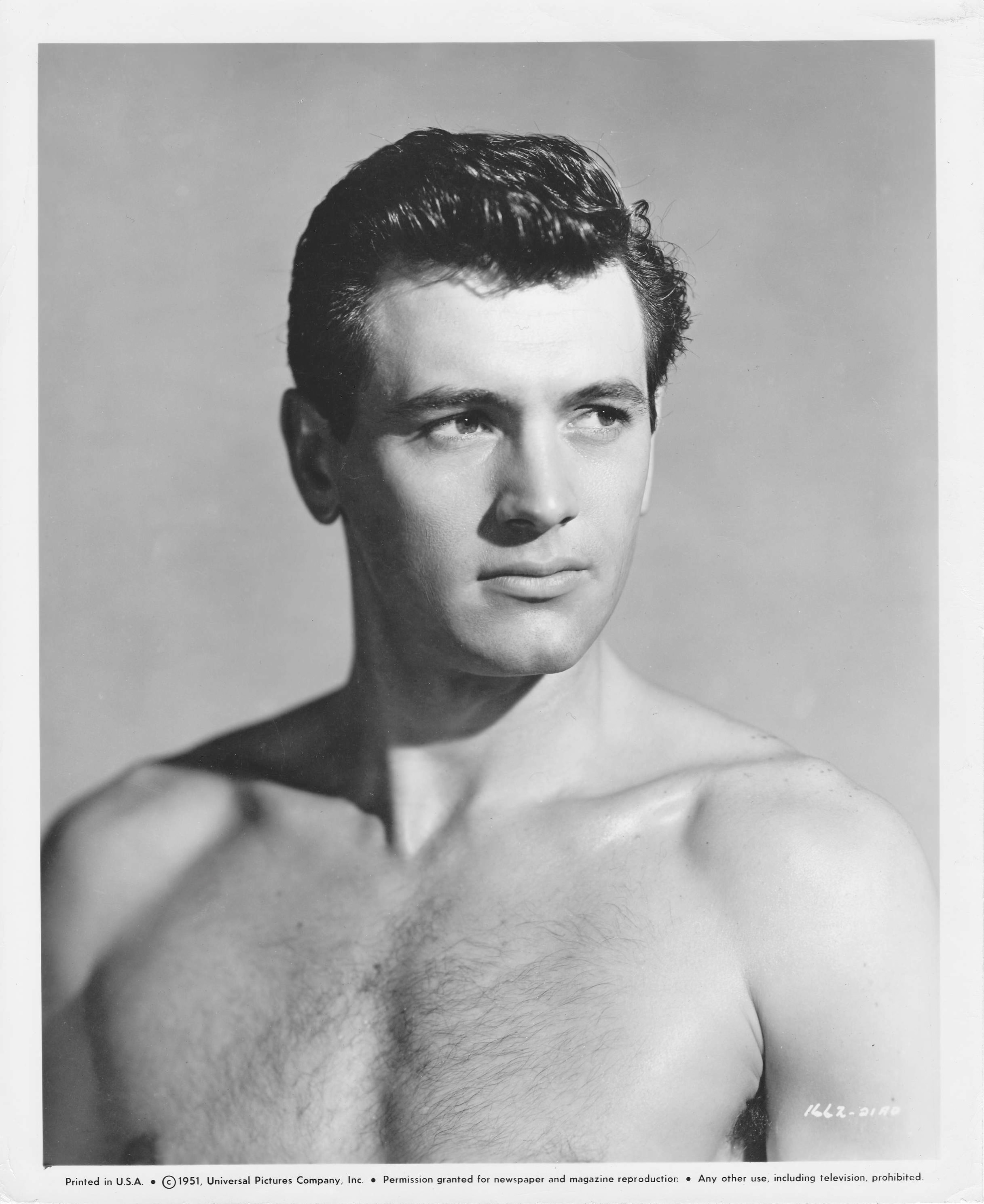
Rock HudsonPublicity Photo of a young Rock Hudson

The first legacy of Rock Hudson is the one he worked for years to create: the true, blue all-American star of the 1950’s. Tall, ruggedly built with a perfectly sculpted jaw line and jet black hair, if Hudson were transposed to the Hollywood of today I have no doubt he would be cast as one of the many larger-than-life super heroes that inundate our screens. But Rock isn’t a star of today, and instead of building his acting career by simply being the manliest of men, he built his acting legacy with romance and comedy.

He displayed his flair for sentimental romanticism as the star-crossed lover, Ron Kirby, in the Douglas Sirk romantic melodrama All That Heaven Allows and subsequently worked with Sirk on two more great melodramas of the 1950s, Magnificent Obsession and Written on the Wind. Later in the decade, Hudson took a step back from the intensity of the melodrama and demonstrated his surprisingly strong command over comedy. In the late 1950s to the mid 1960s Hudson starred opposite Doris Day in some of the most beloved romantic comedies of all time, first in Pillow Talkfollowed by the equally hilarious Lover Come Back, and Send Me No Flowers. Yes, at the peak of his career Hudson had created in himself the very image of the perfect male companion. Solid and strong while tender and caring; the very epitome of the man all the girls wanted to get and all the boys wanted to be. And it is this very image that makes his second legacy so ironic.

Doris Day and Rock HudsonRock Hudson with his most beloved on-screen partner Doris Day in Pillow Talk (1959, Michael Gordon director)

If Hudson is first remembered for how he lived, then he is also remembered for how he died. When Rock Hudson passed away on October 2nd, 1985, it made headlines. Yes, a major star of the American Cinema had passed away, but more paramount to the national discussion was that he had died of AIDS. The news was devastating, surprising, but most of all it was important. No major star before him had died of AIDS nor had any public figure even admitted to having the disease. Before his death the epidemic was seen as nothing more than that “degenerate gay disease,” something unworthy of public care or substantial funding. When Hudson admitted he contracted AIDS, he gave a familiar and beloved face to the horrible and deadly disease. He gave an apathetic nation a reason to care and educate themselves on a completely misunderstood condition. And this, in my opinion, is one of the bravest things he could have done. After his death, Americans finally began to take the threat of AIDS seriously and a true national discussion began to form. Funding and charity began to appear on the local, state, and national levels as awareness for AIDS began to rise. Thanks to the bravery of Rock Hudson, the ignorance surrounding this horrifying disease has been slowly chipped away and this change in public perception is what creates his second legacy.

So, let us celebrate the life of a man whose death irrevocably changed the world. Be sure to tune in every Thursday to spend the night with one of Hollywood bravest stars: Rock Hudson.

Rock Hudson, circa 1961…..

Minoo Allen for Classic Movie Hub

Posted in Posts by Minoo Allen, TCM | Tagged , , , , , , , , , , , | 1 Comment