Silents are Golden: The “Sheik” Phenomenon of the 1920s
Everyone knows about 1920s flappers–the youthful, fun-loving ladies of the Jazz Age. Their style of bobbed hair, tight-fitting hats, and short (as in knee-length) skirts, has become iconic. There’s no doubt that their impact on early 20th-century pop culture was tremendous.
But what about the flapper’s male counterpart, the sheik? With his baggy trousers and shiny, slicked-back hair, he left a big mark on pop culture too. And who were some of these famous screen “sheiks” that were such a phenomenon in Hollywood?
A John Held Jr illustration.
We can trace the label’s origin to Rudolph Valentino’s huge hit The Sheik(1921). At the time, the young Italian-born Valentino was an up-and-coming actor whose role as Julio in The Four Horsemen of the Apocalypse(1921) had made him a household name. His first role as a main star would be Ahmed Ben Hassan in the film version of E.M. Hull’s popular romance novel, The Sheik. Hull’s lurid story, about an independent English beauty who decides to travel through the desert and winds up getting kidnapped by Ahmed, was a sensation when it was published in 1919. Women were apparently intoxicated by the idea of a handsome, “exotic” lover going wild with desire for them. It’s not surprising that a movie producer would jump at the chance to commit the story to film, anchored by an attractive star like Valentino.
Valentino and Agnes Ayres in The Sheik.
The film was a hit and turned Valentino into a phenomenon – and the very concept of a screen “sheik” became a phenomenon as well. Prior to 1921, most Hollywood leading men were staid, dependable types like Thomas Meighan or boyish types like Charles Ray. Sessue Hayakawa was probably the most “exotic” lover the screen had to date, the closest match to the 1920s sheik. But once the undeniably virile Valentino hit the scene, the way romance was depicted onscreen would never quite be the same. It sparked a lot of talk about the pros and cons of “caveman” wooing–cavemen being men who “wouldn’t be bossed around” – and a general new awareness of female tastes and desires.
The “sheik” phenomenon also coincided with the
public’s interest in “Orientalism,” as it was called, which had been strong
since the 1910s. The Far East, particularly the desert, was considered a place
of mystery and beauty where passions could still run wild. Trend-setters
enjoyed decorating with lacquered tables and dressing in Eastern-inspired
clothing, perhaps seeking some escapism. Certainly, the romantic “sheik” was
one of the prime escapist figures of the 1920s, showing up in artwork, comic
strips, ads, and songs like the popular The
Sheik of Araby.
Sheet music banking on Valentino’s popularity.
Studios were eager to pounce on the new craze, attempting to produce sheiks of their own (no matter what). 1921-1924 was probably the high point of this trend, with stars like the stalwart Milton Sills put in pictures like Burning Sands (1922), and the youthful Ramon Novarro decked out in robes for The Arab(1924). Despite these studios’ best efforts, none held quite the fascination that Valentino did (although some actors like Novarro did transcend the sheik genre and became popular in their own right).
Still from The Arab.
With so much public fascination with sheiks, it wasn’t long before trendy young men–particularly those who loved jazz, girls, and fast cars–were being jokingly referred to as “sheiks.” (And flappers their “shebas.”) The label stuck – some even seemed to wear it with pride. And while some young men predictably rolled their eyes at the Valentino fellow so many women were gaga over, they would soon start copying his glossy, slicked-back hairstyle. It would be one of the most popular trends of the decade, likely a way for these youths to signal that they were part of a more dashing, modern breed.
If the flapper had an iconic style, so did these teenaged and college-aged sheiks. Oxford bags (wide-legged trousers) became very popular, especially on college campuses, and many young men also favored loud-patterned sweater vests and sporty straw hats. Carrying a ukelele was a bonus, and spending time at a college game wasn’t complete without wearing a raccoon coat. Buster Keaton and Harold Lloyd would take notice of the new trends, lampooning them in Steamboat Bill Jr.(1928) and The Freshman(1925).
Still from Steamboat Bill Jr.
Valentino would pass away suddenly in 1926 from an infection caused by a gastric ulcer to the shock of his countless fans. He had just completedSon of the Sheik (1926), the sequel to his former blockbuster, and arguably a more smoldering film than the first. By the late 1920s, “sheik” began to be a catch-all term for a matinee idol, with stars as diverse as Ronald Colman, Buddy Rogers, Nils Asther, and Gary Cooper all being pegged as sheiks. But the term finally began to fall out of favor, especially once talkies became the norm.
Typical fluff article from Motion Picture Classic, June 1929.
By the 1930s, both the sheik and his sheba were going out of style. The optimism, partying, and innocent flirtations of Jazz Age films would start to seem dated next to the sarcastic dames and hard-boiled gangsters of the ’30s and beyond. The mirror-shiny hair gloss and baggy trousers were also starting to look very “of its time.” But while the sheik’s vogue was relatively brief, he certainly had a big impact on the 1920s, right alongside that much-admired, impetuous flapper.
Sheik-themed cartoon from 1919
This post was partly based on my article “Homme Fatales and Hair Grease: The Phenomenon of the 1920s ‘Sheik’” which can be accessed here.
Lea Stans is a born-and-raised Minnesotan with a degree in English and an obsessive interest in the silent film era (which she largely blames on Buster Keaton). In addition to blogging about her passion at her site Silent-ology, she is a columnist for the Silent Film Quarterlyand has also written for The Keaton Chronicle.
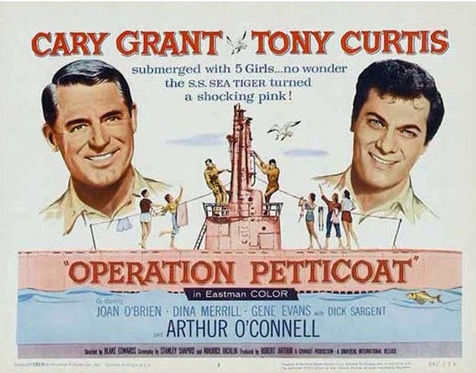
There are classic comedies that capture the perfect blend of superior direction, cast, writing, and appealing aesthetics. You can tell that it works well when we find ourselves forming nostalgic bonds to such films. Even if the content seems outdated to our modern lens, we happily re-watch them. Again and again. One such film that fits that bill for me is Blake Edwards’ Operation Petticoat (1959).
On September 2, 1945, the Japanese delegation officially signed their unconditional surrender aboard the USS Missouri, thereby ending World War II. Many war films followed into the 1950s. By the second half of that decade, America was more than ready to tackle the subject with a lighter touch – with humor and even some sexual innuendo.
On the heels of the success of Pillow Talk (1959), writing team Stanley Shapiro and Maurice Richlin, along with Paul King and Joseph B. Stone, created the perfect comedic tone for a battle of the sexes in the midst of battling the Japanese at sea. Enormously successful Pillow Talk (1959) was released just 2 months prior to Operation Petticoat (1959), for which the seasoned writers Shapiro and Richlin earned Academy Awards for Best Writing, Original Screenplay. This popular formula for sex comedy trended from the late 1950s into the 1960s. Why not take that gender battle to war… on a pink submarine?
Blake Edwards, a successful screenwriter/director had a long career in filmmaking with a panache for comedy.
Blake Edwards was a rising star in directing who evolved from a bit actor during WWII to writing screenplays and scripts for radio, television, and film. Edwards grew up with an inherent understanding of Hollywood and the film world. By the age of 3, his family moved to LA, where his stepfather worked as a film production manager. His mother had remarried when Blake was a baby – to Jack McEdwards, son of silent film director J. Gordon Edwards. According to a 1971 interview in “The Village Voice,” Blake said of those early days: “I worked with the best directors – Ford, Wyler, Preminger – and learned a lot from them. But I wasn’t a very cooperative actor. I was a spunky, smart-assed kid. Maybe even then I was indicating that I wanted to give, not take, direction.”
Blake Edwards had just finished directing The Perfect Furlough (1958), starring Hollywood power couple Tony Curtis and Janet Leigh, which was also written by Shapiro, when he began production for Operation Petticoat (1959). Blake Edwards’ The Perfect Furlough, a CinemaScope Eastmancolor rom-com that focused on sex-starved servicemen, was released a week after Curtis and Leigh’s 2nd daughter Jamie Lee was born. Wasting no time, Edwards, Curtis, and Shapiro and writing team got cracking to make another comedy that centered on sex-starved servicemen with Operation Petticoat.
The basic premise takes us through the waters of Japan in the middle of World War II in a badly damaged submarine. The crew is resourceful and always on the look-out for repair and supplies. And like all farce comedies, the obstacles of immense ridiculousness must ensue. In this case, it presents challenges such as a Pepto-Bismol shade of pink painted sub, bringing aboard unexpected guests such as a crew of servicewomen, and even a pig disguised as a sick sailor.
The new coat of unmistakable pink paint makes them a looming
target in those dangerous waters, from both the enemy and allied crews alike. The
tight quarters with the women officers in snug-fitted uniforms bring an array
of distractions and a slew of battle-of-the-genders jokes and innuendos.
Cary Grant and Tony Curtis serve up an odd couple approach to WW2 strategy that works.
We see a large cast of familiar faces. This includes the comic chemistry of our two main stars, Cary Grant as Lt. Commander Matt Sherman and Tony Curtis as Lt. Nick Holden. Curtis had admired Grant from his youth and in seeing him in films like Destination Tokyo (1943), another submarine war film. It was fated that their paths would cross again. In 1959, the same year as Operation Petticoat, Grant starred in one of his most popular Hitchcock roles as Roger Thornhill in North by Northwest and Curtis impersonated Grant in Billy Wilder’s Some Like It Hot.
Tony Curtis enlisted in the US Navy following Pearl Harbor attack at age 17.
The naval uniform was a familiar fit for Tony. Curtis served
in the U.S. Navy, aboard a submarine tender, USS Proteus. He enlisted following
the attack on Pearl Harbor at age seventeen. By the time of the signing of the
Japanese official surrender aboard the USS Missouri, Curtis was on deck of his ship’s
signal bridge looking across the Tokyo Bay to witness this historic event.
After a decades-long and successful acting career of more than a hundred films,
Tony received full military honors at his funeral on October 4, 2010, at the
age of 85 years-old.
Grant and Curtis charm every scene with perfect chemistry.
By the late 1950s, Cary Grant was more than just a household name. He was still churning out hits for more than a quarter-century. Grant was 55 years-old for the release of Operation Petticoat and worried that he may have been too old for the part. The role of Commander Sherman was originally offered to Jeff Chandler. Bob Hope was also offered a role, which he later regretted turning down. Tina Louise of “Gilligan’s Island” fame was offered Joan O’Brien’s role as nurse Crandall, but she refused because she didn’t want to be simply an on-screen “boob joke.”
The supporting cast rolls out like a who’s who of familiar faces and classic television, such as Dick Sargent from “Bewitched,” Marion Ross from “Happy Days,” and Gavin MacLeod of “The Mary Tyler Moore Show” and “The Love Boat”:
Cary Grant as Lieutenant Commander (later Rear Admiral) Matthew T. “Matt” Sherman, USN
Tony Curtis as Lieutenant, Junior Grade (later Commander) Nicholas “Nick” Holden, USNR (later USN)
Joan O’Brien as Second Lieutenant Dolores Crandall, NC, USAR
Dina Merrill as Second Lieutenant Barbara Duran, NC, USAR
Gene Evans as Chief Torpedoman “Mo” Molumphry, USN, Chief of the Boat of the Sea Tiger
Dick Sargent as Ensign Stovall, USN (billed as Richard Sargent)
Arthur O’Connell as Chief Motor Machinist’s Mate Sam Tostin, USN
Clarence Lung as Sergeant Ramon Gallardo, USMC (billed as Clarence E. Lung)
Frankie Darro as Pharmacist’s Mate 3rd Class Dooley, USN
Tony Pastor, Jr. as Fox
Robert F. Hoy as Reiner
Nicky Blair as Seaman Kraus
John W. Morley as Williams
Ray Austin as Seaman Austin
This film centers on the screwball antics of their
adventures, with a special focus on the ‘odd coupling’ of cool and collected Commander
Matt Sherman (Grant) in contrast to playboy rule-breaker and chaotic cad Nick
Holden (Curtis). These personality differences make for a priceless recipe for
classic comedy, but it is the women who bring a surprising icing on this cake.
Dina Merrill gets chummy with Tony Curtis, trading uniforms for tennis wear.
Dina Merrill as 2nd Lt. Barbara Duran, is Nick’s love interest and connected to co-star Cary Grant in her personal life. Heiress/philanthropist/actress Merrill’s cousin was Barbara Hutton, once married to Grant. Merrill was married three times, including actor Cliff Robertson. But the stand-outs in the female cast are Joan O’Brien’s 2nd Lt. Dolores Crandall and Virginia Gregg’s Major Heywood.
Submerged in hostile waters, quarters get tight between Cary Grant and Joan O’Brien.
2nd Lt. Crandall is a wonderful slapstick highlight. On the surface, it’s easy to think of Crandall as a stereotype of a ditzy Monroe type with every opportunity to target her character as an ongoing busty joke. But she is much more. Dolores is portrayed as a caring, nurturing, and sympathetic character who is more embarrassed by her curvy attributes than flamboyant. The real humor here isn’t in her anatomy, but rather in her ability to pull off physical comedy. Female slapstick comediennes are rare in the studio era so it’s terrifically refreshing to see Crandall be included in this limited group, not unlike an understated Judy Holiday.
Virginia Gregg and Arthur O’Connell battle and overcome gender stereotypes.
Additionally, Major Heywood is another classic Hollywood rarity- the mature female role of competence. Not nearly as openly sarcastic as a Thelma Ritter character, but this lady outwits her male peer with ingenuity, creativity, and intelligence- in a man’s game. I can think of few on-screen examples of female characters of a mature age who could convincingly out best men in such a masculine occupation as the ship’s mechanic while also possessing a soft, romantic side.
A shocking coat of pink paint becomes their “biggest obstacle of war”.
Blake Edwards’ Operation Petticoat (1959) is a fun comedy medley of wartime action (like sinking a truck with a torpedo), a large cast of comforting faces, and all the delightful tension as expected from a co-ed pink sub in the middle of a war zone. If you’re in need to sink below from life’s chaos, this is the perfect escapism respite.
When not performing marketing as her day gig, Kellee Pratt teaches classic film courses in her college town in Kansas (Film Noir, Screwball Comedy, Hitchcock, Billy Wilder, and more). She’s worked for Turner Classic Movies as a Social Producer and TCM Ambassador (2019). An unapologetic social butterfly, she’s an active tweetaholic/original alum for #TCMParty, member of the CMBA, and busy mom of four kids and 3 fur babies. You can follow Kellee on twitter at @IrishJayhawk66 or her own blog, Outspoken & Freckled (kelleepratt.com).
The Handsome Face of Horror in ‘I Married a Monster from Outer Space’
When classic movie fans think of the
faces of horror, we rightly go to some of the most iconic creatures in film
history: the Universal monsters and the images that have defined the look of
vampires, Frankenstein’s monster and other creatures for nearly 90 years;
grotesque aliens and horrific mythological creatures.
But let’s look at it in another way – a disturbing way – and consider when the face of horror is attractive, familiar and even loving. Like … what if you married a monster from outer space?
One of the great publicity shots in I Married a Monster from Outer Space shows Gloria Talbott being carried by an alien.
It happened – at least in the effective 1958 sci-fi horror film I Married a Monster from Outer Space. Seeing this movie again recently was a reminder of this subtle and insidious type of monster.
It was one of many films in the 1950s that fed off growing Cold War fears and anxieties about communism invading America with stories about alien invasions. Often these films had aliens taking over human bodies so we couldn’t see the horror right in front of us.
The best example of this film paranoia would be Invasion of the Body Snatchers (1956), Don Siegel’s terrifying and masterful story of a small California town taken over by pod people. I find this film so unnerving that it’s difficult to watch.
Instead, I wimp out and watch movies
that are easy to shake off.
There’s something not right with these two usually friendly guys in It Came from Outer Space. (That’s Russell Johnson from Gilligan’s Island on the right.)
LikeIt Came from Outer Space (1953) with aliens who crash in the desert and temporarily take over human bodies, but don’t mean any harm – for now.
Or Invaders from Mars (1953) with little David who sees a spaceship land near his house and then convinces a town – and the military – that evil aliens have taken over the bodies of his loving parents and respected townsfolk.
And especially the underrated I
Married a Monster from Outer Space about a newlywed who realizes something is
not right with her husband.
*
* * * *
The film opens with Bill (the tall, dark and handsome Tom Tryon) enjoying drinks with the boys the night before his wedding.
A glowing alien limb grabs Bill (Tom Tryon) in I Married a Monster from Outer Space.
On his way home, he pulls over thinking he has hit someone and is grabbed by a grotesque glowing limb, enveloped in a billowing cloud of smoke and disappears all to a creepy musical cue.
The next morning, Marge (Gloria Talbott and her super short bangs) is nervously awaiting Bill who is late for their wedding. When he arrives, he’s out of sorts but everyone brushes it off. It’s downhill from there.
The honeymoon night is a disaster with Bill inexplicably cold toward his confused new bride. Things don’t improve. On their first anniversary, Marge is writing to her mother about her “horrible” marriage that has left her frightened and bewildered. “Bill isn’t the same man I fell in love with – he’s almost a stranger.”
Oh Marge, you have no idea how right you are.
She does more than wonder as inexplicable things pile on like Bill’s furious reaction to the anniversary gift of a sweet little dog and the dog’s quick demise. (Clearly the movie rule that you don’t hurt animals didn’t exist in the 1950s.) Marge seems to buy his excuse about what happened, but smartly doesn’t let it drop.
“If it weren’t so silly, I would say
you’re Bill’s twin brother from some other place,” she tells him.
She’s getting closer.
Marge is horrified to see an alien emerge from her husband’s body in I Married a Monster from Outer Space.
Growing more troubled, Marge follows Bill
out of the house, boldly running after him through the woods in a night gown and
coat where she watches in horror as her husband is shrouded in that familiar smoke
from which a creature emerges in front of a spaceship. The alien and its human hybrid
face each other and it’s eerie even if the superimposed alien form isn’t too
scary.
Marge seeks help but is stymied as
male friends and the police all act in the same odd way and tell her to just go
home. We can feel her growing paranoia as she realizes how far things have
gone: she can’t make a long-distance phone call, can’t send a telegram and is
stopped from leaving town.
Marge (Gloria Talbott) realizes she’s on her own when even her godfather the police chief refuses to help in I Married a Monster from Outer Space.
Is there anyone she can trust? There is and his idea for finding help is genius and even ironic from the aliens’ viewpoint. But is it enough and how will other complications play into things? No spoilers here.
* * * * *
A low-budget film with big-budget aspirations
I Married a Monster Space was made for only $125,000 and
released with low expectations. It’s never gotten the fair shake it deserves
most likely because of the campy title and matching publicity material. (Sorry,
but an alien never carries the bride in her wedding gown.)
Yet it gives us more than we expect with a strong heroine, solid acting, two-dimensional aliens, surprisingly good filmmaking and a sci-fi yarn that delivers on suspense. (Moments where the alien’s face flickers briefly on its human’s is chilling.)
During a lightning storm, the alien’s true face is revealed over its human host.
The trio of director Gene Fowler Jr., writer Louis Vittes and cinematographer Haskell Boggs gives the film higher production values than we are used to in sci-fi B-movies.
Framing of scenes is wonderfully tense with architectural arches often closing in on Marge, mirroring what is happening in her life. Physical distance is exaggerated between the young couple in their home.
This is one of the scenes that effectively uses darkness in I Married a Monster from Outer Space. You can see Marge’s silhouette on the left while on the right, Bill’s arm is raised up ready to turn on the light to startle her – and viewers.
The fact aliens can see in the dark is used for dramatic effect with shadows and entire scenes in darkness. Light is used as a jump scare as when Bill turns on a light to show his wife he’s been watching her in the dark.
The way Marge is written is refreshing.
We expect the young housewife to be meek and spend the film screaming as similar
characters have been portrayed in movies of the time. But she is smarter and
tougher than she seems, as she looks for explanations into her husband’s strange
behavior. She’s not afraid to ask questions and to confront him.
In one effective scene, Bill finds
Marge in the dark and wants to turn the lights on to which she responds “you
don’t need any.”
When he asks what she knows, Marge
doesn’t hold back.
“I know you’re not Bill. You’re some thing
that has crept into Bill’s body. Something that can’t even breathe the same air
we do,” she answers
When Bill asks, “Aren’t you afraid to
be telling me all this?” we’re thinking the same thing.
Yes, she is afraid but is resilient. Love,
it seems, can make you fearless and Talbott plays the scene to great effect.
Marge (Gloria Talbott) doesn’t sit by quietly as she notices the many changes in her husband.
Presenting Marge that way elevates the
film as well as actress Talbott who has been labeled a Scream Queen in sci-fi
and horror films. She shows she’s better than that.
I like that the story makes the aliens
multidimensional. They are desperate creatures who face extinction from an
unstable sun that has killed all the women on their planet. The yuck factor is
that they’ve come to Earth so human women can breed their children. Since it’s
a 1950s film, it is only talked about in theory as Bill shares it’s not
possible yet.
They also aren’t immune to human
emotions and that comes through in the one honest conversation between Bill the
alien and Marge.
Bill: “Something happened that we
hadn’t foreseen. Along with these bodies, we inherited other things as well …. human
desires, emotions.”
Marge: “Are you telling me you’re
learning how to love.?”
Bill: “I’m telling you I’m learning
what love is.”
Well that was unexpected.
And that’s the appeal of I Married a Monster from Outer Space. You may think you know what you’re getting in a film with such a sensational and direct title, but it has its surprises making it a marriage worth watching.
How you know them
Gloria Talbott. Gloria started as a child actress in
films like A Tree Grows in Brooklyn but was given the title of Scream
Queen after starring in such films as The Daughter of Dr. Jekyll (1957),
The Cyclops (1957) and The Leech Woman (1960). One of her most
notable performances was as Jane Wyman’s daughter in All that Heaven Allows (1955).
Tom Tryon became a successful author.
Tom Tryon. The handsome actor starred in a variety of films including The Longest Day and The Cardinal as well as television work in Western shows and as the title character in Texas John Slaughter movies for The Wonderful World of Disney. But you may know his name more as an author. He left acting in 1969 to write horror and mystery stories and was a success with such novels as “The Other” (1971), which he adapted for film, and “Harvest Home” (1973).
Gene Fowler Jr. The producer and director had a long career as a film editor for the likes of Fritz Lang and Samuel Fuller and those skills are evident in I Married a Monster from Outer Space. Although he won a Golden Globe and four Emmy awards, he remains best known as director of I Was a Teenage Werewolf (1957).
…..
– Toni Ruberto for Classic Movie Hub
You can read all of Toni’s Monsters and Matinees articles here.Toni Ruberto, born and raised in Buffalo, N.Y., is an editor and writer at The Buffalo News. She shares her love for classic movies in her blog, Watching Forever. Toni was the president of the former Buffalo chapter of TCM Backlot and now leads the offshoot group, Buffalo Classic Movie Buffs. She is proud to have put Buffalo and its glorious old movie palaces in the spotlight as the inaugural winner of the TCM in Your Hometown contest. You can find Toni on Twitter at @toniruberto.
Noir Nook: 10 Things About The Asphalt Jungle (1950) That You May Not Know
Of all of the noirs I’ve seen in my lifetime, one of the absolute best, in my estimation, is The Asphalt Jungle (1950). It has so much going for it – a stellar ensemble cast, hard-hitting dialogue, a simple but riveting story, and a perfect noir ending.
Helmed by John Huston, the film focuses on an intricately planned jewelry heist involving a motley crew of criminals. The mastermind is Erwin “Doc” Reidenschneider (Sam Jaffe), who has recently been released from prison and is determined to carry out one last job. With the help of a skittish bookie named Cobby (Marc Lawrence), Doc assembles a team comprised of Gus Minissi, the getaway driver (James Whitmore), safecracker Louis Ciavelli (Anthony Caruso), and Dix Handley (Sterling Hayden), a “hooligan” to serve as the muscle of the group. Also on hand is Alonzo Emmerich (Louis Calhern), an attorney who’s responsible for fencing the stolen jewels. On the distaff side, we have Doll Conovan (Jean Hagen), who is hopelessly devoted to Dix, and Angela Phinlay (Marilyn Monroe), Emmerich’s mistress (who creepily calls him “Uncle Lon”).
This month’s Noir Nook celebrates this first-rate offering from the film noir era by serving up 10 things you may not have known about this famous film.
1. The film received nearly universally rave reviews upon its release. However, notoriously acerbic New York Times critic Bosley Crowther still managed to throw some shade on the production. While acknowledging that director John Huston had “filmed a straight crime story about as cleverly and graphically as it could be filmed,” he maintained that the picture was “corrupt” because it encouraged the audience to “hobnob with a bunch of crooks . . . and actually sympathize with their personal griefs.”
Strother Martin
2. Asphalt Jungle marked the big-screen debut of Strother Martin. He would later appear in such films as True Grit (1969) and Butch Cassidy and the Sundance Kid (1969), along with a slew of TV shows, but he may be best known for telling Paul Newman that “what we have here is failure to communicate” in Cool Hand Luke (1969). An excellent swimmer and diver, Martin won the National Junior Springboard Division Championship at the age of 17, attended the University of Michigan as a member of the diving team, and served in the U.S. Navy as a swimming instructor during World War II. After he moved to California to become an actor, he worked for a time as a swimming instructor to Marion Davies and the children of Charlie Chaplin.
3. John Huston’s first choice to play the part of Angela was Lola Albright, who was not available. In looking at her filmography, she appeared in five films in 1950, the year The Asphalt Jungle was released; perhaps this is why she wasn’t available. She is perhaps best known for playing singer Edie Hart, the girlfriend of TV private eye Peter Gunn.
4. The wife of Louis Ciavelli was played by Teresa Celli. She was born Teresa Levis in Dysart, Pennsylvania, but her family moved to Italy after her father inherited an estate there. Teresa took her professional name from her great-grandmother, Duval Celli, an opera singer. While in Italy, Teresa was seen in both opera and dramatic productions. After her return to the United States, she made her radio debut on NBC’s Star Theater with Frank Sinatra, and her first appearance on the big screen was in the 1949 noir Border Incident. Celli was married from 1951 to 1965 to actor Barry Nelson; after The Asphalt Jungle, she appeared in only three more films.
5. The film earned four Academy Award nominations, for Best Supporting Actor (Sam Jaffe), Best Director, Best Adapted Screenplay for John Huston and Ben Maddow, and Best Black and White Cinematography for Harold Rosson. (Harold Rosson, incidentally, was the third husband of actress Jean Harlow.) The film was bested in every category – by George Sanders in All About Eve for Best Supporting Actor; Joseph Mankiewicz in All About Eve for both Best Director and Best Adapted Screenplay; and Robert Krasker in The Third Man for Best Black and White Cinematography.
6. Actor Frank Cady, perhaps best known for his role as Mr. Drucker in Green Acres, played a small role in the film’s first scene, where he is viewing a police line-up. He was also seen in small parts in several other noirs, including He Walked By Night (1948), The Crooked Way(1948), D.O.A. (1949), Convicted (1950), and Ace in the Hole (1951).
7. The score for the film was written by Miklos Rozsa, who also wrote the scores for such features as Spellbound (1945), A Double Life (1947), and Ben-Hur (1959). In Asphalt Jungle, however, his melodic composition was used sparingly and was only heard for about six minutes in the entire film.
Helene Stanley
8. Helene Stanley portrayed the young lady whose mesmerizing jive dancing leads to Doc Reidenschneider’s downfall. Born Dolores Diane Freymouth, Stanley’s screen debut came at the age of 14 when she appeared in Girls Town (1942). She served as the live-action reference for Disney’s Cinderella (1950), Princess Aurora in Sleeping Beauty (1959), and Anita, the young wife in 101 Dalmatians. In a bit part in All the King’s Men (1949), she played John Derek’s girlfriend, who is killed in a car crash with the drunken Derek at the wheel. She has only two lines (“Come on, Tommy, let’s go faster! Come on!”), and then she’s seen lying on the side of the road after the accident. Stanley was also married to low-level mobster Johnny Stompanato from 1953 to 1955. Three years after their divorce, Stompanato was stabbed to death in the home of screen star Lana Turner. Stanley later married a Beverly Hills physician and retired from show business after the birth of her son in 1961.
10. Several internet sources, including the Internet Movie Database, state that Asphalt Jungle marked the big-screen debut of Jack Warden. I beg to differ, however. Try as I might, on numerous occasions, I have never spotted him. Warden was, however, the star of the 1961 TV series by the same name. Also, there is an actor in the film – James Seay – who bears more than a passing resemblance to Warden. I suspect that the resources have either confused Warden with his association with the television series or mistaken him for Seay. Or possibly both.
And that’s it! I hope this list contained at least a few tidbits that you didn’t already know. Stay tuned for future Noir Nooks for trivia on your favorite noirs!
…
– Karen Burroughs Hannsberry for Classic Movie Hub
Silver Screen Standards: The Night of the Hunter (1955)
The Night of the Hunter (1955) is such a haunting and unusual film that I often wonder what else Charles Laughton might have produced had he directed any more movies, but if he was only going to direct once at least we got this picture to show for it. Laughton’s grim fairy tale of murder and madness in the Depression-era plays like a dark picture book, full of images that linger in the mind of the viewer long after the movie ends. Adapted from the 1953 Southern Gothic thriller by Davis Grubb, the film explores evil, loneliness, and courage in its story of two children pursued by a maniacal serial killer who wants the stolen money their father died to obtain for them. Striking performances from Robert Mitchum, Shelley Winters, and Lillian Gish provide the most memorable scenes, but young Billy Chapin holds the story together as John Harper, whose realistic responses to trauma contrast with the dreamlike scenery around him. The result is a movie that creeps into your psyche and stays there, just like those old stories about lost little children and the monsters who want to swallow them whole.
Harry Powell (Robert Mitchum) pretends to be a preacher, but the tattoos on his knuckles suggest his more sinister nature.
Classic movie fans don’t need an introduction to Robert Mitchum, Lillian Gish, or Charles Laughton, but the contributions of all three are surely enough to lure almost any film fanatic to The Night of the Hunter. Mitchum’s performance is deeply unnerving, a combination of real menace, delusion, and buffoonery that might seem unbelievable if it weren’t so horribly common in real life. Harry Powell has killed so many women he can’t keep count, and we understand from his twitchy knife hand that the killing is a compulsion that exists entirely outside his need for funds. He would kill women for nothing, but killing the ones who are lonely enough to marry him gives him the money to keep going.
His God is a monstrous version of the blood-soaked destroyer of the Old Testament, meting out hellfire and punishment on widows and children while vindicating the wrath of a tyrannical patriarch (the poet William Blake imagined this image of God as “Nobodaddy,” which makes a provocative comparison with “Daddy Powell,” too). Lillian Gish brings balance to this dark vision of God with her role as the stalwart Rachel Cooper, whose God is the protector of children like Moses, Jesus, and John Harper. Rachel is the nurturer whose love is unconditional, even to the hopelessly lovestruck Ruby. Kindness, comfort, and courage shine through her wise face in every scene; she is more than a match for the false prophet Harry Powell, which ought to give us all hope for the world.
Between them, we have Shelley Winters’ portrayal of the martyred Willa, a victim of Harry’s violence and greed but also of her community’s foolish devotion to patriarchal norms and gullibility. She loves her children in a helpless, paralyzed sort of way, but she’s incapable of fighting for them and lies down to await the knife like a sacrificial lamb, leaving John and Pearl to face Daddy Powell alone. Her good intentions, like those of the kindly but drunken Uncle Birdie (James Gleason), are useless in the struggle against real evil. Winters, however, invests her with a sense of quiet tragedy that attracts our sympathy, especially when contrasted with the despicable busybody Icey Spoon (Evelyn Varden).
Rachel Cooper (Lillian Gish) fearlessly defends her adopted children from Harry over the course of a long night, during which she tells them stories from the Bible to distract and encourage them.
When I watched this movie with my husband recently, he commented on the ending and how long it was, going on well beyond the downfall of Harry Powell, but the extended denouement of The Night of the Hunter makes more sense when we consider that John Harper is really the protagonist of this story, although the adult stars get top billing, and this is not a noir film even if many of the classic noir elements are in play.
John and Pearl Harper (Billy Chapin and Sally Jane Bruce) hide from the murderous Harry Powell in the basement before their dramatic first escape from his clutches.
For most of the picture, John is being threatened, damaged, and traumatized while his innate courage and intelligence, as well as his devotion to Pearl, keep him in motion. He barely has time to sleep, much less process the horror of his situation or the scope of his losses. He’s too busy trying to keep himself and his sister alive. The arrest of Harry Powell doesn’t repair the damage done to John’s psyche; in fact, it reinforces that damage by making John repeat the horror of seeing his real father arrested at the beginning of the film. A noir story might have ended there, with fatal justice for Harry but a bleak endpoint for John. Instead, we get several more scenes in which John is slowly put back together as a person by Rachel Cooper’s love and protection. He is integrated into a functional, loving family, albeit one made of other displaced children taken into Rachel’s care. When Rachel faces the camera and tells us that little children abide, she is assuring us that John will be alright, and we need to hear that because otherwise, the story would be too dark to bear. It might not, in the real world, always be true, but we need to hear it in order to have hope, that saving grace that always lights our darkest times, and the sweet, beatific face of Lillian Gish compels us to believe her. The story ends there to tell us that good outlasts evil and that bad times don’t last forever, which is also how fairy tales tend to end, not just with the punishment of the wicked but the salvation and uplifting of the innocent.
Harry Powell (Robert Mitchum) prepares to cut the throat of his bride, Willa (Shelley Winters), who has realized at last that Harry just wants the money her late husband stole.
If you’re interested in the inner workings of fairy tales, use The Night of the Hunter as a leaping off point for further studies with books like Bruno Bettelheim’s The Uses of Enchantment (1976) or even the poetry of Ann Sexton in her 1971 collection, Transformations. For more classic movies with fairy tale roots, try The Blue Bird (1940), Jean Cocteau’s 1946 version of Beauty and the Beast, or The Red Shoes (1948), to name just a few. For a darker double feature with Robert Mitchum, follow up with Cape Fear (1962). The Night of the Hunter is available on a very handsome Blu-ray edition from Criterion Collection with a number of special features, including extensive outtakes and behind the scenes footage from Charles Laughton.
Monroe’s
Last Completed Musical-Comedy: Let’s Make Love (1960)
“Marilyn Monroe is the greatest farceuse in the business,” Fox film producer Jerry Wald asserted. “A female Chaplin.” In the summer of 1959, Wald approached Monroe with The Billionaire, a musical comedy by Norman Krasna who had scripted the sophisticated Indiscreet (1958) for Ingrid Bergman and Cary Grant. Professionally, Monroe was hot, and Fox wanted to capitalize on the success of its own star who’s last two films were made for rival studios. In fact, Monroe hadn’t worked on the Fox lot since Bus Stop (1956).
“[Marilyn] had this absolutely unerring touch with comedy,” Cukor would later say. “In real life she didn’t seem funny, but she had this touch. She acted as if she didn’t quite understand why it was funny, which is what made it so funny.”
Retitled Let’s Make Love, the film is a backstage story about a French billionaire, Jean-Marc Clement (Yves Montand), who learns his Casanova reputation is being satirized in an off-Broadway musical. Dismissing his attorney’s (Wilfrid Hyde-White) urge to shut down the production, the billionaire instead heeds the advice of his public relations agent (Tony Randall) and visits the theater during rehearsals to show good humor. At the theater, he is mistaken for an inexperienced actor auditioning for his part. Dazzled by the production’s leading female performer, Amanda Dell (Monroe), the billionaire accepts the part of the playboy to court her and pretends to be “Alex Dumas.”
Amanda, who attends night school, is serious about self-improvement and voices a strong prejudice against wealthy playboys. She is more interested in the art of acting, men who are awkward with women, and the show’s male singer (Frankie Vaughan). Amanda begins to coach this would-be impersonator whose disguise prevents him from relying upon money and power to impress her. The billionaire hires famous virtuosos in comedy, singing and dancing (Milton Berle, Bing Crosby, and Gene Kelly) to assist him in stirring Amanda, but discovers he is utterly untalented.
The plot’s premise borrows from the previous year’s hit Pillow Talk in which a man pursues a woman disinterested in his playboy reputation by disguising himself as more sensitive and approachable. Even Some Like It Hot was a more skewed variation on the formula.
Contenders for the role of Clement included Gregory Peck, Yul Brynner, Cary Grant, James Stewart, Charlton Heston, Rock Hudson. As casting finalized, Monroe’s husband, playwright Arthur Miller, arranged her introduction to the French actor and vocalist Yves Montand performing in a concert tour in New York, who would become her co-star. Monroe campaigned for Montand’s casting and won. Although he was born near Florence, Italy, the film’s trailer promoted Montand as “the greatest gift France has sent to us since the Statue of Liberty.” With his prominent nose, Montand bore a slight resemblance to Joe DiMaggio.
“Next to my husband and along with Marlon Brando,” Monroe told the press at a reception she hosted at the studio’s Café de Paris commissary, “I think Yves Montand is the most attractive man I’ve ever met.”
Frankie Vaughan, “the singing idol of England,” plays Tony Danton, a cabaret singer in Amanda’s production. Vaughan released more than eighty recordings over the course of his career, mostly covers of American songs.
As Clement’s protective attorney Mr. Wales, Wilfrid Hyde-White, was a British actor best remembered for his role in My Fair Lady (1964). He amused Monroe with a story he heard of a man visiting the wilds of Africa who told a savage tribesman that he was from America, and the head-hunter responded, “America—Marilyn Monroe.”
Screen legends Milton Berle, Bing Crosby, and Gene Kelly portray themselves in cameos as the comedian, singer and dancer who coach Clement.
Cukor, accompanied by
songwriters Sammy Cahn and Jimmy Van Heusen and musical director, Lionel
Newman, traveled to the Monroe’s Manhattan apartment to audition the musical score.
Using her white baby grand piano, the team sang four original songs created for
the film: “Specialization,” “Incurably Romantic,” “Hey You with the Crazy
Eyes,” and “Let’s Make Love.” The four men had a rare glimpse of Monroe as a
stepmother when, in middle of a song, she jumped up and attended to her young
stepson and his best friend.
Monroe records the film’s soundtrack musical numbers.
Monroe’s opening number, a Beatnik version of Cole Porter’s standard “My Heart Belongs to Daddy.” The six-minute sequence was on the scale of “Diamonds Are a Girl’s Best Friend” and “Heat Wave”. Immortalized by Mary Martin, the song was updated to include jazzy “ba-da-da” back-up male vocals. The melody of the chorus is in a minor key while the bridge is in major. Monroe delivered staccato phrasing with precise pitch.
As the number begins, the
camera focuses on a series of firehouse poles as Monroe’s legs appear from
above, opening and closing as she shimmies down a pole and into frame before
whispering, “Boys!” Ten male dancers in casual beige outfits join her. Wearing a
bulky blue Aran sweater over a black leotard body suit and black pumps, Monroe
announces, “My name is…Lolita, and I’m not supposed to play…with boys.” This
phrase calls to mind Nabokov’s controversial novel. Furthering the literary
allusion, Monroe plays with jacks and crawls across the floor between the
spread legs of a row of male dancers.
As in “Diamonds,” the male dancers chase, lift, and carry her around the stage. It is a vigorously acrobatic number, probably the most difficult of her career. Cukor shot the sequence slowly in fifteen second takes while Monroe mimicked the dance moves modeled off-set by Jack Cole. When Cole accidentally caught his foot in a camera dolly, Monroe grimaced and clutched her chest in exact imitation of her choreographer. The number took eleven days to complete
Monroe appreciated Cole’s
patience. She sent him a greeting card and enclosed a check for $1500 and a
note that read, “I really was awful, it must have been a difficult experience,
please go someplace nice for a couple of weeks and act like it all never
happened.” A few days later, Cole received another card with a check for $500 and
an inscription that said, “Stay three more days.” Cole responded with a
telegram: “The universe sparkles with miracles but none among them shines like
you. Remember that when you go to sleep.”
The blue sweater, ordered from Ireland for $75 by costume designer Dorothy Jeakins, created more delays on the set than Monroe than the Hollywood writer’s strike that stalled production. Monroe was slender, having lost the weight gained during her pregnancy in late 1958; however, Fox executive Buddy Adler complained that she looked pregnant in the blue sweater. The sweater gave the illusion of middle fullness as it was sewn into Monroe’s black leotard to prevent it from riding up during the highly physical dance moves.
“I got tired of being ignorant,” Amanda explains of her reason for working toward a high school diploma. “I never knew what people were referring to.”
Amanda coaches Clement (posing as an actor) on how to impersonate the playboy billionaire in Method acting style by “becoming” the role. She scorns the billionaire as a “crude” and “rich louse” and disapproves of him expecting women “to drop dead with the honor” of his interest. Intrigued, Clement asks Amanda on a date, but she declines to study for a geography exam.
Clement notices Amanda knitting between scenes and asks what she is creating. “I haven’t decided yet,” she says, displaying an unidentifiable mass. “It keeps my hands busy.”
After rehearsal, Amanda goes for a jog, Clement is smitten by her spontaneity.
After a stage kiss, Amanda realizes she is falling in love with her co-star.
Amanda supports Tony after he relapses on alcohol.
When “Alex” realizes Amanda loves him, he admits being an imposter. Amanda believes his acting approach has gone too far.
When Clement serves the producer of the off-Broadway musical receive a notice of the injunction, “Alex” suggests that the producer send Amanda directly to the billionaire’s headquarters to charm him into dropping the injunction.
When “Alex” sits behind Clement’s desk, goes through his mail, and pages his secretary, Amanda becomes alarmed, assuming her Method-acting coaching of Alex has convinced him that is, indeed, the billionaire.
Alex reveals his identity.
Fox promised “The Best Entertainment Offer You’ve Had in Years!” and organized a premiere in Reno, where Marilyn was scheduled to film The Misfits. Rather ominously, the city experienced an electrical blackout on the evening of the event. The premiere was canceled and never rescheduled.
With all its deficits, the film
is average; but the public expected a Marilyn Monroe film to produce above
average results. Regardless, Monroe is delightful and approachable in the role.
She speaks in her natural voice, her manner is natural and unaffected, she
portrays Amanda as an approximation to the real Monroe.
New York World-Telegram and Sun
noticed the public’s positive response to her musical performance during a
screening: “Marilyn Monroe is geared for some of the loudest laughter of her
life…It is a gay, preposterously and completely delightful romp…Marilyn
actually dares comparison with Mary Martin by singing ‘My Heart Belongs to
Daddy’ in the first scene. The night I saw it, the audience broke into the
picture with applause.” Conversely, crusty Bosley Crowther commented in the New
York Times, “Who (aside from his mother) would ever have expected to see
Milton Berle steal a show, without much effort, from Marilyn Monroe and Yves Montand?”
Let’s Make Love
received an Oscar nomination for best scoring of a musical. However, it
received a Golden Globe nomination for Best Musical Motion Picture and a
nomination for Best Written American Musical by the Writers Guild of America.
…..
What’s the story behind Monroe’s costume that
got much mileage? Monroe wore two of her own dresses in the
production. One is the designer Jean-Louis’s sheath with bolero jacket which
she frequently wore to events from 1958-1962.
Does Monroe wear the silver
gown from the premiere of Some Like It Hot? In the Specialization
number that highlights the careers of Elvis Presley, Maria Callas and Van
Cliburn, Monroe dons a spangled silver gown adorned with bugle beads that she had
worn to the premiere of Some Like It Hot in March 1959.
Did Monroe have a birthday
party on set? Monroe celebrated her 34th birthday on set and
receive a string of pearls from George Cukor. She was photographed with the
children of cast and crew invited to the event.
Did
Arthur Miller polish the script? The writer’s strike of 1960
delayed production, so Monroe’s husband rewrote key scenes.
A pivotal scene—obviously
scripted by Miller—establishes the emotional connection between Amanda and
Clement. The scrapped dialogue could likely have been a conversation in the
Miller living room on East Fifty-Seventh Street. When Amanda explains that she
wants to be “wonderful” and entertain people, Clement cynically suggests only
one in a hundred audience members really cares about her acting—the rest are
“foolish, perspiring strangers” for whom she is working “like a slave.” Amanda
describes the exhilaration she feels during a good performance and her
connection to the audience: “You’re home. Like in a family.” “How well I know,”
Marilyn printed next to this last line on her working copy of the script, which
describes how an audience’s feedback makes her feel lifted off the ground and
in a home. She changed the words “ground” to “earth” and “home” to “sheltered.”
In the margin, she scribbled, “how true.”
Why all the publicity photos of
the film’s stars drinking coffee? That was Monroe’s media
campaign to save the small business of a coffee and concession vendor. She
inscribed this photo of herself and the vendor, “There’s nothing like your
coffee.” During production, Fox studio was terminating the contract of its
coffee vendor, one man’s livelihood. Monroe wielded her power and protested the
termination, demanding that he remain; there are a series of photos of her and
her co-stars drinking coffee at the vendor’s portable stand which traveled to
the sound stages. Monroe won, and the coffee vendor stayed.
“Maureen O’Hara: The Biography” We have FOUR Books to Give Away this month!
“Aubrey Malone turns back the veil on O’Hara’s closely guarded private life to reveal a truly fascinating, spirited, and down-to-earth woman behind the glamorous movie star.”—News OK
It’s time for our next book giveaway contest! And we’re super excited about this one! That said, CMH is very happy to say that we will be giving away FOUR COPIES of Maureen O’Hara: The Biography by Aubrey Malone, courtesy of University Press of Kentucky, from now through Oct 3.
In order to qualify to win one of these prizes via this contest giveaway, you must complete the below entry task by Saturday, Oct 3 at 6PM EST. However, the sooner you enter, the better chance you have of winning, because we will pick a winner on four different days within the contest period, via random drawings, as listed below. So if you don’t win the first week that you enter, you will still be eligible to win during the following weeks until the contest is over.
Sept 12: One Winner
Sept 19: One Winner
Sept 26: One Winner
Oct 3: One Winner
We will announce each week’s winner on Twitter @ClassicMovieHub, the day after each winner is picked around 9PM EST — for example, we will announce our first week’s winner on Sunday Sept 13 at 9PM EST on Twitter. And, please note that you don’t have to have a Twitter account to enter; just see below for the details.
…..
And now on to the contest!
ENTRY TASK (2-parts) to be completed by Saturday, Oct 3, 2020 at 6PM EST — BUT remember, the sooner you enter, the more chances you have to win…
1) Answer the below question via the comment section at the bottom of this blog post
2)ThenTWEET (not DM) the following message*: Just entered to win the “Maureen O’Hara: The Biography” #BookGiveaway courtesy of @KentuckyPress & @ClassicMovieHub You can #EnterToWin here: http://www.classicmoviehub.com/blog/maureen-ohara-the-biography-book-giveaway-sept/
THE QUESTION: What is one of your favorite Maureen O’Hara movies and why? And if you’re not too familiar with her work, why do you want to win this book?
*If you do not have a Twitter account, you can still enter the contest by simply answering the above question via the comment section at the bottom of this blog — BUT PLEASE ENSURE THAT YOU ADD THIS VERBIAGE TO YOUR ANSWER: I do not have a Twitter account, so I am posting here to enter but cannot tweet the message.
NOTE: if for any reason you encounter a problem commenting here on this blog, please feel free to tweet or DM us, or send an email to clas…@gmail.com and we will be happy to create the entry for you.
ALSO: Please allow us 48 hours to approve your comments. Sorry about that, but we are being overwhelmed with spam, and must sort through 100s of comments…
About the Book: From her first appearances on the stage and screen, Maureen O’Hara commanded attention with her striking beauty, radiant red hair, and impassioned portrayals of spirited heroines. Maureen O’Hara is the first book-length biography of the screen legend hailed as the “Queen of Technicolor.” Following the star from her childhood in Dublin to the height of fame in Hollywood, film critic Aubrey Malone draws on new information from the Irish Film Institute, production notes from films, and details from historical film journals, newspapers, and fan magazines. Malone also examines the actress’s friendship with frequent costar John Wayne and her relationship with director John Ford, and he addresses the hotly debated question of whether the screen siren was a feminist or antifeminist figure. This breakthrough biography offers the first look at the woman behind the larger-than-life persona, sorting through the myths to present a balanced assessment of one of the greatest stars of the silver screen.
That said, here are just some of our Sept picks (over 40 titles in all) available for free streaming on the CMH Channel. All you need to do is click on the movie/show of your choice, then click ‘play’ — you do not have to opt for a 7-day trial.
And for some Friday Fright Night,we’re featuring horror classics starring Boris Karloff and Vincent Price, plus the silent classics Nosferatu and The Cabinet of Dr. Caligari:
And more !
…..
For those of you who aren’t familiar with the service, Best Classics Ever is a new mega streaming channel built especially for classic movie and TV lovers. The idea of the channel was to make lots of classic titles accessible and affordable for all. That said, there are hundreds of titles available for freestreaming on the BCE homepage and the Classic Movie Hub Channel — plus, thousands of titles on the individual channels (Best Stars Ever, Best Westerns Ever, Best Mysteries Ever, Best TV Ever) via subscription ($1.99/mo. per channel or $4.99/mo. for everything).
You can read more about Best Classics Ever and our partnership here.
Classic Movie Travels: Virginia Bruce – Fargo and Los Angeles
Virginia Bruce
Virginia Bruce was a popular star of the 1930s and enjoyed success as an actress and singer. She was born to Earl and Margaret Briggs. Though born Helen Virginia Briggs on September 29, 1909, in Minneapolis, Minnesota, her family soon relocated to Fargo, North Dakota. Two years later, her younger brother, Stanley, was born. The two children grew up and received their education in North Dakota. Virginia harbored happy memories of life in the red brick house and ice skating on a nearby frozen pond during the winters. She also busied herself with swimming and horseback riding.
Virginia
also enjoyed playing the piano. When she found herself expelled for verbally
retaliating at her history teacher just before graduation, the Fargo High
School Choral Society struggled to find an accompanist as talented as she. As a
result, Virginia was asked back and the choir won their contest. Virginia
presented them with their award and also wound up receiving her diploma.
a young Virginia
Soon after her 1928 graduation from Fargo Central High School, her family once again moved to Los Angeles with the intent of Virginia enrolling at the University of California—Los Angeles. There, her father worked as a salesman. Initially, she wished to study music and cultivate her soprano voice but her parents encouraged her to seek work in films. She was discovered by director William Beaudine when Virginia accompanied her clothing designer aunt to a styling appointment with Beaudine’s wife. The meeting turned into an audition of sorts for Virginia, who entertained the Beaudines by playing piano and singing.
Virginia made her screen debut in 1929 in a bit part in Fugitives (1929), following the appearance with many more uncredited roles. She also worked on stage in the Broadway shows Smiles and America’s Sweetheart, returning to Hollywood in 1932. Virginia would find herself as one of the 20 original Goldwyn Girls, including Betty Grable, Paulette Goddard, and Ann Sothern.
Virginia Bruce and John Gilbert
During the production of Kongo (1932), she met and married actor John Gilbert. Their wedding was held in haste in Gilbert’s dressing room, with Irving Thalberg, Donald Ogden Stewart, Cedric Gibbons, and Dolores del Rio in attendance. Their marriage produced one daughter named Susan Ann. The couple divorced in 1934.
Virginia and her daughter, Susan Ann
While working in films, Virginia was given the opportunity to showcase her vocal talents. She introduced the Cole Porter song, “I’ve Got You Under My Skin” in Born to Dance(1936), and also appeared in the hit musical film The Great Ziegfeld (1936). Though her roles gradually improved since her entrance into films, her career plateaued in 1936 with the death of friend and producer Irving Thalberg. Virginia soon found herself featured in B movies. In response, she occasionally appeared on the radio to partake in dramatic shows on the air.
Virginia
In 1937, she married J. Walter Ruben and had a son, Christopher Ruben, with him in 1941. They remained together until his passing in 1942.
Virginia and her son, Christopher Ruben
After a string of disappointing projects, Virginia retired from films in the 1960s. She emerged or a final appearance in Madame Wang’s (1981). In her later years, Virginia dedicated herself to a variety of political causes before passing away from cancer on February 24, 1982, at the Motion Picture & Television Country House and Hospital. She was 72 years old.
Her
family home in 1928 still stands at 421 14th St. S in Fargo. This is the home
today:
421 14th St., Fargo, ND
Unfortunately,
her 1930s home at 4456 Lockwood Ave. in Los Angeles has been razed. This is the
property today:
4456 Lockwood Ave., Los Angeles, California
At this point, Virginia’s filmography and radio performances can continue to be enjoyed.
Annette Bochenek of Chicago, Illinois, is a PhD student at Dominican University and an independent scholar of Hollywood’s Golden Age. She manages the Hometowns to Hollywood blog, in which she writes about her trips exploring the legacies and hometowns of Golden Age stars. Annette also hosts the “Hometowns to Hollywood” film series throughout the Chicago area. She has been featured on Turner Classic Movies and is the president of TCM Backlot’s Chicago chapter. In addition to writing for Classic Movie Hub, she also writes for Silent Film Quarterly, Nostalgia Digest, and Chicago Art Deco SocietyMagazine.
Marilyn Monroe Steps Out of the Chorus Line in her First Starring Role: Ladies of the Chorus (1948)
Marilyn Monroe and Rand Brooks in Ladies of the Chorus (1948)
“It was really dreadful.” This was Marilyn Monroe’s confession to French journalist Georges Belmont in 1960 of her first starring film, Ladies of the Chorus, released twelve years earlier. “I was supposed to be the daughter of a burlesque dancer some guy from Boston falls in love with. It was a terrible story and terribly, badly photographed; everything was awful about it. So, [Columbia] dropped me. But you learn from everything.”
Monroe’s debut as a musical comedy performer in Ladies of the Chorus was arguably far from dreadful. In the succinct, B-movie with a ten-day production schedule, she portrayed Peggy Martin, a burlesque chorus dancer with an overprotective mother, May (Adele Jergens), another dancer in the troupe. When headliner Bubbles LaRue quits, the stage manager asks May to take her place, but she concedes to her daughter. Peggy’s performance is classy, and the audience is smitten by her. Randy Carroll (Rand Brooks), a wealthy young man in the audience, is especially smitten and anonymously sends Peggy orchids by the dozens. When a florist, unaware of Peggy’s identity, disapproves of Randy sending orchids to a burlesque star, Peggy plays along with a sneer. Peggy and Randy begin dating, and Randy quickly proposes.
Protective May approves of Randy but fears his wealthy mother will disapprove of Peggy based on career as a burlesque star. In the past, when May was a young chorus girl, she married a wealthy young man from her audience who had fallen in love with her. After Peggy’s birth, the marriage was annulled because May’s mother-in-law rejected her. Hoping to spare her daughter from the pain she experienced in the past, May urges Randy to inform his mother of Peggy’s profession before introducing them. Randy cannot bring himself to do this, and his mother, Mrs. Carroll (Nana Bryant), hosts an engagement party and invites Peggy and May.
Entertainers invited to the
event recognize the mother and daughter, and May is forced to disclose their
profession to the guests, who all pass judgment. Spoiler alert: Mrs. Carroll
wholeheartedly accepts Peggy and performs a song. She also delivers a bombshell
by informing her guests that she, too, had been a chorus girl, but this is a
tale told to soften her guests. In the end, Peggy and Randy proceed with
marriage plans, and May settles down with her longtime boyfriend, the stage
manager of her show.
Monroe and Adele Jergens
Named “Miss World’s Fairest” at
the 1939 New York World’s Fair, Adele Jergens (1917-2002) had been a Rockette
at Radio City Musical Hall and understudied for burlesque’s Queen of
Striptease, Gypsy Rose Lee. Jergens instinctively felt protective toward Monroe
but thought she was bright and capable of taking care of herself.
Having played Charles Hamilton,
Scarlett O’Hara’s first husband in Gone With the Wind, Rand Brooks
(1918-2003), in the role of Randy, had the distinction of giving Monroe her
first screen kiss, undoubtably thrilling for the former Norma Jeane Baker who
had seen the celebrated film at age thirteen. Brooks had a recurring role the Hopalong
Cassidy series of film westerns and later made appearances on television in
The Adventures of Rin Tin Tin, The Lone Ranger, and Maverick.
Natasha Lytess coached Monroe for six years until the star transitioned to Lee and Paula Strasberg of New York’s Actor’s Studio
Columbia’s acting coach Natasha Lytess, soon to became Monroe’s on-set acting coach on subsequent films until production wrapped on The Seven Year Itch (1955), had recommended Monroe to casting director Harry Romm. Monroe auditioned by singing one of three songs designated to the second female lead. Romm found her irresistible and sent her to Columbia’s director of music and vocal instructor, Fred Karger, for refining.
Monroe performed three songs by Allan Roberts and Lester Lee with choreography by Jack Boyle. As part of a chorus, she sings “Ladies of the Chorus” in the film’s opening and breaks out in the solo, “Anyone Can See I Love You,” on the burlesque stage and in a reprise montage with Brooks. Finally, in “Every Baby Needs a Da-Da-Daddy,” Monroe foreshadows her Beatnik-inspired “My Heart Belong to Daddy” number in Let’s Make Love (1960). In the last number, she steps out of a giant picture album in a flowing gown of virginal white chiffon with a tight, spangled bodice. Poised and graceful, Monroe glows with promise as a future musical comedy queen.
“Every Baby Needs a Da-Da-Daddy” is Monroe’s first significant performance in a musical and strangely predictive. In a stylized set depicting a jewelry store with a neon sign in the shape of a diamond ring. Monroe’s long, sparkling gown with a slit up its side foreshadows her costume in Gentlemen Prefer Blondes (1953). The song’s reference to Tiffany’s prophesized her iconic number, “Diamonds Are a Girl’s Best Friend,” in the same film. With graceful moves and silky hair styled in the coiffure of Columbia’s reigning queen, Rita Hayworth, Monroe is reminiscent of the latter’s “Put the Blame on Mame” number from the studio’s Gilda (1946). However, Monroe’s performance is far more virtuous. The studio clearly marketed her as a somewhat wholesome version of Hayworth — and a far cry from the siren image 20th Century Fox would later invent.
In Ladies of the Chorus,
Monroe demonstrates the promise of star quality. She plays comedic and dramatic
scenes with equal believability and speaks in her natural voice (albeit
influenced by coaching in the industry’s preferred Transcontinental accent) not
yet been replaced by a more breathy, artificial one. The backstory of Monroe’s
affair with vocal coach Karger is coincidently reflected by the class
difference in the plot’s lovers.
When production ended, Monroe’s short-term contract neared its expiration. Unfortunately, Columbia chose not to renew it. Reportedly, mogul Harry Cohn summoned Monroe to his office shortly before the ending of the contract to “negotiate” an extension, but she refused his advances. In My Story, Monroe recounted the incident without specifically naming Cohn. He allegedly showed her a framed picture of his yacht and said, “Will you come along on my yacht? I’m not inviting anyone else but you.”
“I’d love to join you and your
wife on the yacht, Mr. Cohn,” Monroe replied.
“Leave my wife out of this,” he
snapped. Insulted, Monroe fled and never worked at Columbia again.
The incident motivated Monroe to deliver a sarcastic message to him when she achieved superstardom by mailing an autographed portrait sarcastically inscribed, “To my great benefactor, Harry Cohn.” Perhaps attempting to claim discovery of Monroe, Columbia recycled Monroe’s “Every Baby Needs a Da-Da-Daddy” number in Okinawa (1952).
Columbia released Ladies of
the Chorus on October 22, 1948, and Monroe received her first reviews. All
were positive. “One of the bright spots is Miss Monroe’s singing,” proclaimed Motion
Picture Herald. “She is pretty and, with her pleasing voice and style,
shows promise.” Variety announced: “Enough musical numbers are inserted,
topped with nifty warbling of Marilyn Monroe. Miss Monroe presents a nice
personality in her portrayal of the burly singer.”
Accompanied by the Karger
family, Marilyn discreetly attended a public viewing of the film at the Carmel
Theatre on Santa Monica Boulevard in West Hollywood. She wore an oversized coat
and dark glasses to maintain her anonymity.
After the critics’ and
audience’s reactions to Marilyn Monroe, Cohn may have regretted dismissing her
in his knee-jerk reaction to his bruised ego. Perhaps Monroe felt vindicated by
her successes, but her mind was on recognition by those in her more distant
past. “I kept driving past the theatre with my name of the marquee,” she wrote.
“Was I excited! I wished they were using ‘Norma Jeane’ so that all the kids at
the home and schools who never noticed me could see it.”
Monroe’s relationship with vocal coach Fred Karger was
outlived by her long connection to his mother and sister, Anne and Mary. Both women
attended her funeral in 1962.