Silents are Golden: Silent Superstars – Francis X. Bushman, Early Screen Idol
If you were to name a silent film actor famed for being a sex symbol, who would you pick? “Rudolph Valentino” jumps to mind immediately, of course–as is right and just–and maybe some of you would mention John Gilbert or Wallace Reid. “Ah,” I would say, “but what if you went farther back than the 1920s, or even the late 1910s? Who was the matinee idol of the early 1910s?”
Maybe I would get some blank stares, but maybe one of you would know the answer–why, the beefy, blue-eyed, noble-profiled Francis X. Bushman, of course!
Francis X. Bushman
His strong-jawed visage, frequently having pale pancake makeup and heavily-lined eyes, definitely screams “Edwardian era” to us today. But during the early years of cinema Bushman was the romantic idol to be reckoned with, no mean feat in the days when studios were popping up like weeds. His name–the ”X” stood for “Xavier”–might sound stodgy nowadays. But consider how it sounds when you say “Francis X. Bushman” a couple of times really fast. Rest assured, that fitting detail wasn’t lost on fans back then.
One of a dozen energetic children, Bushman was born in 1883 and raised in Baltimore by his Roman Catholic parents. From a young age, he had a strong love of animals, keeping dozens of pets at a time – everything from chickens to snakes to raccoons. He also recalled being fascinated by a toy stage with a wind-up curtain, which he had received for Christmas one year. Little did his parents know that their confident little son would one day make a living on the real-life stage, and beyond.
As a teen, Bushman tried a succession of different jobs (he claimed around 37) before deciding his true desire was to be in the theater. At first, he was limited to tiny, walk-on roles, which was hardly satisfying for a young man as self-assured as Bushman. Influenced by ads touting physical fitness, he decided that having a more muscular frame would guarantee meatier roles. Accordingly, he began intense workouts, slowly building up his body until he was beefy enough to enter strongman competitions.
Fan Fact: Bushman modeled for the statue of Nathan Hale at Harvard and the statue of Lord Baltimore in Baltimore.
The plan worked; not only did Bushman start getting better roles, but he even got numerous jobs posing for sculptors. Stints in touring stock companies started coming his way, and he also landed a few Broadway shows. Now in his early twenties, he married Josephine Duval, who would be the mother of his five children – and first of his four wives. But while Bushman brought in money pretty regularly, his habit of spending it like water caused him to look for better-paying work – and he found it in motion pictures.
At first apprehensive about appearing in something as lowly as the “flickers,” Bushman did recall being impressed by The Great Train Robbery(1903). In 1911 he was signed by the Essanay studio in Chicago. It took him a while to get used to the noise and bustle of film studios, but he was soon one of Essanay’s leading men, starring in dozens of short films–often melodramas, although he appeared in light comedies too.
A.J. Berquist, William S. Davis, Francis X. Bushman, and Beverly Bayne
As his popularity with audiences grew, Bushman
had enough clout to insist that his name be used in Essanay’s advertisements
(actors were often anonymous in the early film days). With his strong jawline,
royal profile and muscular physique, he was swiftly becoming a romantic idol to
countless women–an image he would remain proud of throughout his life.
He would be doubly fortunate to be paired with actress Beverly Bayne, a charming young lady who worked well with Bushman. The two had excellent chemistry and would star in numerous films together, including hits like Dear Old Girl (1913) and Metro’s Romeo and Juliet (1916). They’re often considered cinema’s first “love team.”
Poster for Graustark (1915)
The fame of the “King of the Photoplay” began reaching a peak, with thousands of fan letters pouring into the studio every week. Bushman’s salary skyrocketed – as did his extravagance. Soon he was living like a star, moving to an estate with 115 acres of land complete with rolling orchards and gardens. He kept a bewildering number of pets, his favorites being Great Danes, which he would breed and show in competitions. He also drove the finest automobiles–he would joke that he’d trade them in once the ashtrays were full – and had specially-made monogrammed cigarettes.
As it turned out, Bushman and Bayne didn’t just have chemistry onscreen. In 1918, the public was shocked to hear that the two were having an affair–and that Bushman was married with five children. Wanting to keep their idol’s appeal high, the studio had kept Bushman’s family a secret and allowed moviegoers to assume he was single. As the scandal died down he would divorce Josephine and marry Bayne. They stayed together until 1925 and would tour together in the play The Master Thief.
From Red, White, and Blue Blood (1917).
By the 1920s Bushman’s star was on the wane, as he was starting to look old-fashioned next to dashing new actors like Valentino and Ramon Novarro. But in 1925 he was persuaded to star as the villain Messala in the super production Ben-Hur. Bushman got into the role with gusto (even being able to drive a chariot) and his magisterial performance was a hit. Today, his costume of armor and a winged helmet is considered iconic.
Bushman as Messala in Ben-Hur: A Tale of the Christ (1925)
Despite this impressive role, Bushman never gained his former level of stardom, especially after the great crash of 1929 wiped out what money he hadn’t already spent. Not even a publicity stunt where he offered to auction himself off to the highest woman bidder could kickstart his career. He was excited by the dawn of the talkie era since he had an excellent voice and was eager to start using it. Starting in the 1930s, he would play roles in numerous radio dramas. He would also marry again to a young woman named Norma, and live more quietly with her until her death in 1956.
an older Bushman
As the years went by, he would take small movie
roles and start assorted businesses (including an antique shop and a hamburger
stand). A frequent guest star on television, he worked steadily up until his
death from a heart attack in 1966. He left behind his fourth wife, Iva, and
many memories of a dashing, romantic, muscular hero in the minds of women who
fondly remembered him from their girlhoods.
My main source for this article is the beautifully-written and fascinating King of the Movies: Francis X. Bushman by Lon and Debra Davis. It is highly recommended!
Lea Stans is a born-and-raised Minnesotan with a degree in English and an obsessive interest in the silent film era (which she largely blames on Buster Keaton). In addition to blogging about her passion at her site Silent-ology, she is a columnist for the Silent Film Quarterlyand has also written for The Keaton Chronicle.
It’s a Classic Movie Hub Streaming Celebration! We’re giving away 8 Annual Subscriptions to Best Classics Ever!
BCE – Where the best of TV/Film past is present!
We are so VERY EXCITED to announce this giveaway! As part of our longterm partnership with Best Classics Ever, we’ll be giving away EIGHT Annual Subscriptions to this fun classic movie and TV streaming service!
For those of you who aren’t familiar with the service, Best Classics Ever is a new mega streaming channel built especially for classic movie and TV lovers. The idea of the channel was to make lots of classic titles accessible and affordable for all. That said, there are hundreds of titles available for freestreaming on the BCE homepage and the Classic Movie Hub Channel — plus, thousands of titles on the individual channels (Best Stars Ever, Best Westerns Ever, Best Mysteries Ever, Best TV Ever) via subscription ($1.99/mo. per channel or $4.99/mo. for everything).
Our winners will receive a subscription that includes all of the BCE classic film/TV Channels – Best Stars Ever, Best Westerns Ever, Best Mysteries Ever, Best TV Ever – for 12 months. Please note that the subscriptions must be redeemed no later than Nov 30, 2020.
Best Classics Ever is currently available online, and on mobile (iOS & Android) – and is coming soon on Roku and Amazon Fire.
Cary Grant, Ralph Bellamy and Rosalind Russell, His Girl Friday
…..
Okay, so let’s get started…
In order to qualify to win one of these subscriptions via this contest giveaway, you must complete the below entry task by Saturday, October 10 at 6 PMEST. However, the sooner you enter, the better chance you have of winning, because we will pick a winner on EIGHT different days within the contest period, via random drawings, as listed below… So if you don’t win the first week that you enter, you will still be eligible to win during the following weeks until the contest is over.
Aug 22: One Winner
Aug 29: One Winner
Sept 5: One Winner
Sept 12: One Winner
Sept 19: One Winner
Sept 26: One Winner
Oct 3: One Winner
Oct 10: One Winner
We will announce each week’s winner on Twitter @ClassicMovieHub (or this blog, depending how you entered), the day after each winner is picked at 10PM EST — for example, we will announce our first week’s winner on Sunday Aug 23 10 around 10PM EST.
…..
Vincent Price, House on Haunted Hill
Here’s how you can enter:
ENTRY TASK (2-parts) to be completed by Saturday, Oct 10 at 6PM EST — BUT remember, the sooner you enter, the more chances you have to win…
1) Answer the below question via the comment section at the bottom of this blog post
THE QUESTION: What is it that you love most about Classic Movies and TV Shows?
*If you do not have a Twitter account, you can still enter the contest by simply answering the above question via the comment section at the bottom of this blog — BUT PLEASE ENSURE THAT YOU ADD THIS VERBIAGE TO YOUR ANSWER: I do not have a Twitter account, so I am posting here to enter but cannot tweet the message.
NOTE: if for any reason you encounter a problem commenting here on this blog, please feel free to tweet or DM us, or send an email to clas…@gmail.com and we will be happy to create the entry for you.
Please allow us at least 48 hours to approve (and publish) your comment, as we have an unprecedented amount of spam to sift through…
Marilyn: Behind the Icon — Something’s Got To Give: Monroe’s Final Film Performance:
Marilyn Monroe’s final, uncompleted film, Something’s Got to Give, inspired two documentaries, Marilyn Monroe: The Final Days (2001) and Marilyn: Something’s Got to Give (1990). During the tumultuous production, the star suffered from an upper respiratory infection, fever, symptoms of a serious mental illness, and self-medicated with prescribed medication; however, in fragments of scenes Monroe remains incandescent.
Only brief dazzling excerpts from Monroe’s 30th film appearance would appear in documentaries on her remarkable life, most recycled from Fox’s retrospective, Marilyn (1963) and said to be gleaned from the entirety of only about eight usable minutes of footage. Then in 1990, an investigative Fox News reporter, Henry Schipper, set out on a mission to locate surviving scenes at Fox Entertainment’s archives. He discovered six crates of film reels that vindicated Monroe’s reputation as an actress. Editors eventually compiled about thirty-seven minutes of the footage into a reconstructed, coherent short film.
“It has been accepted ever since that her work on SGTG was a sad finale to an otherwise spectacular career,” Schipper reported. “This film proves the studio wrong. In fact, Monroe never looked better. Her work there is on par with the rest of her career — funny, touching and, at times, superb. She was lighting up the screen as only she could.”
By 1962, Monroe owed Fox two
films to fulfill her renegotiated 1955 contract. After satisfying this
obligation, she would have the freedom to pursue her own productions, select
dramatic roles, and demand script approval. Monroe was one of Fox’s remaining 12
contract players; the studio had boasted 55 the previous year. However, her
title as the queen of the studio offered no solace; Monroe wanted out.
Fully aware of Monroe’s box office draw, Fox strategically assigned her Something’s Got to Give, a remake of RKO Studio’s My Favorite Wife (1940), a screwball comedy starring Cary Grant and Irene Dunne. The property offered Monroe a chance to portray a mother and wife, Ellen Arden, who returns to her family after being declared lost at sea for five years.
Turning 36 during production, Monroe faced a pivotal point in her career that might afford opportunity for a wider range of roles. Fox faced an equally crucial crossroads as its star. The studio had lost nearly $22M due to the production turmoil of Cleopatra, in production with Elizabeth Taylor since 1960. Originally budgeted at $2M, Cleopatra would ultimately cost $44M, the equivalent of about $320M today.
Jean-Louis designed Monroe’s elegant and sophisticated costumes, several made of imported Chinese silk, befitting Hepburn, Kelly, Day, or Turner. Having dressed a fuller Monroe for The Misfits, Louis immediately noticed her drastic reduction to one hundred-fifteen pounds. “The change in her was breathtaking,” Louis said of Monroe. “She had never been so slim and glowing. And, because she was to wear a bikini in several scenes, she had been working out.”
Sydney Guilaroff designed seven hairstyles including a teased bouffant with elements of a “flip,” a style Monroe had preferred during her last year.
George Cukor with Marilyn Monroe on the set of Something’s Got To Give
Monroe’s contract contained George Cukor’s name on her short list of approved directors. He took the helm of SGTG, having worked with her on Let’s Make Love (1960).
Dean Martin and Monroe
Monroe campaigned for Dean Martin in the role of her husband, Nick Arden. Most recently, he costarred in an ensemble piece with his Rat Pack cronies, Ocean’s 11 (1960). Martin smooth voice and laid-back image made him a popular crooner, and his recording career on the Capitol Records (“That’s Amore” and “Ain’t That a Kick in the Head?”).
Before Fox cast Tom Tryon in the role of Steven Burkett, Ellen’s male companion on the island, he played the title role in the Disney television series Texas John Slaughter. Later, Tryon was involved in a relationship with Calvin Culver, also known as Casey Donovan, a star of gay pornography.
Wally Cox and Monroe
Monroe passionately campaigned for comedic actor Wally Cox over Don Knotts in the role of the meek shoe salesman who Ellen attempts to pass as her companion on the island. Cox voice the animated cartoon series Underdog and shared with Monroe a mutual friend, Marlon Brando.
Much of the script’s action takes place on production designer Gene Allen’s set, a reproduction of George Cukor’s six-acre estate and opulent pool on Cordell Drive in Beverly Hills, costing $100,000 (Marilyn’s salary for the film). In 1935, Cukor had remodeled the home as an Italian villa with assistance from silent film star turned interior designer William “Billy” Haines.
The film opens in a courtroom
where Ellen’s husband, Nick, petitions for a judge to declare her legally dead.
During a regatta in Hawaiian Islands, Ellen had fallen overboard in a storm.
Immediately following the declaration of death, the judge begrudgingly
officiates Nick’s civil wedding to Bianca, a neurotic woman dependent upon her
psychoanalyst.
On the day she is declared
dead, Ellen is rescued by a submarine crew and returns to Honolulu after
spending the last five years stranded on a deserted island in the South
Pacific. Before returning home, she checks into the Honolulu resort and spots
Nick entering an elevator with his new bride. Nick recognizes his “dead” wife
but dismisses the vision as guilt for his remarriage.
Nick and Ellen reunite at the
resort. Ellen tells him of rescue, and they recommit their love for each other.
Nick asserts his fidelity to Ellen but avoids telling his reactive new wife the
truth. Incensed, Ellen returns home to reclaim her role in the family and
reunite with her children.
In the reunification scene,
Ellen watches her children playing in the pool. Marilyn conveyed emotion
through her tears and facial expression without the assistance of speaking
lines.
The surviving film allows us to observe the actress who impressed the Actor’s Studio in scenes from Anna Christie and A Streetcar Named Desire. Monroe’s work on this film suggested the professional heights she might achieve.
Ellen immediately establishes
rapport with Timmy and Lita but discovers they have no memory of her. She is
crushed to learn she is only recognized by the family Cocker Spaniel, Tippy. Monroe
filmed the scene with a Cocker Spaniel and his handler. Over twenty takes
survive of Monroe repeatedly delivering her lines letter-perfect as the dog
missed his mark. Tippy had also been the name of Monroe’s childhood pet that
had been tragically killed; perhaps she requested the dog in the film be given
the same name in order for her to summon real emotions in the true Method
approach to acting.
Ellen adjusts to civilization
while bonding with the children and teaching them about survival in the South
Pacific as well as the culture of island natives. On a version of the script,
Monroe inscribed comments alongside this scene: “Too flat/it’s painting black
on black so to speak/We don’t have to worry about Heart/I have one/Believe it
or not/Either they have to trust me to play the scenes with heart or we are
lost.”
Ellen’s son, portrayed by child
actor Robert Christopher Morely, dives into the swimming pool and accidently
hurts himself. Monroe runs toward him as he climbs up the pool ladder. Morely
cries on cue, playing a boy concealing his tears. “When boys in the South Sea
Islands get hurt and don’t want to show their feelings,” Monroe says. “They
bravely ask someone to cry for them. Can I cry for you? I’m good at it.” The
child smiles as Monroe embraces him.
Monroe’s personal pain
motivates her acting to a deeper level and creates convincing scenes. Having
miscarried twice during her marriage to Arthur Miller, her children would have
been ages 4 and 5. Monroe embraces both children simultaneously and expresses
her love for them, calling them her “two best sweethearts in the whole world.”
On the verge of tears, she
shifts to pure joy as the three actors roll on the floor giggling. The
delightful shot was completed in one take.
Ellen skinny-dips in the family
swimming pool under the moon, her routine on the island. That evening, an
insurance agent visits Nick at home to resolve the issue of his company having
paid Ellen’s life insurance claim and discusses an investigation into allegations
that Ellen survived as a castaway: she had not spent the last five alone, but
her companion on the island was an athletic playboy, Stephen Burkett. According
to Burkett’s statement, the couple addressed each other as “Adam and Eve,”
implying sexual involvement in the tropical Eden. “My, listen to that
splashing…” the agent (Phil Silvers) says, hearing Ellen in the pool, “they
must be doing the breaststroke. I hope the pool is heated.” Nick drolly
replies, “It’s being heated right now.”
This leads to a confrontation
between Nick and Ellen, each insistent upon their respective fidelity during
the separation. Monroe and Cukor conspired to make the nudity appear
improvised, but carefully choreographed each step. Jean-Louis had designed a
flesh-colored, strapless bikini top and bottom of the silk soufflé to simulate
nudity, but Monroe would remove the top for realism.
To allay her husband’s doubts
about her fidelity, Ellen recruits a mousy shoe salesman to pose as Burkett. In
the sequence, Wally Cox assists Monroe in trying on a pair of shoes, but they
are obviously too tight. While trying to squeeze her foot into the shoe, she
nearly slides off the chair and realizes her foot has grown from going barefoot
on the island. Suddenly, Ellen schemes to solicit the clerk to pose as Steven,
her island companion. When she invites him to lunch, the clerk nervously says
he brings his lunch to the store to “eat in.” Ellen leans forward and whispers
“I’d be ever so grateful if you’d take it out.”
Meanwhile, Nick has already
sought out and confronted the playboy at the local yacht club. Ellen presents
the show salesman to Nick as “Adam.” Nick plays along as Ellen and the imposter
stumble along in describing the island and their struggle for survival.
This comic scene was Monroe’s final performance of her illustrious career on June 1, 1962, her 36th and final birthday. Martin’s character has already discovered the playboy but humors his wife by quizzing the coached imposter. “We lived in huts,” Ellen explains. The shoe salesman clarifies, “Separate huts.” Nick asks where they lived during the rainy season. Ellen replies that they moved into the trees. The salesman interjects, “Separate trees.”
Monroe’s stand-in, Evelyn Moriarty, coordinated a surprise birthday celebration on the set with a sheet cake from the Farmer’s Market. It was decorated with sparklers and a plastic doll wearing a bikini and swimming in a pool, depicting the infamous nude swimming scene. Evelyn hid the cake in a prop room as Cukor demanded that she present it only after production wrapped to “get a good day’s work” from Monroe.
20th Century-Fox subsequently terminated Monroe from the film in early June citing excessive absences. Indeed, the star had struggled with physical and mental health challenges impairing her ability to work. Monroe and the studio were involved in negotiations to resume production in the fall when she died two month later, on August 5, 1962. Retitled Move Over, Darling, the film was remade with Doris Day and James Garner and released the following year.
At last year’s Turner Classic Movies Film Festival, one of the special presentations was entitled “Celebrity Culture and Hollywood Love Stories.” Hosted by David Pierce, Assistant Chief of the National Audio-Visual Conservation Center at the Library of Congress, and featuring actress Diane Baker, the event focused on the movie magazines that were so popular and influential during Hollywood’s Golden Age. According to Pierce, there were more than 20 national fan magazines during the 1930s alone.
I was especially interested in this presentation because
I’ve always loved fan magazines and I’ve collected them for years. I also have
a book entitled Hollywood and the Great
Fan Magazines, which reprints numerous articles that appeared in the fan
magazines of the 1930s. Even though the classic film noir period had not yet
started, this book serves up a number of stories about the noir veterans who
were about to step into the shadows in the coming decade. The information in
the fan magazines had to be taken with a huge grain of salt (sometimes a few
cupfuls!), but the articles were nonetheless both entertaining and fascinating
– especially in retrospect! This month’s Noir Nook takes a look at some of my
favorite fan magazine stories on the future stars of noir.
Noir Pedigree: Although she’s probably best known for her Oscar-winning turn in The Farmer’s Daughter (1947), Young starred in three film noir features during the 1940s and 1950s: The Stranger (1946), where she plays a small-town wife who discovers that her husband (Orson Welles) is a Nazi war criminal; The Accused (1949), as a schoolteacher who accidentally kills a student who tries to molest her; and Cause For Alarm!(1951), where she’s once again a housewife, this time one who frantically tries to track down a letter written by her delusional spouse in which he accuses her of trying to kill him.
Fan Magazine Feature: Young is featured in a Motion Picture magazine article, “Career Comes First with Loretta,” which actually doesn’t talk about her choosing her career over her private life. Instead, it muses about her certain marriage to director Eddie Sutherland (they never married) and her unique personality traits – including the fact that she’s a “homey gal” who doesn’t even have a personal maid and makes her own bed! Author Dan Camp also shares that Young’s dominant trait is her penchant for kindness (“She cannot bear to hear of anyone’s hurt”) – and that she’s also highly disciplined, mentally acquisitive, and a huge movie fan – her favorites included Greta Garbo and Katharine Hepburn.
Noir Pedigree: Stanwyck, of course, starred in my favorite film noir, Double Indemnity (1944), as the ruthlessly murderous Phyllis Dietrichson, who teams with her lover to murder her spouse and collect a sizable insurance payout. She was also in at least eight other noirs; my favorites are The Strange Love of Martha Ivers(1946), where she plays the title role; and Crime of Passion (1956), in which she stars as a newspaper reporter-turned-bored housewife, whose effort to further her husband’s career leads to murder.
Fan Magazine Feature: In Motion Picture magazine’s “The Truth Behind the Stanwyck Court Case,” author Joan Bonner gives some pretty juicy tidbits about Stanwyck’s fight for custody of her son, Dion, whom she adopted in 1932 with then-husband Frank Fay. According to the article, she stopped allowing Dion to see Fay because each time she did, the little boy would come home “so ill that a doctor had to be called.” (With hanky-wringing pathos, the article quotes Stanwyck: “I can’t let him be a little emotional football tossed about this way and that. I can’t!”) Stanwyck wound up gaining custody of Dion but, ironically, the two were estranged when her son grew up and Dion never had anything good to say about his famous mother.
Paul Henreid and Joan Bennett in Hollow Triumph (1948)
Noir Pedigree: Born into a famous acting family (her older sister was MGM star Constance Bennett), Joan Bennett started her film career as a coquettish blonde, but when she became a brunette, she was transformed into the perfect noir femme. She starred in one of the first-rate Scarlet Street (1945), as a duplicitous dame who encourages the affections of an unhappily married man, leading to a none-too-happy end for them both. She’s also memorable in Woman in the Window(1944), where she’s seen with her Scarlet Street co-stars Edward G. Robinson and Dan Duryea; Hollow Triumph (1948), where her disillusioned doctor’s secretary delivers this memorable line: “It’s a bitter little world full of sad surprises, and you don’t go around letting people hurt you.” And before taking on the role of Elizabeth Taylor’s mother in Father of the Bride and Father’s Little Dividend, she starred in The Reckless Moment(1949), as a woman who will do anything to protect her daughter.
Fan Magazine Feature: In “Joan Denounces Hollywood Gossip,” Screen Book writer Muriel Babcock spends an entire article reporting that Bennett is happily married to husband Gene Markey, in an attempt to, in Bennett’s words, “stop malicious and spiteful rumors that are disseminated by people who apparently enjoy scurrilous gossip and untruths.” The article was accompanied by an effusive retraction by the magazine which, in an earlier issue, had suggested that both Joan and her sister could be facing divorce. The retraction noted the magazine’s “exceeding regrets” and “spirit of repentance,” and goes on to gush: “We have never meant to inure of harm the great Bennetts. We have always and now have great affection and admiration for them, and wish them well in all their undertakings.” Ironically, Bennett and Markey did wind up divorcing – Markey went on to marry actress Hedy Lamarr, and Bennett married producer Walter Wanger (who was jailed after he shot Bennett’s agent, with whom she was reportedly having an affair . . . but that’s another story for another day).
If you haven’t picked up a movie magazine lately, do yourself a favor and track one down. They’re a scream!
…
– Karen Burroughs Hannsberry for Classic Movie Hub
With a new film inspired by the H.G. Wells story having arrived earlier this year, it seems like a great time to revisit the original movie adaptation of The Invisible Man, which made its first appearance back in 1933 and helped to build the horror canon of Universal Pictures and director James Whale. Although he’s not quite as iconic as other horror heavies like Frankenstein’s monster and Dracula, the Invisible Man has enjoyed plenty of cinematic representation over the decades, and the original movie still holds a special appeal for its darkly comedic tone, its startling effects work, and its breakout performance by an unseen Claude Rains.
Although we only see his face once at the very end of the movie, Claude Rains delivers a brilliant performance as the madly ambitious title character.
The tone of The Invisible Man is one of its most striking elements, with Whale indulging a deeply perverse sense of humor even as he unfolds a tragic cautionary tale about delusional, self-destructive madness. The two moods exist simultaneously in almost every scene; we laugh at Jack Griffin’s antics and wild exultation even as we recognize that he’s quite literally a naked madman running through the streets. Whale offers us a delicious but terrible feast of irony, with Rains’ vocal performance as its most essential ingredient. Griffin rants about wealth and power, but he spends most of the movie alone and naked in the snow. He imagines himself a god but quickly sinks to the desperate existence of a rabid animal. Hunted for his crimes, he ends up sleeping in a barn instead of a palace, and the audience knows early on that the “way back” he is obsessed with finding can never exist.
Ambition and greed drove him to invent the serum, and those qualities are amplified as Griffin becomes more and more unhinged, until all that’s left is a raging malignant narcissism that destroys everything around him. The kindest interpretation of events, that is offered by his mentor Dr. Cranley (Henry Travers), is that Griffin’s madness is a side effect of the drug that made him invisible, but we see very clearly that the seeds of that madness were already growing in the man who created such a drug in the first place. It’s a particularly provocative version of the familiar plot about the overreaching scientist, the man who dares to do something that should never be done and foolishly believes he is smart enough to escape the consequences.
Now you see him… now you don’t! The special effects that make Claude Rains invisible are still exciting today, especially the scenes in which Griffin removes his bandages and clothes.
Another highlight of the movie is its use of special effects, many of which look better today than those seen in films made much more recently. Griffin’s unwrapping to reveal his invisible body is such fun that we get to see it several times, and it never fails to impress. Simple tricks make footprints appear in snow, bicycles take off without riders, and furniture flies across the room, but they are presented so perfectly that they seem miraculous even if you know how they’re done. John P. Fulton and his special effects team really deliver in scene after scene, and it’s no wonder that Fulton would go on to win Oscar nominations for his effects work in three Invisible Man sequels, The Invisible Man Returns (1940), The Invisible Woman (1940), and Invisible Agent (1942). Fulton couldn’t be nominated for his work on the original movie because the award didn’t exist in 1933, but the later nominations prove how remarkable and groundbreaking Fulton’s work was on the whole series of films. He’d go on to win Special Effects Oscars for Wonder Man (1945) and The Ten Commandments (1956), but he worked on hundreds of pictures over the course of his career.
Griffin’s love interest, Flora (Gloria Stuart), provides some pathos and sympathy for the increasingly insane protagonist, even if she can’t do much to save him.
The supporting cast in The Invisible Man also deserves a lot of credit for helping the effects work their magic on the audience. They look as thunderstruck or terrified as the situation requires, especially when Griffin cuts loose on the hapless villagers. Gloria Stuart and Henry Travers have the biggest supporting roles but the least interaction with the invisible Griffin, while William Harrigan has to sell his fear of Griffin in multiple scenes. Whale indulges Irish character actress Una O’Connor with plenty of memorable moments in which she shrieks in horror at the invisible invader running amok in her establishment; he apparently thought O’Connor was so funny that he cracked up when shooting her scenes, and I admit that I also laugh out loud every time she starts screaming. Classic horror fans know both O’Connor and E.E. Clive, who plays Constable Jaffers, from their roles in Whale’s Bride of Frankenstein (1935), while sharp-eyed viewers will also recognize genre regular Dwight Frye in an uncredited role as a reporter.
Griffin (Claude Rains) tries to hide his invisible face from his landlady (Una O’Connor) when she interrupts his dinner. Griffin later remarks that newly eaten food is visible inside his body, which we thankfully don’t see demonstrated in the film.
I haven’t seen the 2020 version of The Invisible Man to know how it compares with the original, but I’m much more a fan of classic horror than the modern entries into the genre. I can say that the later invisible protagonist movies lack Whale’s biting ironic humor and instead go for more straightforward comedy, although they still feature some fun effects and performers. The original movie earns its place in the pantheon of horror classics; it’s a must-see picture for fans of Universal monsters, James Whale, or Claude Rains. If watching The Invisible Man leaves you hungry for more than just a glimpse of Rains’ distinctive features, follow up with his turn as Sir John Talbot in The Wolf Man (1941) or as the tragic title character in Phantom of the Opera (1943).
Classic Movie Travels: Hugh Herbert – NYC and Los Angeles
Hugh Herbert
Hugh Herbert
is remembered for his many appearances in a variety of Pre Code films. With his
iconic “woo-woo” laugh and eccentric characters, Herbert’s film roles delighted
audiences across the nation.
Hugh Francis Herbert was born in
Binghamton, New York, to parents who were of Scottish descent. He began
performing early on in vaudeville, typically playing odd or flustered
characters. As the film industry transitioned to sound, stage performers were
actively pursued. In the case of Herbert, his stage experiences helped prepare
him for his time in Hollywood, leading him to have a comedic film presence.
Gold Diggers of 1935(1935)
Herbert was also interested in
writing for the screen, co-writing six screenplays and contributing to others.
Among his writing credits are Lights
of New York
(1928) and Second Wife (1930). He
would also direct He Knew Women (1930).
While under contract at Warner
Bros., Herbert appeared in many successful films, including Footlight
Parade (1933),
Dames(1934), Gold
Diggers of 1935
(1935), A
Midsummer Night’s Dream
(1935), and many more. His persona would also be featured in several Looney
Tunes shorts, with depictions of him in Speaking
of the Weather (1937) and The
Hardship of Miles Standish (1940). Years later, a caricature of his persona
would appear in the Terrytoon short The
Talking Magpies (1946).
Herbert depicted in a Loony Tunes short
On-screen, he played characters similar to the ones he played on stage, usually in supporting roles. Nonetheless, he had a recognizable laugh that quickly became his trademark. Soon enough it would be imitated by other performers such as Curly Howard from The Three Stooges, leading Herbert to slightly alter his laugh to “hoo hoo” into the 1940s. His laugh can also be heard as the inspiration for Daffy Duck’s style of laughing.
Herbert’s brother, Tom Herbert, was
also making strides as a performer. He, too, worked as a comedian on screen,
appearing in the short Double or Nothing (1940)
as his brother’s double.
After working at Warner Bros.,
Herbert went on to work at Universal Pictures. His characters continued to be
similar to the ones he played at Warner Bros., with Herbert going on to offer a
praiseworthy performance in Hellzapoppin’
(1941) as a comedic detective. Herbert would continue to work in comedies at
Columbia Pictures, partaking in many short subject features alongside cast and
crew that had worked on the Three Stooges shorts.
“woo-woo”
Herbert would work in comedies for
the rest of his life. His final screen appearance would be in the short The Gink in the Sink (1952).
Herbert passed away on March 12,
1952, from cardiovascular disease. He was 66 years old. Herbert was buried at
Holy Cross Cemetery in Culver City, California.
Today, locations of relevance to
Herbert remain in his home state and in California.
In 1900, Herbert’s family was
living at 629 10th Ave. in Manhattan. Here is the property today:
629 10th Ave., New York, NY
By 1905, they were living in a home
on W. 12th Ave. in Brooklyn.
In 1917, Herbert was residing at
456 Riverside Dr. in Manhattan. He married Rose Epstein, also known as Anita
Pam, in the same year in Detroit, Michigan. They would divorce in 1949. This is
the property at present:
456 Riverside Dr., New York, NY
By 1930, Herbert had moved to Los
Angeles to work as an actor and director for motion pictures. In 1942, he
maintained a residence at 12321 Moorpark St. in Studio City, California. He
would split his time between the Studio City home and the Hotel Carlyle in New
York City.
This is the Studio City location
today:
12321 Moorpark St., Studio City, California
The
Carlyle remains at 35 E. 76th St. in New York City.
35 E. 76th St., New York, NY
Finally,
Herbert is also memorialized with a star on the Hollywood Walk of Fame. His
star is located at 6251 Hollywood Boulevard.
Herbert’s star on the walk of fame
Today,
Hubert is best celebrated through his many humorous film roles.
Annette Bochenek of
Chicago, Illinois, is a PhD student at Dominican University and an independent
scholar of Hollywood’s Golden Age. She manages the Hometowns to Hollywood blog, in which she writes about her
trips exploring the legacies and hometowns of Golden Age stars. Annette also
hosts the “Hometowns to Hollywood” film series throughout the Chicago area. She
has been featured on Turner Classic Movies and is the president of TCM
Backlot’s Chicago chapter. In addition to writing for Classic Movie Hub, she
also writes for Silent Film Quarterly, Nostalgia Digest, and Chicago Art Deco SocietyMagazine.
Our August picks for the Classic Movie Hub Channel More than 40 Titles Streaming Free All Month Long!
As we announced in June, we are thrilled to have partnered with Best Classics Ever (BCE), a mega streaming channel dedicated to classic films and TV shows! And, we are proud to have our own Classic Movie Hub Channel there, where CMH fans can stream lots of classic movies and TV shows for free each month!
That said, here are just some of our August picks (40+ in all) available for free streaming on the CMH Channel. All you need to do is click on the movie/show of your choice, then click ‘play’ — you do not have to opt for a 7-day trial.
We really hope that you enjoy these films, and please feel free to explore the entire BCE channel. If you click to the BCE Home Page, you can watch even more free classic movies and shows. BCE is able to provide this content for free to you because it includes some commercials – so it’s kind of like watching ‘regular’ TV. There is no sign-up necessary to enjoy this free content, and there are hundreds of movies and TV episodes available with this option. If, instead, you prefer to enjoy your classic movie content ‘straight’ aka commercial-free or if you want access to LOTs more movies and shows, please feel free to check out a 7-day free trial.
You can read more about Best Classics Ever and our partnership here.
Marilyn: Behind the Icon – The Seven Year Itch Delivers Monroe’s Immortal Iconic Image
In 1955, after Marilyn Monroe left Hollywood to study at The Actor’s Studio in Manhattan, she sat in a booth in a diner facing Lowe’s State Theatre on Broadway. Friend and actor Eli Wallach sat across from her. Monroe stared out the window and gazed at the recently unveiled four-story cutout of her in a billowing skirt erected above the marquee of the marquee to promote The Seven Year Itch. “That’s all they think of me,” she said ruefully, appalled by the indelible representation of the very image she was battling to escape. Monroe’s character didn’t even have a name.
The Seven Year Itch gave Monroe an iconic image that would grant her immortality. Her character innocently stands over a subway grate as a train passes beneath, generating a gust of wind that raises her pleated skirt above her waist, revealing her lace panties. The iconic image contributed to the end of her marriage and defined her public persona for future generations.
The trailer for The Seven
Year Itch opened with a wolf whistle. “It’s coming at last!” read the
titles. “The howling stage hit that kept Broadway roaring for three great
years. It tickles! It tantalizes! Now it will sweep the nation with an epidemic
of laughs!”
George Axelrod’s 1952 adultery-themed comedy ran for 1,141 performances. The play starred Tom Ewell as Richard Sherman, a middle-aged Manhattan book editor whose wife and son depart for the country for a summer vacation, leaving him alone in their apartment with a beautiful model subletting the apartment upstairs. The model is every red-blooded heterosexual man’s fantasy — albeit an objectified woman — a character who Axelrod does not give a name. In the script, she is simply “The Girl.” After a protracted comedic internal struggle, summer-bachelor Sherman has an affair with the model.
“You’re married!”
The play’s title refers to a documented 1950s statistic regarding when a married couple is likely to divorce. Social scientists theorized that after seven years of monogamy, an average couple has raised an average of one to two children through infancy, grown apart, and feel an “itch” to seek out another sexual partner.
The role of the tempting model
in the film adaptation seemed ideal for Marilyn Monroe. Her screen persona
embodied the character. The script might well have spelled out that Monroe herself
was subletting the apartment upstairs from Richard Sherman. She was the public
figure with whom many married men fantasized about having an affair. Zanuck
recognized this, as evidenced by a memo dictated early in the production’s
development: “She is an absolute must for this story.”
Censorship threatened to reduce
The Seven Year Itch to an unrecognizable story. The strict Production
Code Administration enforced the forbiddance of adultery as the subject of a
comedy. Much of Axelrod’s funniest dialogue would be eliminated for its racy
tone, but Wilder was a master at repartee that had already passed the censors.
The play derives laughs from Sherman’s consequent guilty feelings and
farfetched imagined repercussions for having metaphorically scratched his itch.
Director and screenwriter lost
the battle with censorship but won Marilyn Monroe. Without her, the film would
simply have not made sense. Monroe’s sexy screen presence communicated visually
much of what could not be implied by plot or verbalized through lines. Her
unparalleled sizzle compensated for all dialogue and plot turns the censors had
excised.
The Girl describes her “artistic” pose having been published in US Camera. To prevent the audience from imagining a nude pose, censors insisted upon flashing to an image in the book of Monroe in a bathing suit.
Actor Walter Matthau was Wilder’s original choice for the role of Richard Sherman, but Zanuck agreed on casting Tom Ewell. “Marilyn was a fighter,” Ewell said of his co-star, honoring an overlooked attribute. “I was extremely fond of her. I grew to admire her because I knew she put up a terrific battle to do what she did. Oh, boy she was a street fighter. She had to be. She had a miserable, miserable early life. Everything she got, she fought for. She really was a wonderful person. There’s never been anyone like her.”
William Travilla’s sunburst-pleated ivory summer dress of rayon-acetate crepe with halter-top was aerodynamically designed to catch a gust of wind from a subway sidewalk grating and became the globally iconic and most recognizable motion picture costume in the history of cinema. Travilla created a dress to make Marilyn’s character “clean and adorable.” The dress sold for $5.6M at auction in 2011.
Whose idea was the skirt-blowing scene? Travilla’s pleated white summer frock itself was not revealing; it was the special effects crew’s manipulation of the aerodynamically designed garment that would expose Monroe’s flesh. The idea is credited to photographer Sam Shaw, based upon his image at Steeplechase Park in Coney Island, taken for a 1941 cover of Our Navy magazine. Shaw suggested that Fox include a scene like his striking shot of a sailor and his girlfriend whose skirt was raised a draft of wind.
On a hot summer night, Sherman and the Girl go to the cinema together and see The Creature from the Black Lagoon (1954), Universal Studio’s 3-D film featuring a menacing amphibious monster that abducts a beautiful girl. Exiting the theater, the Girl spontaneously straddles a sidewalk subway grate to feel a blast of cool air generated by a train speeding under the city, and her pleated skirt rises above her knees. With girlish delight, she holds her dress down and squeals, “Do you feel the breeze from the subway? Isn’t it delicious?” In the preceding dialogue, the Girl expresses empathy for the monster. Although “scary-looking,” it wasn’t “all bad.” The Girl theorizes the monster merely craved affection and “a sense of being loved and needed and wanted.”
The subway grate scene filmed outside the New York’s Trans-Lux Theatre on Lexington Avenue — and inside a soundstage at Fox — captures the Girl in a spontaneous, nonsexual moment of joy—at least this is how Monroe played it. Richard becomes the aroused voyeuristic male. The crowd of onlookers and the audience become voyeuristic as well. Still, what was going through Monroe’s head? She clearly knew the sexual implication. In true Monroe fashion, she played the scene like an innocent child, seemingly unaware of the sexual allure she creates.
The scene can also be argued as
both an example of objectification of a woman; exactly what Monroe battled against,
or a woman exercising her own sexual power. Monroe’s complicity is often
labeled as an act of exhibitionism or self-abasement. But was she really
colluding in her own objectification? Monroe was a hard worker who tried her
best to bring reality and art to any project in which she was involved. She
never expressed shame in portraying the Girl and may have justified the scene
as the price of working with the esteemed Billy Wilder.
Wilder admitted the spectacle could have been offensive and distasteful, but Monroe performed with naïveté. He asserted the act was “the finest instance of a Monroe’s character’s ability to suggest simultaneously both childlike pleasure and sexual delight.” In fact, her casting had been a calculated effort to include tasteful sexuality over obscenity. “She had a natural instinct for how to read a comic line and how to give it something extra, something special,” Wilder said in tribute to Monroe. “She was never vulgar in a role that could have become vulgar, and somehow you felt good when you saw her on the screen. To put it briefly, she had a quality no one else ever had on the screen except Garbo. No one.”
From every angle on Lexington
Avenue, a mob of photographers snapped what Irving Hoffman called “the shot
seen around the world,” referencing a line in Ralph Waldo Emerson’s poem about
the cannon blast that began the American Revolutionary War in 1775, the “shot heard
around the world.”
What scenes were deleted? Wilder reshot Monroe and Ewell’s entire scene when censors objected to Monroe’s “short” shorts; the costume was replaced with matador slacks. A fantasy sequence was also eliminated in which Sherman’s guilty conscience triggers suspicion that the girl is blackmailing him for his adulterous impulses.
Divorced, Monroe and DiMaggio attend the premiere on her 29th birthday in 1955.
During the production, the Monroe-DiMaggio marriage was marked by turbulence and alleged domestic violence. Fox hairdresser Gladys Rasmussen later claimed DiMaggio “beat [Marilyn] up” and left bruises on her shoulders that required extensive coverage with makeup. Before the film wrapped, the couple separated.
Delightful and effervescent
onscreen, Monroe presents no indication of the stress occurring in her personal
life. She was later bashed for requiring numerous retakes during the production.
Producer Charles
Feldman’s memo to Zanuck on Monroe’s challenges refutes this: “There have been
tough days…the 18-takes have only happened on rare occasions with the girl…for
the last two weeks this girl has worked as hard as anyone I have known in my
life.”
Monroe’s pivotal scene in the film appears close to the end, when Sherman tells the Girl no attractive woman would want him. Monroe delivers a heartfelt response. Since it was a long speech, Wilder and the crew assumed it would require multiple takes and many hours to film. Surprising to all, Monroe completed it in a single take and everyone on set applauded. “She told me later she was able to do the scene because she believed every word of what she was saying,” George Axelrod recalled. In the end, the Girl reminds Sherman of what matters, his wife and son. He rushes off to them as she waves from the window.
“Billy’s a wonderful director,” Monroe said. “I want him to direct me again but he’s doing the Lindbergh story next and he won’t let me play Lindbergh.” They collaborated again in Monroe’s greatest professional and commercial success Some Like It Hot (1959).
The recurring musical theme borrows from Brief Encounter starring Celia Johnson and Trevor Howard
Sammy Cahn and Jule Styne wrote a title song for Monroe to sing over the closing titles. However, she left LA for New York shortly after production and didn’t record it. Rachmaninoff ’s dramatic Piano Concerto No. 2 was used in the seduction scene and in dream sequences of Sherman’s lustful fantasies of the Girl. This classical piece, with its low, rhythmic piano and lush strings was used in the British drama Brief Encounter (1945), with a familiar theme of a woman tempted to cheat on her husband with a stranger she meets at a railway station.
Dolores Rosedale and Ewell’s parody of From Here to Eternity
The Seven Year Itch also contains numerous inside jokes, derivatives, and parodies evoking other popular films in its various fantasy sequences. In the first, Helen tells Richard that he imagines things “in CinemaScope with stereophonic sound.” Richard kisses a blonde on the beach in a manner like swimsuit-clad Burt Lancaster and Deborah Kerr passionately necking in the surf in From Here to Eternity. Later, the Girl interrupts her toothpaste live-television commercial by warning the nation of Sherman’s lecherous behavior and compares him to the monster in The Creature from the Black Lagoon. Finally, after being kissed by his secretary, whose unbridled desire results in her ripping open his shirt, Sherman runs off half-dressed like William Holden in Picnic.
Axelrod and Wilder also blurred
Monroe with her nameless screen character. When the Girl recites her lines in
the Dazzledent toothpaste commercial to Sherman, Monroe strikes a pose remarkably
like her own studio publicity photos in an obvious self-parody. Near the end,
when Sherman brags about having a blonde in his kitchen, Tom McKenzie asks,
“What blonde in the kitchen?” Sherman snaps, “Wouldn’t you like to know? Maybe
it’s Marilyn Monroe!”
In the film, Monroe looks like she arrived from the future. She is luminous. She makes co-stars seem obsolete. Her vocal delivery is unlike stagelike staccato of the era. Her comic timing is flawless. Monroe’s reviews were generally positive — with few exceptions by conservative critics seemingly jaded by the sexualized nature of her role rather than her actual performance.
“[Monroe] was
an absolute genius as a comic actress, with an extraordinary sense of comic
dialogue,” Billy Wilder asserted. “Nobody else is in that orbit; everyone is
earthbound by comparison.” Seven years after the film’s release, Monroe would
be dead.
Richard Sherman fantasizes about inviting the Girl to his apartment for a romantic evening.
When Sherman does invite her, the evening doesn’t go as planned; they play “Chopsticks” on the piano and eat potato chips.
When Sherman makes a pass, they fall off the piano bench. “Nothing like this has ever happened to me in all my life,” he says apologetically. “Honest?” the Girl replies. “Happens to me all the time.”
Movie audiences going to see House on Haunted Hill in 1959 knew they were in for a treat. They didn’t know much more than that – only that it was something called “Emergo” and it had never before been seen.
The fact that it came from director William Castle set high expectations for audiences looking for a good fright. On his previous film Macabre(1958), he gave each moviegoer a $1,000 life insurance certificate from Lloyd’s of London in case they died of fright watching the movie.
Besides Emergo, his new film also had the bonus of starring Vincent Price as a millionaire who promises a group of strangers that he’ll give $10,000 to each one who stays the night in a haunted house.
Vincent Price is the charming party host at the House on Haunted Hill.
Audiences must have been so excited to experience Emergo when they took their seats for the movie. But it would be more than an hour – about 69 minutes into the slim 75-minute film – before Emergo would reveal itself. It makes me wonder how they felt sitting all that time. Did the delay work by building a growing anticipation and tension? Or did people forget about Emergo and settle into the film?
With only minutes to spare before the fade to black, it finally came. As moviegoers watched a climactic scene on screen, the same image came to life in theaters as a 12-foot glow-in-the-dark skeleton with red flowing eyes flew over the audience. Emergo turned out to be a skeleton emerging from the darkness and it was over in about a minute.
Audiences
were startled. Screams (and laughter) ensued.
Audiences react to Emergo (AKA a flying skeleton) during a showing of House on Haunted Hill.
It was a success
– to a point. As exciting as it was for first-time watchers, word quickly
spread about the flying skeleton and ruined the Emergo surprise. Kids started
going just to pelt the skeleton with candy and marbles. Theater owners weren’t
happy.
That was it
for Emergo. And that should have been the end of the story.
But here we are, more than 60 years later and still talking about – and watching – House on Haunted Hill. The film has earned the distinction of being a classic in the classic horror genre while remaining a staple on networks like Turner Classic Movies, at repertory theaters and in classic film series, and for Halloween viewing. It’s also one of the choices on the new streaming service Best Classics Ever under the Classic Movie Hub Channel, appropriately found under the theme of “Friday Night.”
While Emergo
helped make the film a box office success, it has only been used in a handful
of screenings since the original release. So how do we explain the lasting
appeal of House on Haunted Hill?
Director William Castle effectively uses shadows to show that characters like Lance (Richard Long) are trapped in House on Haunted Hill.
It’s the combination of a few things. Vincent Price, of course, but also Castle. Though it’s easy for Castle the director to be overshadowed by his showmanship, he had a good eye for directing. He knew how to use camera angles to add tension and suspense, utilizing low and overhead shots to convey fear, fate and feelings of being watched. Shadows of bars on walls trapped the characters, a visualization of how they are imprisoned in the house, too.
That’s not to say he didn’t bring that Castle flair for gimmicks into the film – it’s there in a scene where guests arrive in hearses and another where little coffins are given to guests as “party favors” (they each hold a pistol).
Because the caretakers aren’t creepy enough, small coffins holding pistols were party favors in House on Haunted Hill.
It’s most apparent in the film’s crazy opening that borders on genius (a word I use lightly) in its simplicity and effectiveness.
It’s showtime
Imagine
sitting in a theater – not just in 1959 but in 2020, too – and you’re waiting
for the movie to start.
The studio’s
name appears without fanfare in the screen’s lower left corner – Allied Artists
Pictures Corporation Presents.
Cut to darkness.
More darkness.
Then a
piercing scream. (It’s OK if you jump – everyone does.)
Moaning.
More
screaming. Doors creaking and chains rattling through the darkness.
Finally, we see … something. It’s … a floating head?
It’s creepy and comical at the same time – and it’s vintage Castle.
That talking, floating head is Watson Pritchard (played with perfect jittery anxiety by Elisha Cook Jr.) who is latest owner of the house of the title.
“The ghosts are moving tonight, restless, hungry,” he says, before explaining how his brother was one of seven people murdered in the house he calls “the only really haunted house in the world.”
Enter floating (and talking) head No. 2, millionaire Frederick Loren (Price) who is renting the house to throw a “haunted house party” for his fourth wife, the beguiling Annabelle (Carole Ohmart). He has carefully curated the guest list, offering $10,000 to all who spend the night – 12 hours – locked in the house.
Look closely at the center to see the floating head of Vincent Price start to appear in House on Haunted Hill. The house exterior is the famous Ennis House, designed by Frank Lloyd Wright.
There will be “food and drink and ghosts and maybe a few murders,” he promises.
It’s a startling way to open the film and is still effective today. (I get into it no matter how many times I see the film).
Meet the guests
Like any film worth including in the “strangers in an old house” genre, House on Haunted Hill provides an eclectic array of guests.
These strangers share one trait: they’re all in need of money and that makes them capable of doing anything for $10,000.
Dr. Trent (Alan Marshal), left, Ruth (Julie Mitchum), Frederick (Vincent Price), Lance (Richard Long) and Nora (Carolyn Craig) are taken on a house tour by Watson (Elisha Cook Jr.).
Meet Nora Manning (Carolyn Craig), a sweet young secretary who is supporting her family; handsome pilot Lance Schroeder (Richard Long); columnist Ruth Bridgers (Julie Mitchum) who has a gambling problem; and Dr. David Trent (Alan Marshal) who specializes in hysteria.
We’ve also got Watson who, despite being terrified of the house and its “inhabitants,” can’t stay away (as long as he can fortify himself with liquid courage).
Let’s not forget Annabelle and Frederick, the not-so-loving couple. She’s in her room acting like a spoiled brat who didn’t get to invite her own party guests, but he insists she join the festivities. Calmly and quietly they exchange verbal sparring that is understated yet vicious. It is delightful to watch. (This scene is enough to make them one of my favorite movie couples.)
They may not be in love, but they are definitely entertaining. Frederick Loren (Vincent Price) and his wife, Annabelle (Carole Ohmart), play a loving couple in front of their guests.
He offers her $1 million – tax free – to leave him, but she says she deserves his entire fortune. He’s jealous and possessive, she insists. He reminds her that she’s tried to kill him multiple times. (“Remember the fun we had when you poisoned me?”) Still, he’s no better judging by the fates of his three previous wives.
When he tells her not to be afraid of the ghosts and ghouls, she responds “Darling, the only ghoul in the house is you.”
A grim party theme
Sadly, that humorous scene ends, and Frederick joins the party where killjoy Watson is spinning his “spook talk” of horrific tales of murder and decapitated heads lost “inside” the house. To add to the party atmosphere, Watson takes the guests on a house tour. There’s the spot on the ceiling that shows blood from one grisly murder. (“Whatever got her wasn’t human,” he says of the victim.) In the basement, Watson shows them the vat of acid where a wine maker threw his wife after she criticized his vino.
The group is a mix of skeptics and believers but even as strange things start to happen – look out for that falling chandelier – the money is too good to pass up. Then it’s too late and they’re locked in the house behind a steel door and windows with bars “a jail would be proud of.” There’s no phone, no electricity, no way to call for help. And things are getting really strange now.
Nora (Carolyn Craig) belts out a scream at a terrifying sight in House on Haunted Hill.
Doors open,
close and lock on their own. Blood drips from the ceiling. There are ghostly apparitions,
heads in boxes, secret rooms and a hairy hand. Gas lights have a habit of
flickering in sequence and burning out. Poor Nora will annoyingly scream her lungs
out from one frightful experience after another, giving the doctor something to
do by diagnosing her hysteria.
Others start to unravel as well. They gather multiple times in the drawing room, skulk around hallways, explore the creepy house and hide behind locked bedroom doors where they still aren’t safe. (How is that rope coming through the window and what does it want?) Oh, and someone will die
Let’s leave the plot there – to say more would involve spoilers. Plus, this movie is about the journey, not the destination and that fits in nicely with the cinematic world of William Castle.
From that offbeat opening – clearly inspiration for countless haunted house attractions since – to all the banging doors, hands reaching out from the darkness and crazy effects that look deliberately phony – Castle is taking us on a ride he calls House on Haunted Hill.
Laugh, scream, sigh – react any way you want. Castle – the showman and the filmmaker – would be proud.
Other tricks from William Castle
In his second film for William Castle, Vincent Price starred in The Tingler. He’s pictured with Daryl Hickman, Patricia Cutts and the title creature.
The Tingler/ “Percepto.” (1959). The title character is a large, long insect-like creature that, once activated by fright, attaches to a person’s spinal cord and can only be released by screaming. For “Percepto,” Castle had seat buzzers set to to go off just as the creature gets loose during a scene in a movie theater. “Scream, scream for your lives,” Price tells audiences. And they did.
13 Ghosts / “Illusion-O” (1960). Moviegoers were handed a ghost viewer/remover to use during the movie. In certain segments of the film, if they looked through the red cellophane they could see ghosts; but if they looked through the blue, the ghosts were hidden.
Homicidal/ “Fright Break” (1961). Before the movie’s climax involving a sadistic killer, a 45-second timer went off to give scared moviegoers time to leave. They could collect a refund, but only if they went to the “Coward’s Corner.”
Toni Ruberto, born and raised in Buffalo, N.Y., is an editor and writer at The Buffalo News. She shares her love for classic movies in her blog, Watching Forever. Toni was the president of the former Buffalo chapter of TCM Backlot and now leads the offshoot group, Buffalo Classic Movie Buffs. She is proud to have put Buffalo and its glorious old movie palaces in the spotlight as the inaugural winner of the TCM in Your Hometown contest. You can find Toni on Twitter at @toniruberto.
Marilyn: Behind the Icon – Monroe is Forlorn Perfection in The Misfits
Marilyn Monroe, playwright Arthur Miller
Producer Frank Taylor announced that The Misfits, an independent film, would be the “ultimate motion picture,” the joint vision of a leading American playwright and an internationally prominent actress. The concept originated as a short story, titled “The Misfits or Chicken Feed: The Last Frontier of the Quixotic Cowboy,” published in Esquire in 1957. Arthur Miller later adapted it into a screenplay — a “Valentine” for Monroe and a vehicle intended to advance her dramatic acting career. The character of Roslyn was Miller’s idealized representation of his wife. He documented elements of Monroe’s personality into monologues she had spoken and incorporated into the script personal and painful situations excised from her life; art would imitate life. Numerous obstacles delayed the couple’s film project, so by the time the production began, the marriage was disintegrating.
Miller obtained his 1956 divorce by establishing residency outside of Reno. There he met three aging cowboys who explained to him how they made a living capturing wild Mustangs and selling them to dealers who in turn sold them as riding horses; but now the dealers had begun to sell the Mustangs to companies that used them as meat in the production of dog food. The once large population of wild Mustangs dwindled to a few scattered family units. The misfit cowboys, like the misfit horses, were vanishing along with their way of life. The cowboys inspired Miller’s short story and its screenplay adaptation. In apparent western genre, the script lacks a hero, usually a staple in true westerns.
Clark Gable and Monroe
“It’s supposed to be a Western, but it’s not, is it?” leading man Clark Gable asked Miller.
“It’s sort of an Eastern Western,” Miller explained. “It’s about our lives’ meaninglessness and maybe how we got to where we are.” Despite rodeo scenes, The Misfits was not a contemporary western in the way John Wayne’s films were historic period westerns. Miller’s cowboys are metaphors for those wishing to roam free and resist societal changes. Modern urbanization had eroded their masculine roles much in the same way suburbanization had changed the role of the American male.
Eli Wallach, Thelma Ritter, Clark Gable, Marilyn Monroe
Roslyn (Monroe) is an interpretive jazz dancer from Chicago divorcing her estranged husband (Kevin McCarthy). She meets Guido (Eli Wallach) , a widower and pilot who dropped bombs in the war. Through Guido, Roslyn meets Gay (Clark Gable) , an aging, strong-willed cowboy coming to terms with the vanishing old frontier who avoids working for the man. He is divorced and estranged from his adult children. Gay is immediately attracted to Roslyn, but she is reticent to start a relationship so soon after her divorce. Eventually, they partner and live together in the unfinished home Guido had been building for his wife before her death. The three attend a Rodeo in Dayton along with Roslyn’s older friend and landlady, Isabelle (Thelma Ritter), a divorcee who long ago arrived in Reno when she divorced. At the rodeo, the group connects with Perce (Montgomery Clift), a sensitive cowboy estranged from his mother. The three men mount a plan to capture wild Mustangs and sell them for dog food meat.
Eli Wallach and Monroe
The shallow plot only serves as a canvas for the four leading characters’ exploration of their inner conflicts and attempt to connect and relate to each other. Each exposes emotional and searches for meaning.
Thelma Ritter and Monroe
Roslyn is the center of film. As an outsider to their world, she impacts each of the men by questioning their long-held and unchallenged beliefs. Monroe was determined to deliver a performance that would give the role a darker side and complex backstory absent from the script. In the character, Miller referenced biographical parallels to Monroe’s life: Roslyn’s abandonment by her parents, her continuous search for security; her perceived image by others as the essence of femininity, sensitivity.
Gay represents the idealized masculine role. He is afforded freedom and independence by his trade as an itinerant cowboy but now faces revolution. “He’s the same man,” director John Huston explained, “but the world has changed. Then he was noble. Now he is ignoble.”
Widowed Guido, the most intelligent and educated of the cowboys, is also bitter and cynical. He feels alienated from others and guilty about his violent acts as a soldier in war. With a blending of masculine and feminine traits, Perce yearns for mothering and nurturing after having had experienced rejection by his mother. She remarried after the death of his father and gave her new husband the family farm. Isabelle, Roslyn’s older divorced landlady, represents survival and female resiliency. She is adaptive and thick-skinned. She accepts life as it is without trying to change it.
Throughout the film, Roslyn is a source of light and a point of reference. Whatever happens to someone in Roslyn’s life, Guido says, happens to her. She ministers to each misfit man and is herself a misfit. Gay tells Roslyn that she is the saddest girl he ever met; a line Miller uttered when he first met Monroe. “You have the gift of life, Roslyn,” Guido says. “The rest of us, we’re just looking for a place to hide and watch it all go by.” Perce wonders aloud how she retains the trust of a newly born child.
Roslyn: “We’re all dying, aren’t we? All the husbands and all the wives. And we’re not teaching each other what we really know, are we?”
In Roslyn’s voice, we hear a new morality signaling an emerging counterculture later exemplified by the protest of the Vietnam War and Feminist Movement. She confronts the killing of the Mustangs as barbaric, something the cowboys never pondered, and identifies with the horses as victims of the men’s brutality. Ultimately, Gay—a man of an older generation—finds a way to embrace the new morality and transforms without losing himself.
Miller’s highly cerebral themes are clearly literary and akin to a book rather than to a motion picture. Monroe recognized this upon early review of the screenplay and expressed serious doubts about its cinematic merit. Her opinion mattered. After all, Marilyn Monroe Productions, although uncredited onscreen, partnered with Seven Arts Productions, a subsidiary of United Artists, to produce The Misfits and distribute it globally.
Robert Mitchum turned down the role as Monroe’s leading man based upon his assessment of the script as incomprehensible. Again, art imitated life when the Millers cast Clark Gable as Gaylord Langland. He had been Monroe’s childhood idol and fantasy father figure, and Gable (at 59) was the undisputed King of Hollywood.
Montgomery Clift and Monroe
Monroe urged Huston to cast her friend Montgomery Clift as man-child Perce Howland. He had recently completed Wild River, a film originally intended for Monroe as his co-star. “He’s the only person I know who’s in worse shape than I am,” Monroe said of Clift. “I look at him and see the brother I never had and feel brave and get protective.” Clift said of her: “I have the same problem as Marilyn. We attract people the way honey does bees, but they’re generally the wrong kind of people.”
Monroe also cast her friend from the Actor’s Studio, Eli Wallach, as Guido. As Isabelle, Thelma Ritter had been Monroe’s co-star in two other films. Square-jawed actor Kevin McCarthy, best-know for Invasion of the Body Snatchers (1956), plays Roslyn’s husband.
Designer Dorothy Jeakins suggested the use of several wigs on location due to the wind, dirt, and dryness of the desert and to reduce the time required each morning for hairdressing. The film’s hair stylist Sydney Guilaroff concurred. When Jeakins and Monroe had a falling out, Jean Louis stepped in as designer. Instead of stopping a scene to straighten or curl Monroe’s hair, the hairdresser merely removed her wig and applied another one already styled. Monroe’s appearance starkly diverged from her signature look with an emphasis on weariness over glamour.
Huston’s atypical style of production for The Misfits involved no rehearsals and filming the script in chronological sequence so that the actors developed their characters as the plot unfolded. “When she was herself, she could be marvelously effective,” Huston recalled of Monroe. “She was not pretending to an emotion. It was the real thing. She would go deep down within herself and find it and bring it up into consciousness. But maybe that’s what truly good acting consists of.”
Rear: Frank Taylor and Miller. Middle: Wallach and Huston. Front: Clift, Monroe and Gable
The production moved to Quail Canon Ranch to film scenes at Guido’s ranch. Miller had spent time with the original cowboys who inspire his script in a house on the ranch. Art imitated life when the production used the same house. Necessitating more space for the cameras, the crew sawed through the corners of the house to make them removable by turning a few bolts. Miller later wrote about feeling disturbed by the fact that the walls of the same house where he had visited with the real cowboy and his girlfriend could now be unbolted and repositioned to bring in the light of the open sky.
One of the most difficult scenes in The Misfits involved lengthy dialogue between Marilyn and Clift. Huston wanted to shoot the scene in one take; the longest single take in his entire directorial career. It takes place behind the saloon, where Roslyn sits on a decayed seat from an old automobile, and Perce lays on the ground with his head resting in her lap. Surrounded symbolically by a mound of assorted trash, the characters reflect upon betrayal in their lives. When the 10,000-watt lights were switched on, the flies smarmed, and the trash emitted a vile stench. The crew sprayed fly repellent as Monroe shielded Clift’s eyes with her hand. None of the crew believed the two actors, notorious for their problems in remembering lines, could get through the scene. To everyone’s amazement, they completed the scene in a mere six takes, producing two perfect takes.
Clift escorted Monroe to the film’s premiere in New York in 1961 as she and Miller had already divorced.
“Working with [Monroe] was fantastic…like an escalator,” Clift said. “You would meet her on one level and then she would rise higher and you would rise to that point, and then you would both go higher.”
Monroe’s triumphant climatic scene was filmed on an overcast
day. The cowboys wrestle the mare to the ground and tie its legs together.
Roslyn watches, her heart breaking as the mare’s colt stands helplessly beside
its mother. She erupts in a raw emotional outburst. “Butchers! Killers!
Murderers!” she shrieks. “You liars. All of you, liars! You’re only happy
when you can see something die! Why don’t you kill yourselves and be happy? You
and your God’s country. Freedom! I pity you. You’re three dear, sweet dead men.
Butchers! Murderers! I pity you! You’re three dead men!” Expecting Miller
to allow Roslyn to intelligently articulate her cause, Monroe resented the
speech. Nevertheless, the histrionic explosion presents a more suitable
dramatic climax.
Having captured close-ups of Monroe emoting pain while watching the roping, Huston chose to film her speech from a considerable distance. The volume of her voice and her body motions would carry the performance, as the camera would not read facial expressions. Miller disagreed with the camera set-up, but Huston argued her voice would be a cry from the wilderness. They compromised by filming the scene from both a medium shot and from fifty yards away.
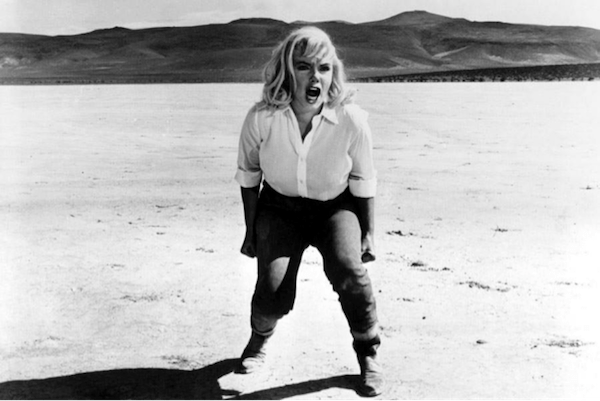
When Huston yelled, “Action,” Monroe began screaming in a
voice never heard by her fans in a powerful performance unlike any of her
previous roles. In a still photograph by Inge Morath, Monroe stands with her
legs spread apart, her torso leaning forward in rage, her fists clenched at her
side. Her head is thrust forward with her mouth open. Her forehead is furrowed,
her hair hangs limp with perspiration. No longer is she the sex symbol pin-up; instead,
she is a serious, dramatic actress. This photograph evokes the impact Huston
could have achieved through a close-up. The extreme distance of Huston’s camera
minimizes Monroe’s effect by recording a fraction of her intensity; had Huston
filmed this powerful performance in a close-up or used the alternate medium
shot, Monroe arguably may have been nominated for an acting award.
Journalist W. J. Weatherby observed Monroe filming the scene
several times as she was “jumping in and out of a state of high emotion without
any preparatory passages.” He wrote that the “wear and tear” on her psyche
“must have been savage.” Between takes, Weatherby described Monroe as a boxer
in the corner of the ring, waiting to come out fighting when the bell sounded.
On a Paramount soundstage in New York, Monroe filmed a critical scene with Wallach. Believing Roslyn’s relationship with Gay has ended, Guido asks her to give him a reason to double-cross his friend and release the roped horses. Monroe’s speech is poignant as she confronts Wallach’s selfishness with disgust and acrimony:
You, a sensitive fellow…so sad for his wife.
Crying to me about the bombs you dropped and the people you killed. You have to
get something to be human? You never felt anything for anybody in your life.
All you know is the sad words. You could blow up the world and all you’d feel
is sorry for yourself.
“Gable has never done anything better on screen, nor has
Miss Monroe,” heralded the New York Daily News. “It is a poignant
conflict between a man and a woman in love, with each trying to maintain
individual characteristics and preserve a fundamental way of life.” Saturday
Review lauded The Misfits as a “powerful experience…” with
“characters at once more lifelike and larger-than life than we are ordinarily
accustomed to in American movies…[Monroe] gets pathos into the role, and a very
winning sweet charm into a great many of her scenes. She shows range, too, and
it can be plainly announced that acting has by no means spoiled Marilyn Monroe.”
“A picture that I can only call superb…” proclaimed New
York Herald Tribune. “There is evidence in the picture that much of it has
a personal relationship to Miss Monroe, but even so her performance ought to
make those dubious of her acting ability reverse their opinions. Here is a
dramatic, serious, accurate performance; and Gable’s is little less than great.
Can anyone deny that in this film these performers are at their best? You
forget they are performing and feel that they ‘are.’”
In his column for The Village Voice, Jonas Mekas penned a review in the rhythm of a Beat poem. It remains one of Monroe’s best critiques and insinuates the film’s appeal to the counterculture:
Marilyn Monroe, the Saint of Nevada Desert…A woman that has known love, has known life, has known men, has been betrayed by all three, but has retained her dream of man, and love, and life…She finds love everywhere, and she cries for everyone, when everybody is so tough, when toughness is everything. It’s MM that is the only beautiful thing in the whole ugly desert, in the whole world, in this whole dump of toughness, atom bomb, death…All the tough men of the world have become cynics, except MM. And she fights for her dream, for the beautiful, innocent, and free…It is MM that tells the truth in this movie, who accuses, judges, reveals. And it is MM who runs into the middle of the desert and in her helplessness shouts…in the most powerful image of the film.
Arguably, the film’s failure stemmed from the fact that Miller and Huston did not deliver the product audiences expected. The Misfits appeared as a Western at face value but did not follow the formula of the genre. The dialogue and theme more closely resembled the French New Wave of filmmaking exemplified by Jean-Luc Godard’s Breathless (1959), Alain Resnais’ Hiroshima, Mon Amour (1959), and the Italian style perfected by Federico Felini in films such as La Dolce Vita (1960). Ultimately, as iconic figures, the leading stars and their repertoire of films following the Hollywood studio formula drew an audience with a high expectation for entertainment congruent with those iconic images and their previous work.
Rock Hudson presents the Golden Globe to Monroe in March 1962.
The Misfits earned increased acclaim over time as the film industry evolved. Today it seems an outlier in 1960s cinema and representative of films made during the 1970s and 1980s. In evaluations by modern critics, the film embodies the advent of the “indie” film, now commonplace. Although Gable and Monroe’s performances did not garner award nominations, Gable’s is posthumously hailed as his best, and Monroe received the Golden Globe for Female Film Favorite of 1961.
The last scene of each star’s last completed film. Roslyn: How do you find your way back in the dark? Gay: Just head for that big star straight on. The highway is under it. It’ll take us right home.