Silver Screen Standards: Ruby Keeler in 42nd Street (1933)
Every time I watch 42nd Street (1933) I fall in love with Ruby Keeler all over again. Just like Peggy Sawyer, the character she plays in the movie, Keeler was a bright newcomer getting her big break; although she had been dancing on stage since she was barely a teenager, she was a new face in Hollywood, just getting started in films after marrying the much older Al Jolson. In 42nd Street, she appears in a veritable mob of Hollywood stars, but she still manages to shine brightly enough to attract our attention, even with roguish charmers like Ginger Rogers and Una Merkel hamming it up. She might not be the greatest singer or even the most talented tap dancer, as she herself admitted, but Ruby Keeler is the sweetheart soul of 42nd Street, the youngster destined to be a star.
Peggy makes her debut in Pretty Lady not as an anonymous chorus girl but as the leading lady of the show.
Keeler’s character, Peggy, strikes it lucky when she arrives at the casting call for Pretty Lady and makes some important new friends. First, she meets juvenile star Billy Lawler (Dick Powell), who takes a shine to her right away. Experienced chorus girls Ann (Ginger Rogers) and Lorraine (Una Merkel) help Peggy make it through the first cuts, and she eventually lands a spot in the chorus, where she rehearses to exhaustion for obsessive director Julian Marsh (Warner Baxter). Peggy also becomes an accidental participant in the romantic difficulties of vaudeville performer Pat Denning (George Brent), whose former partner and girlfriend Dorothy Brock (Bebe Daniels) has the starring role in Marsh’s show thanks to her current wealthy benefactor (Guy Kibbee). When a drunken Dorothy becomes jealous of Peggy’s friendship with Pat, their confrontation has dramatic consequences for both of them, which culminates in Marsh’s iconic speech, “You’re going out a youngster, but you’ve got to come back a star!”
Busby Berkeley’s choreography makes the most of eye-popping optics and prurient imagery as only a pre-Code musical can.
Along with costar Dick Powell, Keeler represents the plucky but innocent aspect of Depression Era America, a necessary reminder to the downtrodden not to lose hope in spite of widespread suffering. They might seem a bit too saccharine for some modern viewers, but their sweetness is an important part of the mix that makes up the whole of the early 30s Hollywood musical. As a Pre-Code picture, 42nd Street gets away with plenty of innuendo and exposed female flesh, but Peggy and Billy balance that element with a friendship that grows into chaste romance. Ironically, it’s Billy who is caught in his underwear at their first meeting, a nice counterpoint to the scores of scantily clad chorus girls who appear throughout the picture. Peggy has sexually charged encounters with other men, but neither of them amounts to much. Pat Denning seems drawn to her in spite of his relationship with Dorothy, and Julian Marsh kisses her in order to inspire her to perform a scene properly (also perhaps to mark the character as heterosexual because he was originally depicted as gay in Bradford Ropes’ 1932 novel). With her slim, clean figure and doe-eyed face, Keeler is the quintessential ingénue, but the more experienced characters support and protect her rather than tear her apart. Even Dorothy, the star whose place Peggy takes, shows up to encourage her on opening night. It might seem strange, but it has the same value as the kindness inevitably shown to a Shirley Temple heroine; in a ragged world of poverty and strife, people want to see something untarnished and pure survive. Keeler is so appealing that we understand the other characters’ reaction to her; she radiates a particular kind of star power, a soft but unadulterated light.
Despite the romantic mood, the relationship between Peggy and Pat Denning (George Brent) turns out to be mere friendship.
Ruby Keeler’s career depended on roles that made the most of that luminous quality, which limited her options, and after her divorce from Al Jolson in 1939 she made very few appearances in films. In the wake of the financial success of 42nd Street, however, there was a brief wave of great Ruby Keeler musicals: Gold Diggers of 1933 (1933), Footlight Parade (1933), and Dames (1934). All of them costar Dick Powell, with whom Keeler would make seven pictures for Warner Bros. Other members of the cast also return for some of the later productions, including Ginger Rogers, Guy Kibbee, and Ned Sparks, although Footlight Parade is particularly notable for adding James Cagney in a leading role and reuniting Keeler with 42nd Street director Lloyd Bacon. Each of them offers a similar mix of showbiz life, musical numbers, comedy, and romance. The later Gold Diggers movies, Gold Diggers of 1935 (1935) and Gold Diggers of 1937 (1937), repeat the same formula with Dick Powell continuing to star but Keeler no longer appearing. She made only one movie with Al Jolson, Go into Your Dance (1935), but her other films with Powell include Flirtation Walk (1934), Shipmates Forever (1935), and Colleen (1936). After Sweetheart of the Campus in 1941, Keeler disappeared from the movies; she remarried in 1941 and settled down to raise four children with her second husband, John Homer Lowe, in addition to the son she had adopted while married to Jolson. Her marriage to Jolson ended so badly that Keeler refused to let her name be used in the 1946 biopic, The Jolson Story, which replaces her with a fictionalized character named Julie Benson (played by Evelyn Keyes).
Peggy (Ruby Keeler) gets an assist from chorus girls Lorraine (Una Merkel) and Ann (Ginger Rogers).
Keeler’s filmography might lack the breadth and depth of Hollywood legends like Bette Davis or Katharine Hepburn, and her early costar Ginger Rogers had a much longer and more varied career, but there’s something about her that always gets to me. Her best musicals from the early 30s are a sure-fire tonic for whatever ails me, and 42nd Street is the movie that first shared her sweetness and light with the world. She really did come back from that outing a star, and she still shines brightly whenever I make a return trip to the bawdy, gaudy backstage world of 42nd Street.
As a huge classic movie fan, I find myself counting the days until the TCM Classic Film Festival that takes place in Hollywood every spring — for us fans it’s like the movie version of Woodstock. I’ve attended every festival since it began in 2010, and have gotten the chance to hear from so many of the greats, including people like Angela Lansbury Kirk Douglas, Jane Powell, Julie Andrews, Christopher Plummer, Maureen O’Hara, Debbie Reynolds, Liza Minnelli, Tony Curtis, Pam Grier, Faye Dunaway, Kim Novak, Mel Brooks, Barbara Rush, Luise Rainer, Dustin Hoffman, Sophia Loren, Mickey Rooney, Nancy Kwan, Betty Garrett, Esther Williams, Warren Beatty, Tippi Hedren, Burt Reynolds, Leslie Caron and so many others including directors Stanley Donen, Martin Scorsese, and William Friedkin. That list is just off the top of my head, I’m sure I’m leaving out dozens of my favorites who have attended the festival, many of them no longer with us. Fans come from all over the world to attend this spectacular event which this year begins on Thursday, April 13th, with the world premiere restoration of Howard Hawks’ 1959 film Rio Bravo. One of the film’s stars, Angie Dickinson, will be in attendance at the gala opening at the world-famous Chinese Theater on Hollywood Boulevard along with Steven Spielberg and Paul Thomas Anderson who will be talking about the important work of the Film Foundation that saves so many of these classic movies.
Eddie Muller & Dave Karger
There will be over 80 films and presentations at this year’s festival which lasts until Sunday, many of them running concurrently at several different theaters in Hollywood so festivalgoers are forced to make many difficult choices over the course of the four days. In preparation for Thursday’s opening, I had a great time talking to two of my favorite TCM hosts this week, the “Czar of Noir,” Eddie Muller, and Dave Karger, about what they’re most looking forward to.
Danny Miller: It’s kind of ridiculous how much I look forward to the festival all year long. I’m part of a Facebook group related to the fest and we talk about it for months beforehand, as soon as the first little bits of info are released. As longtime TCM hosts, do you get a say in the program? Do you share your wish lists with Charlie Tabesh and the other people planning the festival?
Eddie Muller: Putting this festival together is very tricky because you have to take so many different factors into account. Producing my own Noir City festival around the country, I know how difficult it is to balance everything. But yes, I make suggestions to Charlie all year long and then we see if they fit the theme or need to be saved for later. Over the years, Charlie has been very accommodating to my suggestions!
Dave Karger: Charlie and the people on the programming team are the real geniuses of the festival. My favorite part comes after the lineup is settled. They invite us to let them know who we would love to interview and which films we want to introduce. It’s so fun to see the schedule take shape and figure out who I’m going to talk to — and I have some really exciting people that I get to interview this year!
Who’s on your docket?
Well, you know I’m a big musical guy, I absolutely love musicals, so you can imagine how thrilled I am that I’m going to be interviewing Ann-Margret on Saturday at the Bye Bye Birdie screening.
Ooh, lucky! But don’t remind me of the nightmare choice we all have to make during that time slot because it’s at the same time as Crossing Delancey, which I also love, being introduced by Amy Irving and Peter Riegert.
Oh, I know, these choices are so difficult! I’m also going to talk to Shirley Jones after The Music Man.
Wow, classic movie musical royalty!
And there’s going to be a little bit of a surprise during that interview, but I can’t tell you what it is.
Oh my — I’m imagining Ron Howard coming out and singing “The Wells Fargo Wagon” with his big sister, Shirley Jones?
Haha, I can neither confirm nor deny! Also, I’m really excited that I get to interview Frankie Avalon before the poolside 60th anniversary screening of Beach Party on Friday night. As someone who was five years old when Grease came out, I am beyond thrilled, and I feel like Didi Conn about to talk to Teen Angel during “Beauty School Dropout.” It kind of blows my mind, I’m going to try very hard not to dork out with Frankie!
What films are you looking forward to introducing, Eddie?
Well, of course I’m introducing a couple of great noir films such as The Killers and Sorry, Wrong Number, and I love those movies, but I also love getting out of my usual niche at the festival, it’s such a fun opportunity to do that. I’m very excited about introducing a 70mm print of Sam Peckinpah’s The Wild Bunch and a restored 75th anniversary version of Powell & Pressburger’s gorgeous The Red Shoes.
Oh, fun. I look forward to having the spectacular Technicolor of The Red Shoes hurt my eyes, I love that movie.
And I’m very happy to be presenting Joan Micklin Silver’s Crossing Delancey and to talk to Amy Irving and Peter Riegert, who don’t do this kind of thing very much.
Ann-Margret in Bye Bye Birdie, Amy Irving, and Peter Riegert in Crossing Delancey
Oh God, that choice again! I worship both Bye Bye Birdie and Crossing Delancey and I think because I’ve already seen Ann-Margret talk about the former at an Academy screening, I’ll have to head to Delancey. Sorry, Dave!
Dave Karger: Don’t worry, I understand! Some of these choices are impossible!
Eddie Muller: I’m really looking forward to talking to Amy and Peter. It’s a little weird because I just happen to be very good friends with Peter Riegert’s wife so I’ve met him but have never talked about this film with him.
I always tell everyone, “Marry the Pickle Man!” I was hoping that they’d show a double feature of Crossing Delancey and Joan Micklin Silver’s other fantastic movie about American Jews, Hester Street.
Now you’re thinking like a programmer! That would be a great double bill.
Oh, you should hear our constant debates about which films should be shown. As you know, classic movie fans never lack for strong opinions!
Haha, yes, I know!
Like the other day on Doris Day’s birthday, I started obsessing on her very hard-hitting film with Ginger Rogers about the KKK called Storm Warning and wishing they’d show that at the fest.
Fantastic movie. I’m showing it later this year on Noir Alley on TCM with a new intro, but it’s also screening on the network this month because of the Warner Bros. centennial which we’re also celebrating at the festival. It’s one of the great Warner Bros. films that has been restored by the Film Foundation. And Doris is so wonderful in it. I’ve read some criticism by people saying that she and Ginger Rogers are not believable as sisters, but I could not disagree more. Do you know a little piece of Doris Day trivia concerning that film?
No, what?
Of all her movies, it’s the only one in which she dies.
Spoiler alert! So interesting, even though she’s come close in a bunch of other movies. I’ll definitely be there on Sunday morning to watch her being terrorized in Hitchcock’s brilliant The Man Who Knew Too Much at the Chinese. I know it’s an impossible question, but do either of you have a dream interview, alive or dead, that you wish you could do at the festival?
Dave Karger: That is a tough one! The first thing that comes to mind is how sad I am that I never got to meet Cary Grant or Randolph Scott, they’re two of my absolute favorites. Of the living, I would love to talk to Harrison Ford even though I know he can be a challenging interview. I hope to talk to him at the festival some day and show some of his lesser-known films such as The Conversation or The Mosquito Coast or maybe even Witness — something that is not part of a big franchise. And then, because I’m such a 1980s person, I’d love to have Molly Ringwald at the festival as we expand the scope of what is considered classic. As you’ve noticed, we have some films from the 80s and 90s this year, and even a film from after 2000, A Mighty Wind. I think there’s definitely room for someone like Molly at the festival.
I totally agree, the crowd would love it. I love the idea of showing The Mosquito Coast and you could also bring in Martha Plimpton who is so interesting talking about her career as a young actress.
Oh my God, that would be fantastic!
Barbara Stanwyck
Eddie Muller: My absolute dream, which is obviously impossible since she is no longer around, would be to do a full-on in-person tribute to Barbara Stanwyck, in my view the greatest actress in motion picture history. Wouldn’t it be something to do a retrospective of her films, from the pre-Codes of the early 1930s all the way up to the end, and have her there the whole time talking about her movies?
Oh lord, I’d get in line a year in advance. My 13-year-old son’s bedroom is lined with pictures of Stanwyck, she’s a favorite in my house, and she really helped to get us through the pandemic.
It sounds like you’re doing good work as a parent!
Have you noticed any shifts in the demographics of the festival over the years? I’m always excited to see younger people there, as obsessed about the classic movies as we are.
I have. I’m surprised and delighted to see how the festival draws an increasingly younger audience each year. I’m also very happy about the strength of the African American audience that attends. I’ve gotten to know many of these diehard fans who come from all over the country. That audience has only grown since I started doing the festival and the TCM cruises.
Dave Karger: I love seeing people of all ages. One thing I have really liked that they’ve done lately is invite local students to come including from USC and other local universities. That’s exciting to me because it will keep classic film alive way longer than we’re going to be around.
Yes, totally. That made me remember a festival screening of Children of a Lesser God a few years ago that Marlee Matlin invited a lot of young deaf students to attend. They loved the film and I really believe their interaction with Marlee may have changed some lives — I can see some of those kids deciding to go into the arts after that inspiring screening and discussion.
Absolutely. And how wonderful if we can be a tiny part of something like that. I’ve interviewed Marlee Matlin before and it was a total joy.
Robert Osborne at the TCM Classic Film Festival
I think you two and all the current hosts do such a great job on the network and at the festival, but of course the memory of the great Robert Osborne still looms large. Did your time at TCM overlap with his?
I actually met Robert for the first time in 2007 when I was working at Entertainment Weekly. I was invited to go down to Atlanta and co-host with Robert as part of the 31 Days of Oscar. We spent the whole day together and really hit it off, I really connected with him. What ended up happening was that when he was still alive, but too Ill to film his segments, he actually gave the blessing for me to fill in for him. I have him to thank for my role at TCM.
Eddie Muller: I definitely credit Robert with getting my gig at TCM. Did you know that before TCM started he used to run his own film festival? He invited me to come introduce some movies there, I remember talking with him at a screening of Double Indemnity and it was like getting an audience with the Pope! It was a wonderful experience and the cherry on top was that the person who was supposed to introduce Robert’s favorite movie, All About Eve, which we’re also showing this year, didn’t show up and he asked me if I wanted to do it with him. I don’t know that movie nearly as well as he does, but boy, did I get an education including on how to deal with people so beautifully in a public situation. Robert was so kind to me, we got along famously. And, I have to point out, and I don’t mean to be weird about this, but the day that I began my regular Noir Alley gig on TCM, March 6, 2017, was that day that Robert died.
Oh wow, that’s so meaningful, I’m sure he was looking down on you.
He was just a wonderful guy. Even though I had already been doing my own festivals and screenings for seven or eight years before I met Robert, I learned more in 10 minutes on stage with him than I did in all that time. Just watching him and understanding how he handled a microphone, how he sat on the stage, how he would bring another person into a conversation — that was the best education I could ever get. He always said that the point was not to try to impress upon people how much you know about movies, and he knew plenty, the point was to make people feel good about being there to watch a movie together.
The TCM Classic Film Festival takes place in Hollywood from Thursday, April 13 to Sunday, April 16. Click here to see the schedule of this year’s films and events.
Richard Michael “Mickey” Daniels was born on October 11,
1914, in Reliance, Wyoming, to Richard and Hannah Reese Daniels. Per his draft
card, his birthplace is listed as Reliance. He was one of eleven children in
the family, with siblings Ruth, Clifford, Adele, Leonard, Louise, Elsie,
Margaret, Sarah, Melvin, and Edgar. His father was of Welsh descent and had a
background as a miner.
Daniels grew up in Rock Springs, Wyoming, where he was
spotted at the Rialto Theatre during an amateur variety show. Gene Kornman,
photographer and father of Our Gang player
Mary Kornman, was a friend of the Daniels family and recommended freckled,
red-haired Daniels as a possible addition to the cast.
A young Mickey Daniels
Daniels was soon signed to the Our Gang series as one of the lead children, appearing in the shorts from 1922 through 1926. Daniels’s distinct laugh was featured in numerous Our Gang shorts and was also captured as a stock sound used throughout various other Hal Roach productions, namely dubbed in as an animal’s guffaw. He could also be spotted in various other Hal Roach films, even appearing alongside Harold Lloyd in Safety Last!(1923) and Girl Shy(1924). His father also appeared in several Our Gang shorts with him, in addition to Roach’s Girl Shy. His brother, Leonard worked for Roach in the studio’s transportation department.
When his time at Our Gang came to a close, he performed in vaudeville and also in a wide range of bit parts in feature films. In 1930, Daniels transitioned to The Boy Friends, produced by Roach featuring a cast of teenagers. The series of short subjects ended in 1932. He also carried out minor roles in It Happened One Night (1934); Magnificent Obsession(1935); and The Great Ziegfeld (1946), among other film roles. In 1932, his name appeared in several newspapers noting an engagement to Dorothy Mattice, which was called off.
Mary Kornman and Mickey Daneils in Air-Tight (1931)
By the 1950s, Daniels was no longer working in the film
industry. His draft card states that his employer was “Louis Meyer, Inc.,” but
this was crossed out to read “Kaiser Shipyards.” He worked in construction
engineering. The card cites him as having a scar on his upper-left lip and also
notes that he had a wife named Esther; additional sources point to him having a
daughter named Diane.
After struggling to get roles, Daniels became disenchanted
with Hollywood and depressed. He drank heavily during this period and gambled, while
spending time living with his brother. He also took on several construction
jobs overseas, participating in construction projects in Europe, Pearl Harbor,
and Africa. His niece, Marlene Fund, remembered him as a fun uncle. She also
recalled him partying and carousing at night, with him often getting kicked out
of the house, as a result. In the mid-1960s he was traced in Tasmania working
as a materials supervisor at an iron ore mine for the Bechtel Pacific Group
under the name of Mike Daniels. By that time, he was divorced and his ex-wife,
daughter, and grandson were all living in Los Angeles.
Beyond this point, Daniels was quite difficult to track. His
childhood co-stars could not locate information about him for the documentary Our Gang: Inside the Clubhouse (1984),
being unable to confirm a rumor that he had passed away overseas. Tragically,
21 years after his passing, details about his final years came to light. He
returned to the states and lived in a San Diego, California, motel, working as
a taxi driver for Red Top Taxi Cabs during his final three years. He passed
away alone in the motel on August 20, 1970, from cirrhosis. His cremated
remains went unclaimed during those 21 years until they were recovered and
buried near his parents’ graves at Forest Lawn Memorial Park—Glendale in
Glendale, California, in an unmarked grave. Film fan Bob Satterfield raised
money for a headstone in honor of Daniels, which was unveiled and dedicated on
September 27, 2019.
Few tributes to Daniels exist today. The Rialto Theatre,
where he was discovered, stood at 314S. Front St., Rock Springs, Wyoming. It
has since been razed.
In the 1920s, the Daniels family resided at Ahsay Ave. in
Rock Springs, Wyoming. This home has since been razed, though Ahsay Ave.
remains. By 1930, the Daniels family relocated to 3911 ½ S. Harvard Blvd., Los
Angeles, California. At this point, Daniels was already an actor. The home
would remain in the family for years to come, as Daniels’ wife, Esther, is
cited as living at this address in 1940. The home still stands today.
3911 ½ S. Harvard Blvd., Los Angeles, California
In 1940, Daniels was residing at 1213 N. Ainsworth Ave.,
Portland, Oregon, while he was working at the Kaiser Shipyards. This home also
remains.
1213 N. Ainsworth Ave., Portland, Oregon
In 1950, he lived at 308 S. Holt St., Los Angeles,
California, which no longer stands.
The most poignant tribute to him is the marker at his final resting place, thanks to funds contributed to the fans that enjoyed his on-screen performances.
Annette Bochenek, Ph.D., is a film historian, professor, and avid scholar of Hollywood’s Golden Age. She manages the “Hometowns to Hollywood” blog, in which she profiles her trips to the hometowns of classic Hollywood stars. She has also been featured on the popular classic film-oriented television network, Turner Classic Movies. A regular columnist for Classic Movie Hub, her articles have appeared in TCM Backlot, Silent Film Quarterly, Nostalgia Digest, The Dark Pages Film Noir Newsletter, and Chicago Art Deco Society Magazine.
A trio of films bring to life Richard Matheson’s ‘I Am Legend’
The idea of the last man or woman on earth spurs my imagination.
How will it happen? When will it happen? Why will it
happen?
“Germs. Bacteria. Viruses. Vampires.”
That’s author Richard Matheson’s excellent answer to the “why” in I Am Legend, his post-apocalyptic novella set in a world decimated by a mysterious virus. The already intriguing subject is made even better with Matheson’s addition of my favorite creature – the vampire.
Since it was published nearly 70 years ago, his novella has been the source material for three films: The Last Man onEarth (filmed in Rome in 1964 as L’ultimo uomo della Terra) starring Vincent Price, The Omega Man (1971) with Charlton Heston, and I Am Legend (2007) starring Will Smith. (Yes, that’s a much newer film than we write about in Monsters and Matinees, but it’s important to include here.)
Vincent Price arms himself with tools to destroy the plague vampires in The Last Man on Earth.
Matheson wrote I Am Legend in 1954 and set it in January of 1976, five months into a mysterious illness.
Robert Neville is a 36-year-old researcher who has immunity
to whatever is causing a pandemic that has wiped out the world, turning the few
survivors into vampires.
Through Robert’s first-person account we learn about the
“before days” and his happy life with his wife and young daughter, the early signs
of a disease spreading wildly overseas and worries of whether it can get to the
United States. A newspaper headline asks “Is Europe’s disease carried on the
wind?” Yes, it is.
The story – and movies – will jump between those terrifying
early days as frightened people succumb to the disease and Robert’s current
life battling the nightly vampire attacks and his own demons.
Vampire/zombies, including an old friend, taunt Robert (played by Vincent Price) nightly despite the crosses, garlic and mirrors he puts on doors at his home in The Last Man on Earth.
He turns his home into a mini fortress with slats over
windows and garlic and mirrors at the doors to ward off the vampires. One room
“belongs to his stomach,” filled with canned goods and the like. By day, he
hunts the creatures while loading up on gas and supplies. He harvests garlic
from his hothouse, creating an overwhelming and sickening stench. At night, Robert
eats, drinks heavily and plays his records to drown out the taunting cries from
the undead.
He reads Dracula and muses philosophically about vampires (during the early days, there were reports of vampires that many, including Robert, scoffed at believing) and continues to valiantly search for a cure. And he inexorably talks about the passage of time, watching the minutes slowly pass by.
It’s surprisingly sad to watch.
“A man could get used to anything if he had to,” Robert
says, but who is he kidding? Not us.
Of course he hopes to find other survivors, but, like most post-apocalyptic thrillers with a last-person/people-on-earth theme, it’s not all good when he finds them.
In The Omega Man, Charlton Heston battles the mutant humans while nattily dressed in a green velvet jacket and ruffled shirt.
The movies
That’s the basic plot of the story that’s followed at least loosely in the films: Something wipes out most of humanity leaving the few survivors as vampires/killers/mutants except for one man who has immunity and fights for his survival and a cure. If that intrigues you, I highly recommend the movies even knowing that Matheson wasn’t particularly happy with them because, well to be honest, I really get into them.
Will Smith and the family dog sleep in a bathtub while the “Darkseekers” scream outside.
You don’t need to watch them in any order; pick your favorite actor of the three if you like and start watching.
Each film is set in the time it was made (The Omega Man is very much a film of the ‘70s in style and music) and has a different explanation on what caused the virus (bacterial plague, biological warfare etc.).
Three years into a plague, Woodstock remains the only movie Robert (Charlton Heston) can watch in The Omega Man.
The three versions of Robert are similar in that they are intelligent men with backgrounds in research, science and the military which provide them the unique skill sets to survive. Otherwise the actors give him a different personality: Price brings a weariness and pitifulness to his character (renamed Robert Morgan); Heston has a sexy confidence and swagger (it’s amusing how often his shirt is off); Smith is steadfast and loyal.
Rosalind Cash
Outside of Robert, the casting is minimal.
Only The Omega Man is notable with Anthony Zerbe as the creepy mutant leader; Rosalind Cash as a tough survivor whose appearance gives the film an interracial romance that I only note because it was so rare at the time; and a young Eric Laneuville as her little brother.
The infected are portrayed in different manners and gain
strength, speed and aggression with each film.
Director George A. Romero was reportedly inspired by the zombie-like undead in The Last Man on Earthfor his influential zombie film Night of the Living Dead.
In The Omega Man, they seem human, but the virus has
given them albino characteristics of white hair and skin – marked by red burns
from the sun – which are a contrast to their dark clothing and hooded capes. They
also possess a violent mob-like mentality and are a cult – a “family” – that destroys
culture (books, art) from the evil “before time” that they blame on Earth’s
current state. If you aren’t a family member, like Robert, you will be hunted
and killed.
Anthony Zerbe, left, plays the violent leader of mutants who were left sensitive to light and with albino qualities in The Omega Man.
By I Am Legend, they are very much a monster. Lightning fast and extremely violent, they have a fiendish appearance – fake fiend, that is.
These computer-generated images look like they were created by a computer and that’s never good. They’re only scary because of the high-pitched demonic screams created by Mike Patton, former lead singer of the metal band Faith No More.
In interviews about the film, Patton said he spent “four straight hours of screaming my head off” while improvising in front of a movie screen. He works; the CGI doesn’t. What makes it worse is that the filmmakers switched to using CGI for the creatures early in the filming because they didn’t think actors worked.
Watching these three film versions of Robert battle demons – an undead wife at the door, a mob building a two-story bonfire to draw him out to his death or the hounds of hell waiting to pounce when the sun goes down – are a few examples of the horror in his world.
A stray dog brings companionship and joy to Vincent Price in The Last Man on Earth.
But there’s another type of horror Matheson is writing about that is profoundly human. Robert Neville is a man alone and consumed by a terrible loneliness that is its own horror. That loneliness leads to the loss of a person’s humanity and a craving for contact even with a dog (an important character in the book and movies) or an inanimate object like a statue or mannequin. They are all used to great dramatic and emotional effect as surrogate companions or possible enemies. (Is that a mannequin or a person?).
Watch Price’s reaction to a stray dog, Heston get dressed up for Sunday dinner and conversation with a bust of Caesar and Smith carry on one-sided conversations with mannequins, pleading with one to simply “say hello to me.” Don’t be surprised if it gets to you – it’s supposed to. Ultimately, I Am Legend in all of its forms is about humanity.
Mannequins are a safe distraction for our hero in The Omega Man – until one of them moves.
A ‘Legend’ sequel
What happens when your
alternate ending to a film is nearly perfect, yet you don’t use it?
You base a sequel off it nearly 20 years later.
I Am Legend writer and producer Akiva Goldsman recently announced that a sequel to his 2007 film is in development with Will Smith reprising his role and Michael B. Jordan joining the cast.
Will Smith comes face-to-face with a leader of the “Darkseekers” in a scene from the superior alternative ending for I Am Legend.
Though the film made near $600 million worldwide, it was criticized for straying from Richard Matheson’s 1954 novella especially with its cheesy epic Hollywood ending that goes big and dumb. (OK, those are my words.)
Without spoilers, the Smith character has been experimenting on “Darkseekers” to find a cure. When his laboratory is attacked, a kid could figure out the connection between the Alpha female Smith has captured and the angry Alpha male. What happens next is ridiculous, but it sounds like that will be amended with the new film.
Goldsman told Deadline that the sequel will work off of that alternate ending and be set about 20 years later. (Think the structure of HBO’s The Last of Us, which Goldsman says he is “obsessed with.”)
“We trace back to the original Matheson book, and the alternate ending as opposed to the released ending in the original film,” Goldsman said in the interview. “What Matheson was talking about was that man’s time on the planet as the dominant species had come to an end. That’s a really interesting thing we’re going to get to explore. There will be a little more fidelity to the original text.”
If the film is how Goldsman describes it, this is one sequel I am looking forward to seeing.
Vincent Price battles vampires created by a plague in The Last Man on Earth.
Toni Ruberto, born and raised in Buffalo, N.Y., is an editor and writer at
The Buffalo News. She shares her love for classic movies in her blog, Watching Forever and is a
member of the Classic
Movie Blog Association. Toni was the president of the former Buffalo
chapter of TCM Backlot and now leads the offshoot group, Buffalo Classic Movie
Buffs. She is proud to have put Buffalo and its glorious old movie palaces in
the spotlight as the inaugural winner of the TCM in Your Hometown contest. You
can find Toni on Twitter at @toniruberto.
“I’ve never known a congenital wise-guy yet that didn’t outsmart himself.”
Sterling Hayden never quite fit. Primed for stardom at the height of the studio system, he was dubbed “The Beautiful Blond Viking God” by Paramount Pictures and dropped into star-studded dramas like Virginia and Bahama Passage (both 1941). The sales pitch didn’t stick. It was audiences that were reluctant to embrace the “Viking God,” mind you, it was Hayden himself. He felt like a phony, and decided to reestablish his personal standard of authenticity by fighting in World War II.
Hayden was gone for a whopping six years, and when he returned to the states, he had a fresh outlook on Hollywood. “I feel a real obligation to make this a better country,” he told the press. “And I believe the movies are the place to do it.” Hayden made good on his word. During the 1950s, he starred in a series of noir films that rank among the most acclaimed and influential of all time: The Asphalt Jungle (1950), Crime Wave (1954), and The Killing (1956), just to name a few. These films were narrative and stylistic triumphs, but more importantly, they allowed Hayden to craft a screen persona that was authentically him: contemplative, craggy, and deceptively cunning. The “Viking God” was a mortal the whole time. Albeit, a very intimidating one.
The film’s original poster.
The transition from matinee idol to genre icon didn’t happen overnight. Hayden had some years in the wilderness, where he struggled to make sense of what kind of actor he should be, which is what makes 1949’s Manhandled such an interesting watch. It was only his third film back from military service, and it perfectly straddles the line between the actor he was and the actor he would become.
Hayden is actually third-billed in Manhandled, behind Dan Duryea and Dorothy Lamour. The latter two were at the height of their office appeal, and they dominate the first act of the film accordingly. Merl Kramer (Lamour) is a psychiatrist’s secretary who overhears a patient discussing uxoricide. She finds it interesting enough to mention to her boyfriend, private detective Karl Benson (Duryea), not realizing that Karl is desperate enough to do something about it. Karl bumps off the patient’s wife and steals her jewels under the assumption that he can frame the patient. If that doesn’t work, he can pawn the whole thing off on Merl.
Duryea’s character schemes his way into a jewelry heist.
It’s a novel premise that quickly gets confusing to follow. It’s unclear who actually committed the murder for most of the film’s runtime, even though we know Karl is hiding the jewels. There’s also the discovery that Merl faked her credentials to get the secretary job, which momentarily casts doubt on her motives, but is quickly walked back when it’s revealed that Karl faked the credentials and sold her on the idea of them being legitimate.
Enter Joe Cooper (Hayden). He arrives at the scene of the murder before the police, but he’s still changing out of his pajamas. He’s technically an insurance investigator, tasked with recovering the stolen jewelry, but he works the crime scene with such conviction that he elbows the police out of the way. Lt. Dawson (Art Smith), the man in charge, has to tell Cooper to take it down. It’s a wonderful introduction for the character, instantly setting him up as a hero who’s thorough without being stiff.
Lt Cooper (right) casts a suspicious eye on Karl.
Hayden is much looser than he would go on to be in aforementioned classics like Crime Wave and The Killing. In those films, he projects disdain to such a degree that it’s hard to imagine either character ever being happy. The cop he plays in Crime Wave is trying to quit smoking, and the tightly-wound energy is palpable as he leans on ex-cons for information. In Manhandled, however, the actor is amused by the happenings around him, and takes the opportunity to flaunt his detecting skills in front of his policeman peers. It’s fun to watch because he seems to be having fun.
Eventually, Cooper and Dawson team up, resulting in a broad yet effective scene in which the two men agree to take a pharmaceutical mixture of downers. They’ve determined that the alibi provided to them by the patient may have been falsified thanks to some medication, so they test the concoction for themselves. The only problem is, Cooper took the right combination and Dawson took the wrong one, which means the latter struggles desperately to stay awake while they pursue a lead. This sort of comedy can go awry in a film noir, but the chemistry between the actors and the application of it within the larger story makes it work surprisingly well.
Hayden is the film’s stylish moral center.
Manhandled is no lost classic, as it loses steam towards the backend, but it does provide ample room for its three stars to shine. Duryea does sleazy better than pretty much anybody, and Lamour, while mostly foreign to the film noir landscape, does a fine job of playing a hard-bitten victim. Still, it’s Hayden that steals the show here. He’s bursting with energy in each scene, most of which open with him haphazardly changing out of his pajamas.
He proves that he still has some romantic chops during the nightclub sequence with Lamour’s character, and he manages to rile Duryea’s crooked detective despite only crossing paths with him a few times. The film is a fun watch in isolation, but it plays even better as a preamble to the legendary run that Hayden would start the following year.
TRIVIA: In her autobiography, Dorothy Lamour, recalls working with the actor who played the insurance investigator. She mistakenly refers to the actor as George Reeves, when it was in fact, Sterling Hayden.
Danilo Castro is the managing editor of NOIR CITY Magazine and a Contributing Writer for Classic Movie Hub. You can follow Danilo on Twitter @DaniloSCastro.
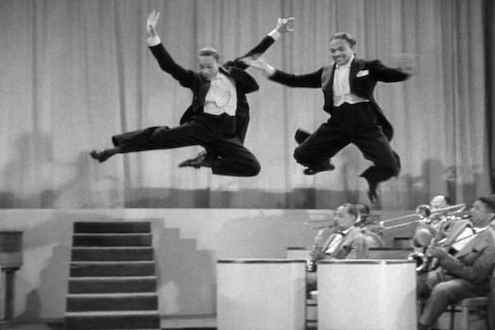
Most classic movie fans have seen The Nicholas Brothers’ showstopping performance in the 1943 film Stormy Weather. But other than that I am sure most film fans don’t know much about them. Since today is Harold Nicholas’ birthday, I thought this would be a good time to write about them.
Fayard Nicholas was born March 17, 1914 in Mobile, AL, and Harold Nicholas was born March 27, 1921 in Winston-Salem, NC. They grew up in Philadelphia. Their father, Ulysses Nicholas, was a drummer, and their mother, Viola Harden, played piano. They led a band at the Standard Theater in Philadelphia. Fayard watched them from the front row as a child and he saw all the black vaudeville acts. He was fascinated by dancers like the legendary Bill Robinson. So he imitated them.
Fayard taught himself by watching the stage performers and then imitating them. First he taught his sister Dorothy, and they performed as the Nicholas Kids. Then Harold joined the act. Dorothy dropped out and the Nicholas Brothers were born. Harold usually imitated Fayard. Their tap dancing style is called “flash dance” popularized by The Four Step Brothers and The Berry Brothers. I’m sure Fayard saw them perform.
As their fame grew, the Nicholas Brothers became the featured act at New York’s Cotton Club. Fayard was 16 and Harold was 11. While at the Cotton Club for two years, they appeared with bands led by Lucky Millinder, Cab Calloway, Duke Ellington and Jimmy Lunceford. They appeared in the 1932 short film, Pie Pie Blackbird, featuring Eubie Blake. When producer Samuel Goldwyn saw the Nicholas Brothers at the Cotton Club, he brought them to Hollywood to appear in the 1934 film Kid Millions. They appeared in the Broadway musicals The Ziegfield Follies of 1936 and the 1937 musical Babes in Arms. Famed ballet choreographer George Balanchine was so impressed that he taught them some new techniques.
The Nicholas Brothers moved to Hollywood in 1940. Their most high-profile performance was performing Jumpin’ Jive with Cab Calloway and his Orchestra in the 1943 film Stormy Weather. Other films include Down Argentine Way (1940), Tin Pan Alley (1940), The Great American Broadcast (1941), Sun Valley Serenade (1941) and Orchestra Wives (1942). The Nicholas Brothers never starred in a film. They were featured performers and their segments were removed so the films could be shown in the Southern US where there were still Jim Crow laws. But there’s no question The Nicholas Brothers were the highlight of any film they were in.
After dancing with Gene Kelly in the 1948 film The Pirate, Harold moved to France. So they didn’t perform together anymore. They were forgotten until they appeared in the 1974 film That’s Entertainment. And there was interest in them after that. They received Kennedy Center Honors in 1991. Harold Nicholas died on July 3, 2000 in 2000 and Fayard Nicholas died on Jan. 24, 2006 at age 91. Here’s Cab Calloway and his Orchestra with The Nicholas Brothers performing Jumpin’ Jive from the 1943 film Stormy Weather.
Frank Pozen writes about music, wrestling and more at his blog, Frank Pozen’s Big Bad Blog, including his AccuRadio Song of the Day post. You can follow Frank at twitter @frankp316.
George
“Spanky” McFarland portrayed the iconic leader of the Our Gang cast of children, beloved for his role as Spanky. He was
born George Philips McFarland at Methodist Hospital on October 2, 1928, in
Dallas, Texas, to Robert and Virginia McFarland. His father worked as a manager
for a loan company and, later, automobile broker. He had three siblings: Tommy,
Amanda, and Roderick or “Rod.”
Initially,
McFarland was dubbed “Sonny” by his parents and modeled children’s clothes in
department stores throughout the Dallas area. He could also be spotted in print
ads and highway billboards to promote Wonder Bread. By 1930, McFarland was
comfortable and recognizable before the camera.
McFarland as a baby
In 1931, Hal Roach Studios printed a trade magazine ad calling for photograph submissions of “cute kids.” In response to the ad, McFarland’s aunt sent over various pictures from McFarland’s modeling days. As a result, he was invited to partake in a screen test, which opened the door to a career as an actor. In fact, parts of his initial screen test were worked into the Our Gang short “Spanky” (1932). In later interviews McFarland shared that the nickname was given to him by a reporter. Per his studio contract, McFarland was given permission to use the “Spanky” name in all subsequent business and personal activities.
McFarland became a core member of the Our Gang cast at age three. Though extremely young, he was adorable before cameras, laughing and babbling his way through his earliest scenes. His character grew more outspoken as the series continued, eventually making him the ringleader of the group. As a contract player at Hal Roach Studios, he mingled with many other studio stars, including the likes of Stan Laurel and Oliver Hardy. Laurel taught him how to perform double-takes and many of his mannerisms were further inspired by Hardy.
Though McFarland appeared in numerous shorts, his only starring film role was in General Spanky(1936), produced by Hal Roach. While the film attempted to transition the Our Gang series into feature films, it was unsuccessful. Nonetheless, McFarland appeared in many other films beyond Hal Roach Studios. His younger brother, Tommy, could also be spotted in some of the shorts.
Spanky in Good Bad Boys (1940)
In 1938,
McFarland retired from Our Gang and
participated in several personal appearances. The Our Gang unit was sold by Roach to Metro-Goldwyn-Mayer, rehiring
McFarland to reprise his role. McFarland returned to Our Gang and carried out his Spanky character until his last
appearance in the series in 1942, at fourteen years old. McFarland then
attended Lancaster High School in Lancaster, Texas.
As
McFarland entered into adulthood, he served in the United States Air Force.
Upon his return, he found himself struggling to get roles in films because he
was so closely associated with the Spanky character. As a result, he took on
other careers, including working at a soft drink factory, popsicle factory, and
hamburger stand. By the 1950s, the Our
Gang shorts were syndicated on television and McFarland began hosting a
children’s show called The Spanky Show, airing
in Tulsa, Oklahoma. The show aired Little
Rascals shorts—as the Our Gang shorts
were now named in syndication—but the station deterred McFarland from expanding
his show, leading him to quit in 1960.
McFarland
continued to take on a variety of odd jobs, including selling wine, appliances,
electronics, and furniture. He also operated a restaurant and night club at one
point. He had success selling products for the Philco-Ford Corporation,
ultimate working his way up to national sales training director.
McFarland
married twice—first to Paula Jeanne Wilkinson and next to Doris Taulman
McFarland. He and Doris had three children: George Gregory McFarland, Verne
Emmett McFarland, and Betsy McFarland.
All the
while, he was still making personal and cameo appearances in films and on
television—affectionately nicknamed “Spank,” by then—with his former Our Gang peers. In 1985, also went on to help launch The Nostalgia
Channel, a Texas-based channel that screened classic films.
By the
1990s, McFarland was semi-retired. He participated in numerous fundraisers and
golf tournaments, including the Annual Spanky McFarland Celebrity Golf Classic,
which was held for 16 years in Marion, Indiana, throughout the 1970s and 1980s.
McFarland’s final television appearance would be in a walk-on role for Cheers,
as himself, in the “Woody Gets an Election” episode.
Spanky in a 1993 Episode of Cheers “Woody Gets an Election”
McFarland
passed away from a heart attack on June 30, 1993. He was 64 years old. He was
cremated soon after and plans were made to place a cenotaph in his honor at
Texas State Cemetery in Austin, Texas. While these plans were approved, they
have yet to be executed at the time of writing this article.
Today, few
points of interest relating to McFarland remain. In 1928, McFarland and his
family lived at 836 ½ N. Madison Ave., Dallas, Texas, which no longer stands.
By 1930, his family boarded at 233 Jefferson Ave., Dallas, Texas, which has
also been razed. In 1940, he and his family resided at 4626 Morse Ave., Sherman
Oaks, California, which stands today.
4626 Morse Ave., Sherman Oaks, California
McFarland
also lived at 1711 Lakewood Blvd., Euless, Texas, which also stands.
1711 Lakewood Blvd., Euless, Texas
Additionally,
he lived at 8500 Buckner Ln., Ft. Worth, Texas. The home listing also noted
that this was McFarland’s former estate. This home still stands, as well.
8500 Buckner Ln., Ft. Worth, Texas
Today,
McFarland and Jackie Cooper are the only Our Gang members with stars on
the Hollywood Walk of Fame. McFarland posthumously received his star in 1994,
located at 7095 Hollywood Blvd., Los Angeles, California.
Annette Bochenek, Ph.D., is a film historian, professor, and avid scholar of Hollywood’s Golden Age. She manages the “Hometowns to Hollywood” blog, in which she profiles her trips to the hometowns of classic Hollywood stars. She has also been featured on the popular classic film-oriented television network, Turner Classic Movies. A regular columnist for Classic Movie Hub, her articles have appeared in TCM Backlot, Silent Film Quarterly, Nostalgia Digest, The Dark Pages Film Noir Newsletter, and Chicago Art Deco Society Magazine.
One of my favorite times of the year is awards season. For
years now, as soon as the Academy Awards are announced, I set upon a quest to
see as many Oscar-nominated films and performances as possible. And I’m pleased
to say that in 2022, because of streaming, I was able for the first time to see
every film in each of eight major categories!
But I digress. The point of this month’s Noir Nook is not to discuss movies or performers that received Oscar accolades in the past but, instead, to shine the spotlight on Edward G. Robinson, a noir vet who was never a recipient of that golden statuette.
It’s hard to fathom, but Robinson was never even nominated for an Academy Award – this, despite a career that spanned seven decades and gave us versatile performances in such films as Little Caesar (1931), The Whole Town’s Talking (1935), Sea Wolf (1941), and Our Vines Have Tender Grapes (1945). Today, I’m taking a look at three of his noir performances that, in my opinion, should have been applauded by the Academy.
Fred MacMurray and Edward G. Robinson in Double Indemnity (1944)
This feature – my all-time favorite, incidentally – centers on the deadly duo of housewife Phyllis Dietrichson (Barbara Stanwyck) and insurance agent Walter Neff (Fred MacMurray). These two team up for a little hanky-panky and a little murder, and intend to collect a big insurance payday after they do away with Phyllis’s hapless husband.
Robinson played Walter’s boss, a claims adjuster who houses a “little man” inside his gut that renders him capable of detecting all manner of subterfuge and wrongdoing. As Barton Keyes, Robinson serves up a master class in acting and gives us a character who is shrewd and relentless, compassionate, funny, and admirable. By all accounts, Robinson was initially reluctant to take on this supporting role, but he turned it into one of noir’s most memorable performances. He’s a standout from his first scene, where he outsmarts a luckless truck driver trying to collect on a fraudulent claim, to his last, full of pathos as he tenderly lights the cigarette of his doomed co-worker and friend.
Robinson stars here as an unassuming cashier whose life is turned upside down when he saves the alluring Kitty March (Joan Bennett) from what appears to be an attack in the street by a stranger. Turns out that the stranger is Kitty’s no-good boyfriend, Johnny (Dan Duryea), who sees nothing but dollar signs when he and Kitty mistakenly believe that Chris is a wealthy artist. It’s an error that will ultimately lead to disaster for them all.
For my money, Chris Cross is one of Robinson’s most
fascinating characters. He’s completely sympathetic, if a bit pitiable; he
shows himself at the start to be an upstanding citizen, and when we meet his
shrewish wife, we don’t blame him for stepping out with another woman. His primary
joy in life (before meeting Kitty, that is), is putting his rather unusual
point of view on canvas. And, unfortunately, once he falls for Kitty, he makes
decisions that he otherwise would never have considered. Bad ones. And Robinson
plays all of these facets to believable perfection.
Edward G. Robinson and Luther Adler in House of Strangers (1950)
In this feature, Robinson is the strong-willed patriarch of an Italian family and the proprietor of a bank that he operates in the same way that he runs his family – with his own rules and an iron fist. Gino’s questionable banking practices land him in hot water with the law, but after years of being browbeaten by their father, three of his sons refuse to help. Only his favorite son, Max (Richard Conte), is willing to step up, but when Max bribes a jury member, he winds up serving a seven-year prison stretch – and, fueled by his father’s bitterness, emerges vowing vengeance against his siblings.
Robinson plays Gino as the despot you love to hate. We’re introduced to him as he’s taking a bubble bath, loudly belting an Italian song. When his eldest son, Joe (Luther Adler), enters, Gino commands him to scrub his back, barking out directions (“Higher! Harder! A little lower!”) before flicking suds in Joe’s face. We see further evidence of Gino’s treatment of his sons during one of the family’s weekly dinner gatherings. At Gino’s insistence, the meal is delayed in favor of the tardy Max, and when the youngest son, Pietro (Paul Valentine), eats a piece of bread, Gino orders him to spit it out, repeatedly referring to him as “Dumbhead.” Outside of the home, Gino’s king-like persona is demonstrated at the bank where each morning he hosts a throng of community residents, all seeking money from him, which he doles out in cash from a strongbox after listening to their various stories – a man who signs a note for $150 for a new horse is only given $120 (“Interest,” Gino explains. “I take it out in advance.”), while a woman who wants $62 train fare to send her sick child to Denver is given a fistful of money. When the woman tells him he has given her too much, Gino shrugs. “So I make a mistake.” In scene after scene, Robinson skillfully brings to life a character who embodies tyranny, ambition, and compassion, and – at the very end, an all-consuming resentment toward the three sons who turned against him.
I can’t think of another performer from Hollywood’s Golden Age who exhibited such talent and versatility yet was never recognized by the Academy. For my money, Edward G. Robinson should have, at the very least, been nominated for these three performances, if not received an Oscar for all three. What do you think? And can you think of any other noir performances that deserved Oscar recognition? Leave a comment and let me know!
…
– Karen Burroughs Hannsberry for Classic Movie Hub
Karen Burroughs Hannsberry is the author of the Shadows and Satin blog, which focuses on movies and performers from the film noir and pre-Code eras, and the editor-in-chief of The Dark Pages, a bimonthly newsletter devoted to all things film noir. Karen is also the author of two books on film noir – Femme Noir: The Bad Girls of Film and Bad Boys: The Actors of Film Noir. You can follow Karen on Twitter at @TheDarkPages. If you’re interested in learning more about Karen’s books, you can read more about them on amazon here:
Adapted from a hit play that won the Pulitzer Prize for drama, the 1950 film Harvey celebrates gentle, odd characters whose eccentricities make life more interesting for everyone around them. If you’ve spent much time around such folks, or perhaps are one yourself, you’ll find a lot to appreciate in this classic comedy about an amiable middle-aged bachelor and his invisible pooka pal.
Dr. Sanderson (Charles Drake) and Nurse Kelly (Peggy Dow) think that Elwood has been committed by mistake before they find out about Harvey.
The movie was a particular favorite of its star, James Stewart, who earned an Academy Award nomination for his performance as Elwood P. Dowd, and it’s certainly an example of Stewart at his sweetest, a huge shift from his darker roles in films from Anthony Mann and Alfred Hitchcock. Henry Koster directs this genial comedy, which supports Stewart with particularly memorable performances from Cecil Kellaway, Victoria Horne, and Jesse White, but it’s the delightfully dotty Josephine Hull who steals the picture as Elwood’s scatterbrained older sister.
Stewart leads as the alcoholic but affable Elwood,
whose inherited financial comfort allows him to spend his days drinking in bars
with his invisible rabbit companion, the titular Harvey. Elwood’s widowed
sister, Veta (Josephine Hull), and her daughter, Myrtle Mae (Victoria Horne),
live with Elwood but are frustrated by the effect he and Harvey have on their
social life. Veta conspires with a family friend, Judge Gaffney (William H.
Lynn), to have Elwood declared insane and committed to a local sanitarium, but
the process goes awry when the doctors mistakenly think that Veta is their new
patient.
Dr. Chumley (Cecil Kellaway) begins to see things from Elwood’s point of view after a few drinks and a visit from Harvey.
Real mental illness is a serious subject, of course, but the characters in Harvey are not seriously ill. They’re kooky eccentrics of the type often seen in stage plays, screwball comedies, and sit coms. They’re also commonly found in real life, where they are referred to as “characters,” as if to suggest that they belong more to fictional space than humdrum reality. Elwood is certainly a “character” in that sense, but so are Veta, Myrtle Mae, the sanitarium attendant Martin (Jesse White), Dr. Chumley (Cecil Kellaway), and even his wife (Nana Bryant). The sanest people in the story are the young doctor (Charles Drake) and his lovelorn nurse (Peggy Dow), and they’re also the most boring, although it’s fun to watch Nurse Kelly fume at the clueless Dr. Sanderson.
Sane as they are, even these two fall for Elwood’s benevolence and gentle charm. Only a truly brutal person could wish normalcy on Mr. Dowd, as the taxi driver (Wallace Ford) makes clear in one of the picture’s most important scenes. “After this,” he warns Veta, “he’ll be a perfectly normal human being. And you know what stinkers they are!” If being normal means being miserable, then sanity isn’t worth it, although the movie’s last few scenes prove that Elwood is less crazy than everybody thinks.
Although we never see Harvey in the actual movie, we do see a striking portrait of the giant rabbit with his dear friend, Elwood P. Dowd (James Stewart).
Stewart’s performance is thoroughly enjoyable, especially his scenes interacting with the unseen Harvey, for whom he carries a coat, pulls out chairs, holds doors, and dodges traffic. Every time Elwood meets a new person, he insists on introducing them to Harvey, which Stewart approaches with unflappable patience even as other characters talk over him or attempt to stop him. Given that the story is called Harvey, it’s crucial for us to accept that Elwood believes in the pooka even if we don’t, and Stewart sells us on the reality of the giant rabbit from the start. Stewart, however, claimed that Josephine Hull had the most difficult job in the cast because she had to believe and not believe in Harvey simultaneously. She manages the challenge brilliantly, but every scene with her is a hoot, whether she’s complaining about Harvey or trying to keep Myrtle Mae away from the amorous Martin. Having originated the role onstage, Hull knew her character intimately, and her performance won the Oscar for Best Supporting Actress, beating out Hope Emerson in Caged (1950), Nancy Olson in Sunset Boulevard (1950), and both Celeste Holm and Thelma Ritter for All About Eve (1950).
While it’s a shame that Josephine Hull didn’t appear in more movies, we have to be grateful that the few she did make include such hilarious classics as Harvey and Arsenic and Old Lace (1944), another film in which Hull reprises her original stage role. As a fan of Cecil Kellaway in general, I’m sorry that he doesn’t get more screen time here, but his later scenes as Dr. Chumley, the head of the sanitarium, justify the casting choice.
Flanked by Judge Gaffney (William H. Lynn) and Myrtle Mae (Victoria Horne), Veta (Josephine Hull) recounts the horrors of her experience at the sanitarium.
If you enjoy Jimmy Stewart comedies, try Wife vs. Secretary (1936), You Can’t Take It with You (1938), The Shop Around the Corner (1940), and, of course, The Philadelphia Story (1940), for which Stewart won his only Best Actor Oscar. It’s hard to think of other movies exactly like Harvey, but a number of comedic fantasies feature some of the same cast. For more of Cecil Kellaway, see the enchanting romantic comedy, I Married a Witch (1942). Kellaway and Jesse White both appear in the talking mule sequel, Francis Goes to the Races (1951). You’ll also find White in Disney’s talking cat comedy, The Cat from Outer Space(1978); late in his career he did voice work for animation and thus actually became a talking animal himself. Look for Peggy Dow with a larger role in the very unusual animal fantasy You Never Can Tell (1951), which stars Dick Powell as a German Shepherd reincarnated as a private detective to solve his own murder. Although we never actually hear Harvey speak, I’ve shown Harvey as part of a series featuring talking animal comedies like Francis (1950) and The Incredible Mr. Limpet(1964). You could also pair it with Who Framed Roger Rabbit (1988) if rabbits hold particular appeal.
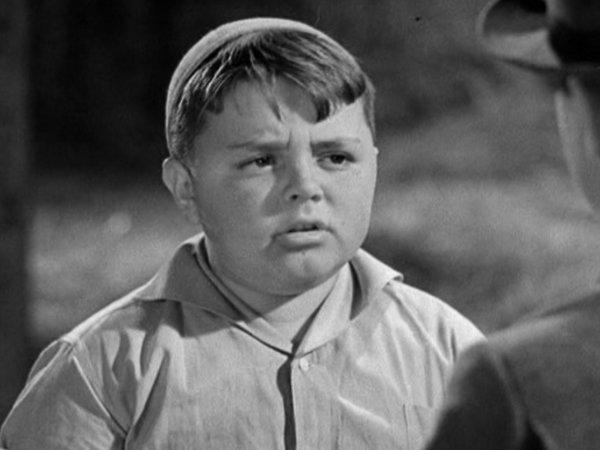
Thomas Ross Bond was born on September 16, 1926, in Dallas, Texas, to Ashley Ross Bond and Margaret Bond. His father worked as a commercial artist, focusing on ceramic art work. Young “Tommy” got his start as a child actor by the age of four, when a Hal Roach Studios talent scout encountered him as he was leaving a local cinema in Dallas with his mother. In 1931, after a long trek in the car with his grandmother to Hollywood, California, and with no guarantee of a role, he was hired at the Hal Roach Studios to appear in the Our Gang series.
Initially, Bond appeared as “Tommy,” a supporting character
with minimal lines. He eventually gained more screen time over a period of
three years until he left the series to attend public school.
Bond still continued to fulfill minor roles in other films, including Kid Millions(1934). He also found work as a voice actor, notably voicing the speaking parts for the jazzy “Owl Jolson” character in Tex Avery’s Merrie Melodies cartoon, I Love to Singa, in 1936. Hal Roach saw Bond portraying bratty characters in films and had a new idea for a character: “Butch,” the bully. In the same year, Bond returned to Our Gang, this time as Butch. He first appeared as Butch in Glove Taps(1937), bullying the neighborhood children and—to Alfalfa’s (Carl Switzer) dismay—vying for the affections of Darla (played by Darla Hood). Bond also worked alongside other Hal Roach Studios stars, including Charley Chase, Stan Laurel, and Oliver Hardy. In 1937, Bond was also among the charter members of the Screen Actors Guild.
Tommy Bond as Butch in an Our Gang short, Party Fever (1938)
Bond continued with Our
Gang on through its continuation at MGM studios in 1938. His last Our Gang appearance came in Building Troubles (1940) before Bond outgrew
the role and transitioned out of series, appearing in other MGM films but often
struggling to find roles as a young adult. In the end, Bond could be seen in 27
Our Gang shorts, appearing in 13 of
them as Tommy and in the remaining 14 as Butch.
Despite his tough and troublesome on-screen image, Bond was by all accounts a kind and gentle person off-screen. As the years went on, Bond served in the U.S. Navy, once again, returned to acting. He appeared in two Gas House Kids films alongside former Our Gang co-star Switzer. Though the two were on-screen enemies in Our Gang, they were actually good friends off-camera. Bond also appeared as young reporter Jimmy Olsen in Superman (1948) and Atom Man vs. Superman (1950).
Tommy Bond as Jimmy Olsen and Noel Neill as Lois Lane in Superman (1948)
Bond went on to marry Pauline “Polly” Francis Goebel,
otherwise known as Polly Ellis Bond and Miss California 1945. The two had one
son, Tomas Robert Bond, II, and remained married until Bond’s passing.
In the early 1950s, Bond attended Los Angeles City College
and earned a degree in theater arts from California State University, Los
Angeles. Though he stopped acting professionally, he continued to work in the
entertainment industry in television direction and production, including
working as a production manager for Rowan
& Martin’s Laugh-In. He was employed at KTTV in Los Angeles,
California, from the 1950s to the 1970s, and later at KFSN in Fresno,
California, from the 1970s to 1991.
Bond was also dedicated to his Lutheran faith, actively involved in the Emmanuel Lutheran Church community in North Hollywood, California. He and many of his friends worked on the production and presentation of the community’s Christmas Pageant, presented on the grounds of the church’s school. This was no ordinary production—the pageant included several hundred participants, Hollywood sets and lighting, the construction of grandstands, and live animals. Horses were contributed from Spahn’s Movie Ranch, which previously supplied horses for Ben-Hur (1959). Bond was also instrumental in having the production filmed and aired on KTTV in 1965. The pageant was presented annually on the school’s grounds from 1960-1971, with a set costing more than $65,000. One videotape documenting the broadcast was found in the church storage room years later. All color copies were destroyed in a fire.
An older Bond
Bond retired from television in 1991 and frequently reflected upon his life and career, including his time in Our Gang. He published an autobiography in 1994, entitled Darn Right It’s Butch: Memories of Our Gang/The Little Rascals. He and Tommy R. Bond, II, worked together in their family production company, Biograph Company, as his son became a film and television producer. Bond also hosted a documentary called The Rascals, focusing on the Our Gang stars and serial. His final film role was as a neighbor in Bob’s Night Out (2004).
Bond passed away on September 24, 2005, from heart disease
in Northridge, California. He was 79 years old. Bond was buried at Riverside
National Cemetery in Riverside, California.
Today, various points of interest relating to Bond’s life
remain. In 1926, he and his family lived at 4613 Gaston Ave., Dallas, Texas.
The home stands today.
4613 Gaston Ave., Dallas, Texas
In 1930, the family was living on Mockingbird Lane in
Dallas, Texas. Census records are unclear as to the home address but,
sequentially, his family was near 4452 Mockingbird Ln., Dallas, Texas.
4452 Mockingbird Ln., Dallas, Texas
In 1940, Bond resided at 5230 Zelzah Ave., Encino,
California. The original home no longer stands.
By 1950, Bond was living at 4742 Fulton Ave., Sherman Oaks,
California. The original home no longer stands.
Bond’s alma mater, Los Angeles City College is located at
855 N. Vermont Ave., Los Angeles, California.
Los Angeles City College, 855 N. Vermont Ave., Los Angeles, California
Likewise, California State University, Los Angeles, is
located at 5151 State University Dr., Los Angeles, California.
California State University, 5151 State University Dr., Los Angeles, California
Emmanuel Lutheran Church stands at 6020 Radford Ave., North
Hollywood, California.
Emmanuel Lutheran Church, 6020 Radford Ave., North Hollywood, California
Riverside National Cemetery is located at 22495 Van Buren
Blvd., Riverside, California.
Riverside National Cemetery, 22495 Van Buren Blvd., Riverside, California
Annette Bochenek, Ph.D., is a film historian, professor, and avid scholar of Hollywood’s Golden Age. She manages the “Hometowns to Hollywood” blog, in which she profiles her trips to the hometowns of classic Hollywood stars. She has also been featured on the popular classic film-oriented television network, Turner Classic Movies. A regular columnist for Classic Movie Hub, her articles have appeared in TCM Backlot, Silent Film Quarterly, Nostalgia Digest, The Dark Pages Film Noir Newsletter, and Chicago Art Deco Society Magazine.