Monsters and Matinees: The Evil Queen was a Beast Hidden within a Beauty

The Evil Queen was a Beast Hidden within a Beauty

Her lips are as red as a rose, her skin as white as snow and though we can’t see her hair, the dark wimple wrapped around her head and throat is as black as ebony.

In the 90 years since she was introduced in Walt Disney’s 1937 animated classic Snow White and the Seven Dwarfs, she has remained an iconic image that is referenced today, most recently in the new 2025 live-action Disney film.

But make no mistake, I’m not talking about sweet young Snow White, but rather her stepmother, the magnificent Evil Queen.

The Evil Queen is a stunning beauty who lives up to her name in Walt Disney’s Snow White and the Seven Dwarfs.

Fairy tale beginnings

When the Brothers Grimm introduced her in their 1812 fairy tale, it was simply with the word beautiful. (She was also proud and haughty, quite unattractive attributes.)

Fast forward more than a century when Disney chose Snow White as his first full-length animated feature. In the “storybook” introduction that opens his film, she is called the “vain Queen” – and she has good reason for that.

The Queen is stunning in her gold crown, oversized white collar, flowing black cape and regal blue-purple gown. Her pale skin is colored by the same rosy cheeks and red lips as Snow White. Her oval eyes are impeccably enhanced with deep purple eyeshadow, long lashes and thin, but pronounced, eyebrows.

She is breathtaking.

As the first character in the film, she’s also immediately unsettling with a coldness radiating from that beauty. Something is off. She is calm but stern as she talks to the slave in the mirror, looking for affirmation that she is the “fairest one of all.” But this time, for the first time, she isn’t.

That’s when her deep blue eyes turn green with jealousy and anger, conjuring strong winds that whip around her. Though her posture is erect in the way that royals hold themselves, her expressive eyes speak volumes as she glares in a way that makes you think “if looks could kill…”

A queen as a monster

What is the Evil Queen doing in a column about classic film monsters? Because she is one – a monster that is a beauty and a beast in one.

Her murderous soul orders the chilling murder of a child without hesitation. If she must eat a human heart to get what she wants, so be it. She’s driven by vanity and arrogance without apology.

No explanations, no backstory to soften her evilness as happens in some modern variations like the well-made TV series “Once Upon a Time.”

The Evil Queen is one of my favorite villains, even outside of the Disney universe. I’ve been thinking about her again with the new Disney film starring Gal Gadot in the role. As with any Snow White adaptation, I’m interested in how the Evil Queen looks and is portrayed. Gadot’s Queen is a dark, gothic figure with an impressive crown. Costume designer Sandy Powell based her design on the original film’s iconic appearance of the Evil Queen because “I think it’s a really striking look,” she said in a video shared by Disney.

How did we get here?

The look of the witch on film has come a long way since this depiction of an old hag in the 1932 Silly Symphonies Babes in the Woods.

The changing face of the witch

For centuries, witches were presented in literature as grotesque creatures with pointy hats and broomsticks. Films of the early 19th century depicted witches as a mix of frumpy, silly women or as caricatures of that witch on the broomstick with warts and a snaggle tooth.

That’s how she appears in the 1932 Walt Disney’s Silly Symphonies short Babes in the Woods – a take on Hansel and Gretel – where the witch also had chin whiskers, a crooked nose with a wart and wears a tattered black cape and large brown hat.

Early film witches could be comical like the “Evil Queen” in Betty Boop in Snow-White.

In the 1933 short film Betty Boop in Snow-White, from Max Fleischer’s Fleischer Studios, she was homely, a bit plump and comical with a face that bears a resemblance to, of all characters, Olive Oyl (who also was drawn by the Fleischer studio).

For Walt Disney’s Snow White, his first full-length animated film, he gave his illustrators a great deal of leeway to experiment – while also giving some direction, of course. They would create drawings where she was chunky and comical (an ode to queens of the royal variety) and “a high-collar stately beautiful type,” according to the book Walt Disney’s Snow White and the Seven Dwarfs & The Making of the Classic Film.

In an early 1934 outline for the film, Disney described her as “a mixture of Lady Macbeth and the Big Bad Wolf – Her beauty is sinister, mature, plenty of curves. …”

That’s her, all right.

Two women who look similar to Disney’s Evil Queen are the title character in the 1935 sci-fi film She (portrayed by Helen Gaughan), left, and Uta von Ballenstedt, a noblewoman in Medieval Germany whose likeness is immortalized in a 13th century statue (at right). They are worthy of being an inspiration.

Inspiration for the queen

Though I obviously love the queen’s look, I never thought about the inspiration for her monstrous beauty until a few years ago. I was watching the 1935 sci-fi fantasy She for the first time – and there she was: Disney’s Evil Queen, except she was the title character – She Who Must Be Obeyed is the full name – played by the stately Helen Gaughan.

Of the multiple theories about the Queen, She is near the bottom of the list because it’s the one that has never been officially confirmed. Trust me, you’ll see the similarities.

The moment I saw She on her throne, I pictured the Evil Queen. Her pale face with thin eyebrows and deep lips is framed by a black wimple beneath the large crown. She’s dressed in a deep-colored robe with an ornamental jewel at the base of her neck.

Beyond the clothing and makeup, she recalls the Evil Queen in the way she stands, moves and holds her head high with confidence that borders on arrogance. And like the Evil Queen, she erupts when provoked in the slightest way. She was made two years before Snow White and it seems clear to me that someone at Disney was inspired by this film and there’s nothing wrong with that.

If She is not a widely regarded inspiration for the Evil Queen, who is? There are three popular theories.

This portrait shows masks by Polish illustrator Władysław Teodor “W.T.” Benda, whose work was referenced in early character sketches of the Evil Queen. (Courtesy of Genthe photograph collection, Library of Congress, Prints and Photographs Division)

Masks of WT Benda:In the first outline of Disney’s Snow White in August of 1934, the masks of Polish illustrator Władysław Teodor “W.T.” Benda, were mentioned as an inspiration. Walt Disney was a fan of the Polish illustrator whose dramatic masks were used in magazines and in theater. Cold and mysterious, they held a unique beauty from the dark eyebrows, long lashes and red lips that provided bold detail to an otherwise pale face. Sound familiar? Yes, those are the same striking details of the Evil Queen.

A German beauty:For her wardrobe and overall appearance, look to Uta von Ballenstedt, a noblewoman in Medieval Germany. She is captured eternally in a famous 13th century painted statue with a fabulous upturned high collar, large golden crown with a wimple around her face and neck and a cape majestically wrapped around her shoulders. She has a softness about her beauty that the Evil Queen lacks, but you can still see the similarity. The statue stands today outside of Naumburg Cathedral in Germany, where it is a popular selfie spot, partially because of the link to the Evil Queen.

Actresses who inspired the look of the Evil Queen included Greta Garbo, left, Joan Crawford and Gale Sondergaard (fittingly pictured in a test for the Wicked Witch of the West in The Wizard of Oz). Note all women have high-arched eyebrows, dramatic eye makeup and deep-colored lips – like the Evil Queen.

Hollywood stars:The one-word description of the Queen as being “beautiful” in the original fairy tale gave much room for interpretation to the illustrators. So why not look to the glamorous Hollywood actresses of the time for inspiration? And they did.

Greta Garbo, Joan Crawford, Marlene Dietrich and Gale Sondergaard are the actresses most often mentioned as reference, and you can see that in EQ by looking at their faces. In the 1920s and ‘30s, actresses often had their eyebrows plucked and redrawn in a pencil-thin line. Their eyes and lips were heavy with makeup, their beauty cool and mysterious. They carried themselves like royalty, with a sexy swagger, and they had an unmistakable magnetism and sultry magnetism.

The Evil Queen’s cold beauty and dark heart influenced how the witch is portrayed on film.

Her role in Hollywood

The Disney animators could not have realized how their version of the Evil Queen would change the depiction of the witch on film. It’s a topic discussed in the 2020 documentary “Witches of Hollywood.” In the Disney film, the witch was not the traditional hag (until she changed herself into one), but an empowered woman (evil, but empowered).

She also was the first witch on film who was beautiful and evil; “more than one thing,” as author Dianca London puts it.

“She’s not just the beautiful kind of cold, mean queen, or the hag in the woods – she’s both,” London said. “And she has the ability to shift between the two things at her own will which I think is a new and exciting thing.”

Heather Green, author of Bell Book and Camera, said the Disney film is significant in that it has two important witch figures: the recognizable crone, as well as the “very first fantasy vamp witch.”

“She is a woman who is out for her own power, who is more interested in her beauty and her sexuality than in anything else. And she’s seeking to destroy a young girl to achieve that,” Green said. “For the first time in American film, we saw a very, very powerful, beautiful alluring woman as a witch.”

Yes, the Evil Queen gave permission for evil not to look monstrous. With her wicked nature hidden beneath her beauty, you didn’t see evil coming for you.

That’s something now common in movies, but it started with the Evil Queen and that cinematic legacy is her crowning achievement.

 Toni Ruberto for Classic Movie Hub

You can read all of Toni’s Monsters and Matinees articles here.

Toni Ruberto, born and raised in Buffalo, N.Y., is an editor and writer at The Buffalo News. She shares her love for classic movies in her blog, Watching Forever and is a member and board chair of the Classic Movie Blog Association. Toni was the president of the former Buffalo chapter of TCM Backlot and led the offshoot group, Buffalo Classic Movie Buffs. She is proud to have put Buffalo and its glorious old movie palaces in the spotlight as the inaugural winner of the TCM in Your Hometown contest. You can find Toni on Twitter at @toniruberto or on Bluesky at @watchingforever.bsky.social

Posted in Horror, Monsters and Matinees, Posts by Toni Ruberto | Tagged , , , , , , , , , , , | Leave a comment

Classic Movie Travels: Frank Morgan

Classic Movie Travels: Frank Morgan

frank morgan portrait
Frank Morgan

Francis Phillip Wuppermann was born on June 1, 1890, in New York, New York, to Josephine Wright and George Diogracia Wuppermann. His father was born in Venezuela and of Spanish and German descent, while his mother was born in the United States and was of English descent. Francis was the youngest of 11 children, with five brothers and five sisters. His family had earned considerable wealth through the distribution of Angostura Aromatic Bitters via the Angostura-Wuppermann Corporation, marketing bitters for use in drinks and cocktails.

As a young boy, Wuppermann sang soprano in his church’s choir. He also took on odd jobs, including selling toothbrushes and advertisements, and bronco-busting—breaking a wild horse or bronco for riding.

Wuppermann attended Cornell University, where he was active in the Phi Kappa Psi fraternity and Glee Club. He soon pursued an interest in acting on stage, following in the footsteps of his brother, Ralph. While working in vaudeville, he changed his last name from Wuppermann to Morgan. His first stage performance was in Mr. Wu in 1914, followed by numerous appearances in other shows, including The Lullaby, Gentlemen Prefer Blondes, Topaze, The Band Wagon, and Hey Nonny Nonny!

In 1914, Morgan married Alma Muller. They had one son named George. The couple remained married until Morgan’s passing in 1949.

From 1916 to 1936, Morgan appeared in various silent films. His screen debut occurred in The Suspect (1916). Next, he worked in Raffles, the Amateur Cracksman (1917) with John Barrymore. Of his many siblings, he was closest to his brother, Carlos. While Carlos’ passing was initially deemed a suicide while serving in the United States Army’s Corps of Intelligence Police in Germany, it was later revealed that he was murdered by a fellow soldier. Carlos was a writer and actor, and Morgan appeared in his deceased brother’s play The Triumph of X (1921) on Broadway.

John Barrymore and Frank Morgan in Reunion in Vienna (1933)

Once he became a contract player for MGM, Morgan appeared in Hallelujah, I’m a Bum (1933) alongside Al Jolson. He received an Academy Award nomination for Best Leading Actor for his performance as Alessandro, Duke of Florence, in The Affairs of Cellini (1934). He soon appeared in The Good Fairy (1935) with Margaret Sullavan, The Great Ziegfeld (1936) with William Powell and Myrna Loy, and Dimples (1936) with Shirley Temple.

In The Wizard of Oz (1939), Morgan carried out the titular role in addition to four other roles: Professor Marvel, the Gatekeeper, the “horse of a different color” carriage driver, and the Palace Guard. Morgan secured the role after the studio tired of W.C. Fields continually negotiating his potential pay for the part. 

frank morgan wizard of oz

In 1939, Morgan was involved in a serious car accident in New Mexico. While he and his family survived, his chauffer did not.

While in the throes of his film career, Morgan also performed in radio. He co-starred with Fanny Brice in The Frank Morgan-Fanny Brice Show. When Brice left the program in 1944, Morgan continued for a year with The Frank Morgan Show. In 1947, he starred in the radio series The Fabulous Dr. Tweedy and also recorded several children’s records, including Gossamer Wump.

Over the years, Morgan proved to be an asset to the studio in not only bumbling, comedic roles but also in portraying more serious and downtrodden characters. He could be seen in Saratoga (1937), The Shop Around the Corner (1940), The Mortal Storm (1940), and The Human Comedy (1943). Morgan also received an Academy Award nomination for Best Supporting Actor in Tortilla Flat (1942). In addition, Morgan appeared in a compilation film called The Great Morgan (1946), theoretically playing himself albeit in familiar bumbling roles. In the film, Morgan jumps at the chance to produce a film, but it all goes awry when he edits several unrelated musical and comedy film clips together into his own film. This was considered to be a lost film until 1980, when one print was discovered, followed by yet another.

Morgan was known to drink in his dressing room. He occasionally carried a black brief case to work, fully stocked with a mini bar.

Morgan’s final film role was in Key to the City (1950), filmed in 1949 and released after his death. Morgan had actually filmed some scenes as Buffalo Bill for the musical Annie Get Your Gun (1950) when he passed away in his sleep from a heart attack on September 18, 1949. He was replaced by Louis Calhern in the role. Morgan was 59 years old. He was buried in the Wuppermann family plot in Green-Wood Cemetery in Brooklyn, New York. In 2003, his son was buried in the same family plot.

Today, there are some extant tributes and points of interest relating to Morgan’s life and career.

In 1900, Morgan and his family lived at 35 W. 124th St., New York, New York. By 1917, they relocated to 236 W. 70th St., New York, New York. Both of these homes have since been razed.

In 1920, Morgan, Alma, and George resided at 5 St. Lukes Pl., New York, New York, with servant Maria Johnson. This home stands today.

5 St. Lukes Pl., New York, New York

In 1927, Morgan and his family resided at 430 E. 57th St., New York, New York, per his application for joining the Sons of the American Revolution. This building also stands.

430 E. 57th St., New York, New York

By 1940, Morgan and his family had relocated to 1025 Ridgedale Dr., Beverly Hills, California. Also in residence with them were a nurse (Ruth Halppner), maid (William White), cook (Elma Martin), and chauffeur (Annanzo White). This home also stands.

1025 Ridgedale Dr., Beverly Hills, California

Morgan has two stars on the Hollywood Walk of Fame, honoring his work in motion pictures and radio. They are located at 1708 Vine St. and 6700 Hollywood Blvd., Hollywood, California, respectively.

Frank Morgan walk of fame star
Hollywood Walk of Fame Star

The pants Morgan wore to portray Professor Marvel in The Wizard of Oz (1939) are on display at Movie Madness Video in Portland, Oregon.

–Annette Bochenek for Classic Movie Hub

Annette Bochenek pens our monthly Classic Movie Travels column. You can read all of Annette’s Classic Movie Travel articles here.

Annette Bochenek, Ph.D., is a film historian, professor, and avid scholar of Hollywood’s Golden Age. She manages the “Hometowns to Hollywood” blog, in which she profiles her trips to the hometowns of classic Hollywood stars. She has also been featured on the popular classic film-oriented television network, Turner Classic Movies. A regular columnist for Classic Movie Hub, her articles have appeared in TCM Backlot, Silent Film Quarterly, Nostalgia Digest, The Dark Pages Film Noir Newsletter, and Chicago Art Deco Society Magazine.

Posted in Classic Movie Travels, Posts by Annette Bochenek | Tagged | Leave a comment

Western RoundUp: Final Resting Places, More Western Filmmakers 3

More Western Filmmakers Final Resting Places

This month it’s time for another of my periodic tributes to Western filmmakers as we visit their final resting places throughout the Los Angeles area.

During my visits to these sites over the years I’ve spent time reflecting on the enjoyment each person’s work has given me, especially in the Western genre. I hope following along here enables readers across the country and around the world to do likewise.

In this column we’ll start with Oscar-winning actor Burt Lancaster, who appeared in numerous Westerns over his long career, including Vengeance Valley (1951), The Kentuckian (1955), and The Unforgiven (1960); I reviewed Gunfight at the O.K. Corral (1957), in which he played Wyatt Earp, in my column in 2023. Lancaster died in 1994 at the age of 80, and his cremated remains are interred in an unassuming little spot in Westwood Memorial Park.

Burt Lancaster final resting place
Burt Lancaster

Back in 2018 I reviewed another Wyatt Earp film, Tombstone: The Town Too Tough to Die (1942). The actor who portrayed Earp in that film, Richard Dix, died in 1949, age 56, and is buried at Forest Lawn Glendale. He’s interred next to his son Richard, who sadly died in a logging accident a few years later. Richard Dix’s other Westerns include Cimarron (1931), an Oscar winner for Best Picture, as well as The Conquerors (1932), The Arizonian (1935), and The Kansan (1943), among others.

Richard Dix final resting place
Richard Dix

I included Oscar-winning actor Edmond O’Brien in my 2019 column here on “Unexpected Western Leads.” While viewers might first think of him as a “city” type who was in numerous well-known crime and film noir titles, he appeared in a significant number of Westerns, most notably John Ford’s The Man Who Shot Liberty Valance (1961) and Sam Peckinpah’s The Wild Bunch (1968). My favorite O’Brien Western is a little-known Western called Cow Country (1953) which I’ve enjoyed numerous times. He died in 1985 at the age of 69 and is buried at Holy Cross Cemetery in Culver City, California.

Edmond O'Brien final resting place
Edmond O’Brien

Like Edmond O’Brien, Ricardo Montalban was in a John Ford Western, in this case Cheyenne Autumn (1964), and also like O’Brien, Montalban is buried at Holy Cross. Montalban also appeared in William Wellman’s Across the Wide Missouri (1951), where he unfortunately suffered an accident that would leave him with lifelong back issues. Montalban was 88 when he died in 2009; he was preceded in death by his longtime wife Georgiana, who was the younger half-sister of Loretta Young.

Ricardo Montalban final resting place
Ricardo Montalban

I’ve visited the graves of several other cast members of Across the Wide Missouri, including Richard Anderson. Anderson, perhaps best known today for his TV roles on The Six Million Dollar Man and The Bionic Woman, had his second movie role in a Monte Hale Western, The Vanishing Westerner (1950). He was also in John Sturges’ Escape From Fort Bravo (1953). Anderson died at 91 in 2017 and is buried at Westwood Memorial Park.

Richard Anderson final resting place
Richard Anderson

Another cast member of Across the Wide Missouri, John Hodiak, was sadly only 41 when he died of a heart attack in 1955. He’s interred in the mausoleum at Calvary Cemetery in East Los Angeles. Hodiak’s other Westerns included the classic Judy Garland musical The Harvey Girls (1946); a favorite Robert Taylor “Cavalry Western,” Ambush (1950); and Conquest of Cochise (1953), in which he played the title role.

John Hodiak final resting place
John Hodiak

Like Richard Anderson, three-time Oscar nominee Eleanor Parker appeared in the excellent Cavalry Western Escape From Fort Bravo (1953). She also played the lead opposite Robert Taylor in the comedic Western Many Rivers to Cross (1955) and was Clark Gable’s leading lady in The King and Four Queens (1956). In 2013 she died in Palm Springs at the age of 91 and is buried at Forest Lawn Hollywood Hills.

Eleanor Parker final resting place
Eleanor Parker

Richard Conte had an early career role in the MGM Western Big Jack (1949) opposite Wallace Beery. He only made a couple of Westerns, including Universal’s Riders of Vengeance (1952), but I wanted to include him here as he’s such a favorite. He also appeared in the military Western They Came to Cordura (1959) with Gary Cooper. He died in 1975 at the age of 65 and is at Westwood Memorial Park.

Richard Conte final resting place
Richard Conte

Director Frank Lloyd had a long career beginning in silent movies, including filming silent versions of Zane Grey Westerns. His sound-era Westerns included Wells Fargo (1937) starring real-life husband and wife Joel McCrea and Frances Dee; the delightful The Lady From Cheyenne (1941) with Loretta Young as a Wyoming settler crusading for women’s suffrage; the “Northerner” Alaska-set film The Spoilers (1942) starring John Wayne, Randolph Scott, and Marlene Dietrich; and his final film, The Last Command (1955), about the Battle of the Alamo. Several sources list Lloyd’s birth year as 1886, while his gravestone says 1888. He died in 1960 and is buried at Forest Lawn Glendale.

Frank Lloyd final resting place
Frank Lloyd

Finally, we return once more to Westwood Memorial Park, the final resting place of director Louis King. Like Frank Lloyd, King’s early directing career included silent Westerns. He made several modern-era Westerns which might also be called “horse” or “ranching” films, including Thunderhead, Son of Flicka (1945), Smoky (1946), and Green Grass of Wyoming (1948). He also directed Dick Powell and Evelyn Keyes in the fine Mrs. Mike (1948), set on the Canadian frontier, and his final film was Massacre (1956) starring Dane Clark. King, who was the younger brother of better-known director Henry King, was 64 when he died in 1962.

Louis King final resting place
Louis King

For additional photos of the burial sites of Western filmmakers, please visit my columns from May 2019February 2022November 2, 2022November 29, 2022April 2023November 2023March 2024, and July 2024.

– Laura Grieve for Classic Movie Hub

Laura can be found at her blog, Laura’s Miscellaneous Musings, where she’s been writing about movies since 2005, and on Twitter at @LaurasMiscMovie. A lifelong film fan, Laura loves the classics including Disney, Film Noir, Musicals, and Westerns.  She regularly covers Southern California classic film festivals.  Laura will scribe on all things western at the ‘Western RoundUp’ for CMH.

Posted in Posts by Laura Grieve, Western RoundUp | Tagged , , , , , , , , , | 1 Comment

Silents are Golden: A Closer Look At: True Heart Susie (1919)

A Closer Look At: True Heart Susie (1919)

True Heart Susie and her beloved pet cow

Some of the best films of the silent era weren’t necessarily grand epics, experimental dramas, or high-budget adventures. Some were simple, quiet stories, focusing on just a few carefully-sketched characters. One film that always comes to my mind right away is True Heart Susie (1919), a sweet melodrama by D.W. Griffith that was later described by its star Lillian Gish as a “rural poem.”

This was one of several nostalgic melodramas Griffith directed in the late 1910s in between more prestigious projects like Hearts of the World (1918) and Broken Blossoms (1919). Starring Lillian Gish, Robert Harron and Clarine Seymour, its intimate story and country setting are infused with nostalgia for times gone by. Today, there’s an added charm in knowing that when True Heart Susie was made in 1919, much of that “old-fashioned” world still existed in a sense.

True Heart Susie (1919), Lillian Gish and Robert Harron
Lillian Gish and Robert Harron

The story revolves around the sweet and naive Susie (Lillian Gish), a “plain girl” who lives with her aunt in a little house in the country. Young William Jenkins (Robert Harron), who Susie secretly loves, lives across the street. He dreams of going to college to become a minister, but can’t afford the expense. Susie wants William to achieve his dreams and decides to sell her beloved pet cow and give him the money anonymously. William is overjoyed, believing the money came from a wealthy benefactor he’d met in town.

William completes his studies and returns home a full-fledged minister, much to Susie’s joy. At the local soda fountain he talks earnestly with her about how young men want to be “plain and simple” girls, not “painted and powdered” types. Susie is sure that her dream of marrying William will soon come true–until one fateful day when she sees him with the fun-loving and decidedly painted-and-powdered Betty Hopkins (Clarine Seymour).

True Heart Susie (1919), Kate Bruce, Clarine Seymour and Robert Harron
Kate Bruce, Clarine Seymour and Robert Harron

At the time of True Heart Susie Gish had worked in films for eight years. From her first role with her sister Dorothy in the short Biograph drama An Unseen Enemy (1912) to appearances in prestige pictures like Intolerance (1916), her delicate, emotional performances had made her one of Hollywood’s finest talents. In her autobiography she recalled that by the time of True Heart Susie D.W. Griffith often welcomed her suggestions for her characters. While a “quaint,” quiet character like Susie can be a challenge to bring to life, Gish rose to the occasion. She seemed to understand Susie almost instinctively, using a slightly stilted way of walking to emphasize her character’s naivete and adding little flashes of humor at just the right moments. The majority of Gish’s costumes involved pinafores, slightly out-of-date–dresses, and funny little hats. She’s a deeply sympathetic figure, and the audience feels for her throughout her various ups and downs.

True Heart Susie (1919), Lillian Gish
Lillian Gish

Robert Harron is also excellent as the bashful William. An Irish Catholic lad from New York City, Harron had joined Biograph in 1908 as an errand boy and soon started appearing on screen in bit parts. Thanks to his hardworking, genial nature he became one of the studio’s most reliable actors. As his career progressed under D.W. Griffith’s tutelage he began to show astonishing versatility, his finest role arguably being “The Boy” in Intolerance. In True Heart Susie he’s convincing as both a gawky young boy and a self-assured minister, and he and Gish have a winsome chemistry.

True Heart Susie (1919), Robert Harron
Robert Harron

Clarine Seymour was a relative newcomer to the Griffith studio. Born in Brooklyn, she started acting in Thanhouser films to help support her family and soon hopped over to Pathé and then to the Rolin Film Company. Her first film for Griffith was The Girl Who Stayed at Home (1919), where she played “Cutie Beautiful” and was charmingly paired with Robert Harron. Small and spunky with big saucer eyes, she was very much a “flapper type” just before flappers would start dominating the theater screens. She makes a strong impression as the flighty, fun-loving Betty who unknowingly becomes Susie’s romantic rival.

True Heart Susie (1919), Clarine Seymour
Clarine Seymour

With its warm, homey cinematography and sentimental storytelling that never feels overdone, True Heart Susie’s reputation has aged like fine wine throughout the years. It was filmed not long after the debut of United Artists, which Griffith helped found alongside Mary Pickford, Charlie Chaplin and Douglas Fairbanks. It was also released right on the heels of Griffith’s much-admired Broken Blossoms (1919), which is still considered an artistic masterpiece today. Perhaps inevitably, True Heart Susie was a bit overshadowed by Broken Blossom’s success. But today it’s a much-admired highlight in Griffith’s filmography, with particular praise going toward Gish’s performance

True Heart Susie (1919), Lillian Gish and Robert Harron
Lillian Gish and Robert Harron

Griffith would pair Gish and Harron one more time in The Greatest Question (1919), another melodrama with a rural setting. Seymour starred in The Idol Dancer (1920), a drama of the South Seas co-starring Richard Barthetlmess. And Harron would be loaned to Metro to be the star of what was supposed to be a four-picture deal.

Unfortunately, neither Harron nor Seymour would live to see their careers progress through the impending Jazz Age. Seymour would fall ill and pass away from an intestinal obstruction during the filming of Griffith’s Way Down East (1920). Harron’s life was claimed by a self-inflicted gunshot wound (thought to be accidental). Only one film had been completed for his deal with Metro, a light comedy called Coincidence (1920). Gish alone would go on to have a very lengthy and legendary career on both screen and stage. To the end of her life she spoke fondly of her time at the Griffith studio, proud of her work and a bit wistful for an era long gone by.

True Heart Susie (1919), Lillian Gish, flowers
Lillian Gish

–  

–Lea Stans for Classic Movie Hub

You can read all of Lea’s Silents are Golden articles here.

Lea Stans is a born-and-raised Minnesotan with a degree in English and an obsessive interest in the silent film era (which she largely blames on Buster Keaton). In addition to blogging about her passion at her site Silent-ology, she is a columnist for the Silent Film Quarterly and has also written for The Keaton Chronicle.

Posted in Films, Posts by Lea Stans, Silent Films, Silents are Golden | Tagged , , , , , | Leave a comment

Noir Nook: 75th Anniversary Noir – 2025 Edition

75th Anniversary Noir – 2025 Edition

If it’s February at the Noir Nook, it’s time to take a look at the 75th anniversary release of some of my favorite noirs. And 1950 served up a veritable smorgasbord of first-rate shadowy features! I always single out four films each year on which to shine the anniversary spotlight, but whittling down the outstanding releases from 1950 was like pushing a boulder up a steep hill – not impossible, but darned difficult!

I finally managed to decide on my Final Four, but I also have to give the nod to some of the many fine films that didn’t make the cut: The Asphalt Jungle, The Damned Don’t Cry, D.O.A., No Man of Her Own, and Shakedown. You can put all of these films in a bag, shake ‘em up, and select any one – you simply cannot go wrong. But in the meantime, here’s my look at the four features from 1950 that I absolutely love the best.

…..

The Breaking Point

The Breaking Point, Patricia Neal and John Garfield

This feature, starring John Garfield, Phyllis Thaxter, and Patricia Neal, was the second of three film adaptations of Ernest Hemingway’s 1937 novel, To Have and Have Not. (The first, with the same name as the novel, was released in 1944 and starred Humphrey Bogart and Lauren Bacall, and the third, The Gun Runners, starred Audie Murphy and was released in 1958.) The story focuses on Garfield’s character, Harry Morgan, an ex-Naval officer who lives with his wife, Lucy (Thaxter), and two daughters, and operates a charter fishing boat in Newport Beach, California. Barely able to make the payments on his boat, Morgan is pressured into an illegal operation by a shady lawyer (Wallace Ford) and his life is complicated further by the presence of Leona Charles (Neal), a sexy passenger with eyes for Morgan. Also on hand, providing a combination of reasonable objections and loyal support is Morgan’s right-hand man, Wesley Park (Juano Hernandez).

The Breaking Point doesn’t get a lot of attention, and that’s a real shame. It has a first-rate pedigree: direction by the great Michael Curtiz, a fabulous cast, and the stamp of approval from Hemingway himself, who considered it to be the best adaptation of any of his books. I really can’t say enough about how good this movie is, from start to finish – and speaking of the finish, the ending is one of the most gut-punching in all of film noir and one you won’t soon forget.

Favorite quote: “All I got left to peddle is guts. I’m not sure I got any. I have to find out.” – Harry Morgan

…..

Gun Crazy

Gun Crazy, John Dall and Peggy Cummins

Based on a short story, “Deadly is the Female,” written by MacKinlay Kantor and published in the Saturday Evening Post, Gun Crazy tells the story of ill-fated lovers Annie Laurie Starr (Peggy Cummins) and Bart Tare (John Dall), who go together, as Bart observes, “like guns and ammunition.” After a unique meet-cute at a carnival where Annie works as a sharpshooter, the two fall in love and get married, but when they can’t make ends meet, they’re pushed into a life of crime (with Annie doing the shoving). They start out with small-time thefts, but eventually advance to bank robberies and an intricate payroll heist – and Annie’s penchant for shooting first and never asking questions leaves a trail of dead bodies in their wake. It’s a love story that’s doomed from the start.

Whether they’re eating (very tasty-looking) burgers at a diner, shooting up a gumball machine during a robbery of a Travelers Aid kiosk, or doing simultaneous U-turns in the middle of a road because they can’t bear to part, Annie and Bart are positively riveting. Director Joseph Lewis (who also helmed the noir gems My Name is Julia Ross [1945] and The Big Combo [1955]) does a masterful job of spinning a tale that makes us root for those crazy kids to make it safely to Mexico and live ever after happily.

Favorite quote: “I’ve been kicked around all my life, and from now on, I’m gonna start kicking back.” – Annie Laurie Starr

…..

Night and the City

Night and the City, Richard Widmark

Directed by Jules Dassin and set in London, this feature shines the spotlight on Harry Fabian (Richard Widmark), a small-time grifter whose life revolves around his determination to get rich quick, by whatever means necessary. His latest scheme centers on becoming a wrestling promoter, with an aging Greco-Roman wrestler named Gregorius (Stanislaus Zbyszko) as his prime attraction. The problem is, outside of Harry’s natural penchant for screw-ups, his business is shakily financed through a backdoor deal with his boss’s wife Helen Nosseross (Googie Withers), and Gregorius’s mobster son Kristo (Herbert Lom) is none too happy about his father’s exploitation by Harry. The plot is superbly supported by Gene Tierney as Mary Bristol, Harry’s long-suffering girlfriend; Francis L. Sullivan as Harry’s vindictive boss, Phillip; and Mike Mazurki as a wrestler under Kristo’s employ.

For my money, Night and the City gives us Richard Widmark’s best performance, as he brings to life a character who is alternately pitiable, admirable, and repugnant. As the centerpiece of the film, he’s got his fingers in all sorts of tangled human connections, from the estrangement between Gregorius and Kristo, to the miserable marriage of Phillip and Helen Nosseross, and his own tenuous relationship with Mary. The film is fascinating on so many levels and delivers a shocking climax that’ll practically leave you breathless.

Favorite quote: “Harry. You could have been anything. Anything. You had brains. Ambition. You worked harder than any 10 men. But the wrong things. Always the wrong things.” – Mary Bristol

…..

Sunset Blvd.

Sunset Blvd, Gloria Swanson and William Holden

William Holden stars in this film as Joe Gillis, a down-on-his-luck screenwriter whose luck is so down that he can’t sell his work and he’s just one step ahead of the men who are trying to repossess his car. While fleeing the repo men, Joe serendipitously (or not, as it happens) turns into the driveway of one Norma Desmond (Gloria Swanson), an eccentric, isolated, former silent film star who gives “living in the past” a whole new meaning. Viewing Norma as the foundation for an easy payday, Joe agrees to move into her house and edit the massive screenplay she’s writing for her return to the silver screen. Unfortunately, for Joe, the best laid plans of mice and men often go awry, and he soon learns that all that glitters isn’t gold. (Did I put enough cliches into that?) Adding to the film’s action are Max Von Mayerling (Erich von Stroheim), Norma’s chauffeur, right-hand man, and first husband; and Betty Schaefer (Nancy Olson), a would-be writer who falls in love with Joe.  

Arguably one of cinema’s most iconic films, Sunset Blvd. is one of those features that I simply cannot see too many times. It’s chock full of unforgettable lines, scenes, and sets, and helmed by one of my favorite directors, Billy Wilder. And in addition to the leading quartet of performers, the cast includes small but standout performances by Fred Clark, as a Paramount Studios producer with stomach issues; Lloyd Gough, as Joe’s unsympathetic and unhelpful agent; and, of course, as Norma’s card-playing partners (who Joe dubs “The Waxworks”), Buster Keaton, Anna Q. Nilsson, and H.B. Warner. It’s a stellar production in every way.

Favorite quote: “We didn’t need dialogue. We had faces!”

What are some of your favorite noirs from 75 years ago? Leave a comment and let me know!

– Karen Burroughs Hannsberry for Classic Movie Hub

You can read all of Karen’s Noir Nook articles here.

Karen Burroughs Hannsberry is the author of the Shadows and Satin blog, which focuses on movies and performers from the film noir and pre-Code eras, and the editor-in-chief of The Dark Pages, a bimonthly newsletter devoted to all things film noir. Karen is also the author of two books on film noir – Femme Noir: The Bad Girls of Film and Bad Boys: The Actors of Film Noir. You can follow Karen on Twitter at @TheDarkPages.
If you’re interested in learning more about Karen’s books, you can read more about them on amazon here:

Posted in Noir Nook, Posts by Karen Burroughs Hannsberry | Tagged , , , , , , , , , , | 1 Comment

Silver Screen Standards: The Major and the Minor (1942)

The Major and the Minor (1942)

I’m not sure you could make a picture like The Major and the Minor (1942) today, and given the Lolita undertones of the story that might be a good thing, although writer and director Billy Wilder couldn’t have predicted the arrival of Nabokov’s controversial novel more than a decade after this movie first appeared. Wilder, of course, wasn’t afraid to present his audiences with absurd and/or risqué situations, and this screwball comedy has both in spades. It’s a wacky, fast-paced directorial debut for the iconic Hollywood writer, whose collaborations with Charles Brackett had already proven their creative talent with screenplays for Midnight (1939), Ninotchka (1939), and Ball of Fire (1941). Fresh from her Oscar-winning performance in Kitty Foyle (1940), Ginger Rogers proves once again that she can carry a picture without dancing or Fred Astaire, and this is really her movie, although we get enjoyable supporting performances from Ray Milland, Diana Lynn, and even Rogers’ real-life mother, Lela Rogers, here making her only onscreen acting appearance.

The Major and the Minor, Ginger Rogers, Station
Unable to afford the adult fare back to her hometown, Susan (Ginger Rogers) disguises herself as a child to get a half-price ticket.

Ginger Rogers stars as Susan Applegate, a young woman tired of being perpetually propositioned at her jobs in New York City and resigned to taking the train back to her small hometown. Unfortunately, her emergency reserve is not enough to cover an adult fare, so she disguises herself as a rather mature pre-teen and calls herself “Su-Su.” When gallant Major Philip Kirby (Ray Milland) comes to her aid, Susan is immediately attracted to him and wants to tell him the truth, but complications arise to prevent her revelation. Philip takes Susan to his home at a military academy, where she meets his manipulative fiancée, Pamela (Rita Johnson), her quick-witted sister, Lucy (Diana Lynn), and a whole campus of teenage Romeos in training.

The Major and the Minor, Ray Milland and Ginger Rogers Train
While fleeing suspicious train conductors, Susan meets kindly military school instructor Philip Kirby (Ray Milland), who believes her to be a child in need of assistance.

Obviously, a grown man being attracted to a twelve-year-old girl is a grossly inappropriate situation, but the audience always knows that Susan is really an adult, and Philip never suggests or attempts anything to undermine our sense of him as a good guy. In fact, he’s the only male of any age to behave himself when left alone with Susan, which is why she likes him in the first place. Having fled New York because of all the adult men who acted like heels, Susan discovers at the academy that they pick up their bad habits early, with every boy there trying his best to court and kiss her. One of them (Frankie Thomas) even turns out to be the son of Albert Osborne (Robert Benchley), the lecherous New Yorker whose attempts convinced Susan to leave the city. In a world full of such swine, it’s little wonder that Susan likes the decorous Philip, but of course Philip believes her to be absolutely out of bounds. The audience is never fooled for a minute, especially with Rogers being in her early 30s and playing a woman in her early 20s who is trying to disguise herself as a girl on the verge of her teens, but it’s fun to watch Rogers attempt the deception with her impression of girlish behavior and her improbable stories about being from “Swedish stock.”

The Major and the Minor, Diana Lynn and Ginger Rogers
The best friend Susan makes at the academy is her rival’s teenage sister, Lucy (Diana Lynn), who helps Susan maintain her ruse and navigate life at the school.

As much as I like Ray Milland, for me the other MVP in this picture is actual teenager Diana Lynn, who plays Lucy with all the wit and sharp commentary of a Pre-Code Ginger Rogers. Lucy is supposed to be a “real” twelve-year-old girl, although Lynn was actually 16 at the time and just starting her film career after gaining fame as a child prodigy pianist. Lucy, a student of biology and the smartest person Susan meets throughout the entire movie, immediately sees through the Su-Su disguise but becomes an ally in Susan’s ruse. With her scientific and worldly knowledge, Lucy serves as a foil to the childish Su-Su idea of adolescent girlhood and the handsy stupidity of the boys, but she also provides Susan with a much-needed friend. Lucy already knows that her older sister is a rotten egg, but Susan’s arrival gives Lucy an opportunity to undermine Pamela’s intention to make Philip miserable for life. Once they’re together, they remind me of the pals Rogers and Una Merkel play in 42nd Street (1933), with a snappy camaraderie that quickly deepens into real friendship. Susan might bring the screwy aspect of screwball comedy into play with her hastily assumed disguise, but Lucy brings the fiendish, chaotic intelligence needed to vanquish rivals and ensure a happy ending. It’s a crucial role in the picture, and I can’t imagine any young actress handling it better than Lynn does.

The Major and the Minor, Ray Milland, Eye
With one eye closed, Philip (Ray Milland) can almost see past the Susu façade and recognize the grown woman he finds so mysteriously appealing.

Billy Wilder would turn to darker fare for his next several films, but he reunited with Ray Milland to make The Lost Weekend (1945), which earned Oscars for both Milland and Wilder and won Best Picture. Ginger Rogers can, of course, be found in her numerous pictures with Fred Astaire, but for more of her other comedies try Bachelor Mother (1939) and Monkey Business (1952). She and Milland reunite for Lady in the Dark (1944), while Rita Johnson also appears with Milland in The Big Clock (1948). Diana Lynn plays a female version of Ray Milland’s character in the gender-swapped 1995 remake, You’re Never Too Young, in which Jerry Lewis is the adult who poses as a child. As a teen, however, Lynn has another memorable role in The Miracle of Morgan’s Creek (1943).

— Jennifer Garlen for Classic Movie Hub

Jennifer Garlen pens our monthly Silver Screen Standards column. You can read all of Jennifer’s Silver Screen Standards articles here.

Jennifer is a former college professor with a PhD in English Literature and a lifelong obsession with film. She writes about classic movies at her blog, Virtual Virago, and presents classic film programs for lifetime learning groups and retirement communities. She’s the author of Beyond Casablanca: 100 Classic Movies Worth Watching and its sequel, Beyond Casablanca II: 101 Classic Movies Worth Watching, and she is also the co-editor of two books about the works of Jim Henson.

Posted in Films, Posts by Jennifer Garlen, Silver Screen Standards | Tagged , , , | Leave a comment

Classic Movie Travels: Louise Fazenda

Classic Movie Travels: Louise Fazenda

Louise Fazenda
Louise Fazenda

Louise Fazenda was born on June 17, 1895, in Lafayette, Indiana. She was the daughter of Joseph Fazenda and Nelda Schilling Fazenda. Louise was born in the ground floor northwest room of her maternal grandparents’ house on North Salisbury Street, while her mother was visiting her brother. Louise’s father was a merchandise broker from Mexico and her mother was a native of Chicago, Illinois.

The family soon moved to California, where Joseph operated a grocery store. Fazenda attended Los Angeles High School and St. Mary’s Convent. After school, she delivered groceries for her father’s business by a horse-drawn wagon. While appearing in a high school performance, she was discovered by a talent agent working for Mack Sennett.

Louise Fazenda acting

Fazenda began her film career in 1913, namely in bit parts. She later became a character actress and displayed a knack for slapstick comedy in silent films. During this period, she worked with numerous other comedy greats, including Ben Turpin, Roscoe “Fatty” Arbuckle, and more. She left the film industry for a brief period to perform in vaudeville.

In 1917, she married director and writer Noel M. Smith. They divorced in 1926.

In the following year, she married Warner Bros. producer Hal B. Wallis. At the time, he was working as a publicist. She accepted his proposal in a speech before the National Press Club in Washington, closing her talk by saying, “I appreciate you newspapermen. In fact, I have such an appreciation of newspapermen that I think I’ll marry one when I get back to California.” The couple had one son: Harold “Hal” Brent Wallis. Fazenda and Wallis remained married until her passing.

Louise Fazenda and Hal B. Wallis

By the time sound entered films, Fazenda was securing more serious roles, including an antiwar film called The Road Back (1937). Her last film would be The Old Maid (1939), capping her career at roughly 265 films.

Fazenda and Wallis traveled extensively. They also boarded two British children during World War II. They lived on a 30-acre property in the San Fernando Valley.

Fazenda passed away from a cerebral hemorrhage in Beverly Hills, California, on April 17, 1962. She was 66 years old. At her funeral, stories of her volunteer work caring for children at UCLA Medical Center in addition to rooming and boarding children during World War II were shared. She was interred at Inglewood Park Cemetery in Inglewood, California.

Fazenda’s birthplace was located at 1104 N. Salisbury St., West Lafayette, Indiana. In 1900, Fazenda and her parents resided at 629 Kohler St., Los Angeles, California. In 1920, Fazenda and her family resided at 1132 Lemoyne St., Los Angeles, California. All of these homes have since been razed.

In 1930, she and Wallis resided at 5402 W. 9th St., Los Angeles, California. Her parents lived next door at 5400. Today, her home stands, but the one at which her parents resided does not.

Louise Fazenda home 5402 W. 9th St., Los Angeles, Californi
5402 W. 9th St., Los Angeles, California

In 1940, she, Wallis, and their son resided at 5100 Woodman Ave., Sherman Oaks, California. In addition, a maid (Anne Baffish), butcher (Edward McGuigan), cook (Martha McGuigan), and governess (Louisa Baker) resided with them. This home does not exist.

Fazenda is honored with a star on the Hollywood Walk of Fame, celebrating her work in motion pictures. It is located at 6801 Hollywood Blvd., Hollywood, California.

Louise Fazenda Hollywood Walk of Fame Star

–Annette Bochenek for Classic Movie Hub

Annette Bochenek pens our monthly Classic Movie Travels column. You can read all of Annette’s Classic Movie Travel articles here.

Annette Bochenek, Ph.D., is a film historian, professor, and avid scholar of Hollywood’s Golden Age. She manages the “Hometowns to Hollywood” blog, in which she profiles her trips to the hometowns of classic Hollywood stars. She has also been featured on the popular classic film-oriented television network, Turner Classic Movies. A regular columnist for Classic Movie Hub, her articles have appeared in TCM Backlot, Silent Film Quarterly, Nostalgia Digest, The Dark Pages Film Noir Newsletter, and Chicago Art Deco Society Magazine.

Posted in Classic Movie Travels, Posts by Annette Bochenek | Tagged | Leave a comment

Monsters & Matinees: Caught in the Silly Grasp of ‘The Giant Claw’

Caught in the Silly Grasp of ‘The Giant Claw’

Monsters, by their very name, are supposed to be monstrous. Perhaps hideous like The Hideous Sun Demon, or beastly like Beast from 20,000 Fathoms. Just throw an exclamation point on a film title like Them! or Tarantula! so we know something terrible is coming. Just give us a monster – it’s why we watch.

But there’s the chance if the monster lets us down through no fault of its own – bad design, poor effects or lame powers – it can taint our film experience. That means low-budget B-movie monsters – a favorite of mine – are at a disadvantage from a lack of resources. (I like to think filmmakers do the best with their creativity and budget, so I’ll forgive the shortcomings of the B-movie monsters.)

What a face! That’s the title creature in The Giant Claw.

That brings us to The Giant Claw. I’m not talking about the grocery store arcade game where you lower the big claw into a pile of soft toys and nearly always come up empty, but the 1957 sci-fi film from the prolific duo of director Fred F. Sears and producer Sam Katzman (more on them later).

I only discovered the film in recent years while researching actress Mara Corday and was intrigued by the promise of the title. What was The Giant Claw? Was it a killer bear? (One of my phobias.) A predatory lion? A surprisingly fast-moving sloth?

No. It’s a big bird – just one big bird. And when you see it, please hold back the laughter. This creature isn’t monstrous, it’s goofy looking. As film historian and critic Leonard Maltin has been widely quoted as saying “Big bird is laughable.”

With a wild tuft of hair, big eyes and funny beak, the beast in The Giant Claw could be called the Goofy Claw.

That’s true, but I still had an immediate soft spot in my B-movie heart for the film and its Goofy Claw title creature. I think of the film and smile because our big bird could be the homeliest monster on film, and I say that with affection. After the initial shock of meeting GC – we’ll call her GC for short since it works for both giant and goofy claw – I was rooting for her (we learn she is a girl bird later).

GC has a hilarious tuft of unruly hair sticking off the top of her oversized head, a snarled beak that makes it look like she’s trying too hard to be tough, and big bug eyes like you’ll find on children’s toys. I can’t help picturing GC as a huggable plush toy that I would buy right now if I could. She’s such a quirky, bizarre bird that she looks like she could use a hug (which we could do if she was a plush stuffed toy). We won’t talk about the odd cackling noise she makes – this poor bird can’t catch a break.

Despite the funny looking monster, this is a serious sci-fi film. There’s a narrator (the voice of our director Fred F. Sears) who pops in throughout to explain things, plenty of scientific mumbo-jumbo about atoms and anti-matter, and bold, exciting proclamations (“That bird is from a god-forsaken anti-matter galaxy!” “It was a flying battleship!”).

Sally (played by Mara Corday) can hold her own against Mitch (Jeff Morrow).

* * * * *

Pilot and engineer Mitch MacAfee (played by Jeff Morrow) spots a UFO while on a radar test flight at the North Pole. The folks tracking him from below – including mathematician Sally Caldwell (played by Mara Corday) – don’t see anything on radar. Technically, Mitch didn’t see it either. It was just a big blur that got too close. “Something like a cloud, but moving too fast,” he says. Because of his persistence, three fighter jets are scrambled to find his UFO, but all are tragically lost with no proof of anything in the air. (The viewer sees what happened though.)

After that accident, the military isn’t happy with Mitch and sends him back to New York with Sally. Their small plane is attacked by a UFO (is it the same one?) and crashes in the Adirondacks. They’re helped by friendly French-Canadian farmer Pierre (Lou Merrill) who discovers something wrong near his barn and yells about la Carcagne, a legendary creature with the face of a wolf and body of a woman with wings who foreshadows death. What does this have to do with GC? Not much except to increase the tension as a terrified Pierre repeatedly yells “la Carcagne, la Carcagne.” He is afraid of something he doesn’t understand, much like what the world will soon be feeling.

Even after a smattering of reports about UFOs and lost planes, the military still has trouble believing Mitch since – and I will repeat – there’s nothing on the radar. (What is up with that?) The few who have seen it describe as a blur, just like Mitch, and that’s how it’s often presented to the viewer as a way to show its speed and those out of focus scenes are funnier than GC.

A jet can’t fly fast enough to escape the clutches of The Giant Claw.

It takes an odd feather in plane wreckage for authorities to finally believe there’s something like a giant bird in the sky. Now they ask questions. How is the bird evading the radar? Why does the feather defy chemical analysis? What is this feathered nightmare on wings that can fly around the world faster than Superman leaving death and destruction in its path?

Clearly, it’s up to Mitch and the super smart Sally to answer those questions and save the world. But first, let’s talk about our two main characters.

In a room full of men, Mara Corday is the one who figures out how to stop the beast in the sky. Standing next to her is Jeff Morrow. That’s familiar face Morris Ankrum at the far right.

Mitch is not the most likable guy. He’s apt to lose his cool and often talks down to others including Sally who he calls “Mademoiselle Mathematician.” That doesn’t stop him from hitting on her, even kissing her while she’s sleeping on a plane in one creepy scene.

Where Morrow is dour and lacks the charm that could tame his arrogance, Corday infuses Sally with spunk and quiet confidence. She did the same with her characters in her two sci-fi films before this – Tarantula! (1955) and The Black Scorpion (1957). In this trio of films, she played a smart woman who could hold her own and doesn’t sit around waiting to be saved. She certainly won’t take anything from Mitch, even amusingly using his “Mademoiselle Mathematician” nickname against him. You’ll be rooting for her as she uses her smarts surrounded by men as she figures out how to deal with the big bird in the sky.

The film progresses as we expect. There are more sightings of big bird, attacks on trains and anything else that moves and people running in terror in recognizable spots around the world. With Sally’s math, Mitch devises a machine that could disrupt big bird’s shield. But, in good B-movie fashion, it’s never been tried before so there will be suspense of whether it will work as GC heads to New York City.

So you may be distracted by our big bird, but the film around it is everything we expect in a 1950s sci-fi B-movie and that makes it watchable.

In the end, I found the two females – Sally and GC – the most memorable part of The Giant Claw. Now if I could just get my stuffed plush movie collectible.

Mama bird protects her egg from those pesky humans in The Giant Claw.

MORE ON THE FILM

Sears/Katzman combo. Director Fred F. Sears and producer Sam Katzman worked on at least 18  movies together – 14 of them over just two years. That includes the genre films Earth vs. Flying Saucers (1956), the underappreciated and aptly title werewolf film The Werewolf (1956) and The Night the World Exploded (1957), plus the 1956 musicals Rock Around the Clock and Don’t Knock the Rock both starring Bill Haley and the Comets. In his career, Sears directed 51 films but sadly died at age 44 in November 1957 before all his films were released.

The look of The Giant Claw. Katzman originally planned to go all out and spend much of his budget on the creature and bring on stop-motion animation master Ray Harryhausen to create the flying wonder. Budget constraints nixed the idea. So instead of another Harryhausen stop-motion wonder, the big bird was created as a marionette – a puppet – as is obvious to viewers. It was a shock, however, to the cast and crew, who didn’t get a look at the creature until they saw the movie in a theater. Star Jeff Morrow has shared that he was watching the film in his hometown and was so embarrassed at the audience laughing at the bird that he left early.

 Toni Ruberto for Classic Movie Hub

You can read all of Toni’s Monsters and Matinees articles here.

Toni Ruberto, born and raised in Buffalo, N.Y., is an editor and writer at The Buffalo News. She shares her love for classic movies in her blog, Watching Forever and is a member and board chair of the Classic Movie Blog Association. Toni was the president of the former Buffalo chapter of TCM Backlot and led the offshoot group, Buffalo Classic Movie Buffs. She is proud to have put Buffalo and its glorious old movie palaces in the spotlight as the inaugural winner of the TCM in Your Hometown contest. You can find Toni on Twitter at @toniruberto or on Bluesky at @watchingforever.bsky.social

Posted in Horror, Monsters and Matinees, Posts by Toni Ruberto | Tagged , , , , , , , , , , , , , , | 1 Comment

Western RoundUp: The Lonely Man (1957)

The Lonely Man (1957)

It’s been a few months since my last full-length film Western review, so in this month’s column I’m reviewing The Lonely Man (1957), which was just released on Blu-ray by Kino Lorber Studio Classics.

The Lonely Man Lobby Card

I had no previous familiarity with The Lonely Man, an 88-minute Paramount Pictures film which has an interesting story and a top cast of Western character actors.

Kino Lorber, I’d like to insert here, has done a wonderful job in recent years releasing previously hard-to-find Westerns on Blu-ray, all of which have enriched my Western viewing.

Their releases include Audie Murphy films, a couple of which I’ve reviewed here, and relatively obscure ’50s Westerns such as Man From Del Rio (1956) and The Ride Back (1957), both starring Anthony Quinn. Additional Audie Murphy boxed sets are among the films which have been mentioned as possible future releases.

Kino Lorber The Lonely man

The Lonely Man has strong echoes of The Gunfighter (1950), as Jacob Wade (Jack Palance) returns home after many years. He left town after being accused of shooting the sheriff, with more killings to his name in the years since, but he hopes to make things right for his wife and son before time runs out.

Jacob learns his wife is dead; his sullen young son Riley (Anthony Perkins) resents him. Undeterred, Jacob wants to set the shiftless Riley up in some sort of business which will give him a secure future. He sets fire to Riley’s run-down shack, and a grudging Riley accompanies his father back on the road.

Jacob looks over a possible livery stable business for Riley in one town, but the Wades are immediately sent on their way by local citizens, and they ultimately end up at the isolated home of Ada (Elaine Aiken). Jacob and Ada had once been lovers, and when he left he gifted her the house.

Elaine Aiken and Jack Palance

Jacob, Ada, and Jacob’s old friend Ben (Robert Middleton) go to work capturing wild horses, with Jacob thinking breaking and selling horses might be a good business for Riley.

Right around this time, we learn why Jacob feels such urgency to help his son: He’s going blind. And it doesn’t help matters knowing that old enemies, including King Fisher (Neville Brand), Faro (Lee Van Cleef), and Blackburn (Claude Akins) are in the area, given that his vision woes no longer provide the security of being a fast gun.

I found The Lonely Man imperfect yet worthwhile. Its strengths start with spectacular black and white VistaVision location filming in Lone Pine, California, by Lionel Lindon. Both the movie and the Blu-ray look absolutely fantastic.

Robert Middleton, Jack Palance and Anthony Perkins
Robert Middleton, Jack Palance, and Anthony Perkins

The extensive location shooting was of particular interest to me, having spent countless hours in Lone Pine, and those unfamiliar with the area firsthand will nonetheless enjoy its distinctive vistas, including the Alabama Hills and the majestic views of Mount Whitney and Lone Pine Peak.

Other California locations, including Iverson Ranch and Vasquez Rocks, are seen very briefly. The Lonely Man has a definite “A” game in terms of visuals.

Palance is strong is a sympathetic role as the stoic gunslinger. We sense early on that there is more to the man and his story than initially presented. His wordless, beaming delight when Riley finally calls him “Pa” is a highlight of the film.

Palance is surrounded by some of the most menacing baddies in the Western movie business in Brand, Van Cleef, and Akins. Middleton, who often plays villains, is good in a nicely rounded role as Jacob’s flawed yet loyal pal. Middleton has a particularly strong scene when he finally gives Riley the facts on why his father left town years ago and seemingly abandoned his mother.

Jack Palance and Elaine Aiken

The movie also boasts appearances from a host of great character actors, including Elisha Cook Jr., James Bell, John Doucette, Russell Simpson, Tudor Owen, and Denver Pyle.

The performances from Perkins and Aiken are unfortunately less stellar. Perkins is fairly colorless and wooden as the conflicted son — much the same as I found him in the same year’s The Tin Star (1957). He’s simply a placeholder as Riley, in a role which cries out for a more sympathetic and appealing performance.

Aiken, who was appearing in her first film and has an “introducing” card in the opening credits, seems too mannered and theatrical compared to Palance’s natural performance. Her line deliveries at times are quite stilted, especially in her first reunion scene with Palance.

After watching the film I learned Aiken had studied with Lee Strasberg and later cofounded New York’s Actors Conservatory in the ’80s, and that seems to perhaps explain the “staginess” of her performance, along with her lack of screen experience. After The Lonely Man she had only a handful of film and TV roles, spread over many years. She passed on in 1998.

Elaine Aiken and Anthony Perkins

Perkins and Aiken shared an underdeveloped romantic relationship late in the film; it comes as a surprise, given her continued devotion to Jacob. That was a misstep in the script by Harry Essex and Robert Smith, nor was it convincingly acted.

The Lonely Man was directed by Henry Levin, one of a small number of Westerns he directed over his long career. Other Levin Westerns included The Man From Colorado (1948) with Glenn Ford and William Holden and the semi-Western The Gambler From Natchez (1954) with Rory Calhoun and Debra Paget.

I was surprised to realize that I’ve seen a very significant number of Levin’s films, most of which aren’t considered classics as such, yet are consistently entertaining. Levin favorites include The Bandit of Sherwood Forest (1946) with Cornel Wilde and Anita Louise and The Mating of Millie (1948) with Glenn Ford and Evelyn Keyes.

The score for The Lonely Man was by Van Cleave, with the theme song by Van Cleave and Jack Brooks, sung by Tennessee Ernie Ford. I was also interested to note, per IMDb, that famed guitarist Laurindo Almeida was heard on the soundtrack.

The Lonely Man Poster

Kino Lorber’s Blu-ray is from a new HD master from Paramount, from a 6K scan of the 35mm original VistaVision camera negative. It’s truly beautiful and one of the reasons to check out this disc. Sound quality is also excellent.

Kino Lorber has presented The Lonely Man as a special edition with a cardboard slipcase. Disc extras include the trailer; a gallery of five trailers for other Westerns available from Kino Lorber; and a commentary track by Western movie expert Toby Roan.

While a somewhat dark storyline and a pair of weak supporting performances disappointed, on the whole I enjoyed viewing this new-to-me Western completely “cold.” I found quite a bit to like, including most of the cast and the gorgeous views. I suspect fellow Western fans will also find it worth checking out, particularly given the excellent presentation by Kino Lorber Studio Classics.

If any of this column’s readers would like to share thoughts on this movie, please feel welcome to do so in the comments!

Thanks to Kino Lorber for providing a review copy of this Blu-ray.

– Laura Grieve for Classic Movie Hub

Laura can be found at her blog, Laura’s Miscellaneous Musings, where she’s been writing about movies since 2005, and on Twitter at @LaurasMiscMovie. A lifelong film fan, Laura loves the classics including Disney, Film Noir, Musicals, and Westerns.  She regularly covers Southern California classic film festivals.  Laura will scribe on all things western at the ‘Western RoundUp’ for CMH.

Posted in Posts by Laura Grieve, Western RoundUp | Tagged , , , , , , , , , , , , , | 8 Comments

Silents Are Golden: Silent Superstars: The Classy Bebe Daniels

Silent Superstars: The Classy Bebe Daniels

bebe daniels

Often overshadowed by the major names like Clara Bow or Louise Brooks, Bebe Daniels is mainly familiar to fans of old Hollywood. But back in the 1920s she was one of the era’s brightest stars, and she and husband Ben Lyon were one of Movieland’s most beloved–and authentic!–celebrity couples. Beautiful and versatile, she was able to transition to both radio and television later in life, enjoying a happier fate than some of her forgotten contemporaries.

bebe daniels 2

Daniels always maintained that she was born in Dallas, Texas, although her family’s exact whereabouts in Texas at the time are a bit of a mystery. Her birthdate was likely 1900, not 1901 as was usually claimed, and according to census records she was apparently christened Eva after her grandmother (although some sources say Phyllis). Her theater manager father Melville was Scottish, and her actress mother Phyllis was born in Columbia and had both Colombian and Welsh ancestry. “Bebe” was a Spanish-inspired nickname that stuck.

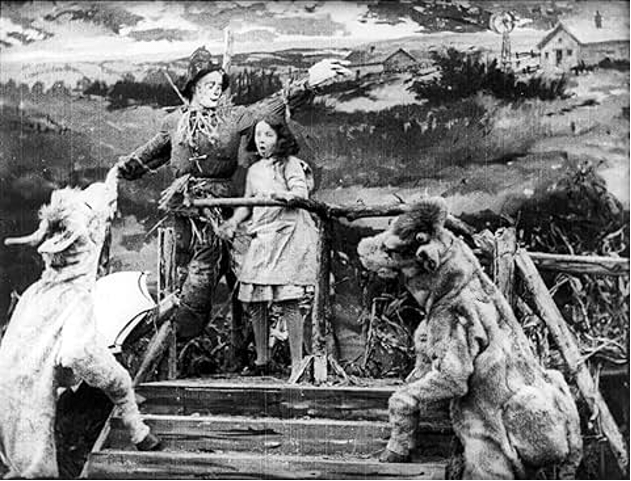
An only child, little Bebe was neglected at times until her father realized he could incorporate her into his stage shows. After the Daniels marriage ended in divorce Bebe and Phyllis moved to Los Angeles and eked out a living working in stock companies. Eventually they would be hired by Colonel Selig, builder of the first permanent movie studio in L.A. Bebe always said that her first film was Selig’s The Common Enemy (1910), although some historians allege she starred in The Wonderful Wizard of Oz (1910) around the same time. Since she never mentioned the Oz film herself and since it was most likely filmed at Selig’s Chicago studio, it might always be impossible to confirm.

bebe daniels wizard of oz
Bebe…or not Bebe.

Her stint at Selig was followed by work at Kalem, Vitagraph, Pathé, and obscure studios like the Albuquerque Film Manufacturing Company. When she heard that the little Rolin comedy studio was looking for a leading lady to play opposite their one-reeler star Harold Lloyd, 14-year-old Bebe instantly went and asked for the job. Her confidence impressed manager Hal Roach enough that she was hired. Bebe and Harold got along famously and also had a good rapport with Rolin’s third star, vaudevillian Snub Pollard. The trio would end up starring in dozens of comedy shorts where Lloyd was billed as “Lonesome Luke” before transitioning to his familiar “Glasses” character, often known simply as “The Boy.”

Snub Pollard Bebe Daniel Harold Lloyd in The Lamb
The trio starring The Lamb (1918).

In time Harold and Bebe became an item, often winning dance trophies together at local contests. By now Bebe was quickly becoming a comedy favorite, to the point where Cecil B. DeMille tried to tempt her away from Rolin in 1917. She stayed loyal to her contract, and to Harold. It wasn’t until 1919, with her Rolin contract expired, that she decided to finally take up DeMille on an impressive offer of $1000 a week. She and Harold broke up around this time, although they would maintain a warm friendship to the end of their lives.

harold lloyd and bebe daniel eating ice cream
Harold Lloyd and Bebe Daniels

Bebe’s beauty and confident air lead to “vamp” roles in DeMille’s Male and Female (1919) and Why Change Your Wife? (1920). She then starred in a series of light comedies such as She Couldn’t Help It (1921) where she tended to play a succession of “good little bad girls.” She also earned the nickname “The Speed Girl” after an incident in 1921 when she was caught speeding (not a rare occurrence for the thrill-loving star.). The unmoving judge sentenced her to 10 days in jail, and naturally every bit of publicity was squeezed out of this stay. Bebe’s cell was luxuriously furnished by a local store, she was serenaded by musicians outside her jail window, and she received dozens of visitors a day. The whole circus only increased her fame–and showed her good sense of humor about herself.

bebe daniels the speed girl in jail being serenaded by musicians

For much of the 1920s she was a Paramount star, by now commanding a high weekly salary and drawing legions of fans. She was paired with other major stars like Wallace Reid and Rudolph Valentino, and was romantically linked with boxer Jack Dempsey and athlete-turned-actor Charles Paddock. In the late ‘20s she became involved with fellow actor Ben Lyon, and on June 14, 1930 they tied the knot. It was the beginning of a long and happy marriage, as well as a fruitful partnership in the entertainment industry.

ben lyon and bebe daniels
Ben Lyon and Bebe

With the talkies in full swing, Bebe starred in the early version of The Maltese Falcon (1931) and a number of musicals, the most famous one today being 42nd Street (1933). She and Ben welcomed their first child, Barbara, in 1931. After worrying run-ins with stalkers and a growing dissatisfaction with Hollywood, Bebe decided to retire from Hollywood in 1935. The Lyons would appear together onstage and eventually move to England, where they were already very popular with the British public.

The Lyons would adopt a son, Richard, and continue their careers by starring in radio programs such as Rinso Radio Review, Hi Gang! and the long-running Life With the Lyons. During World War II they refused to return to the U.S., choosing to stay and contribute to the war effort. Their show Stars and Stripes in Britain featured interviews with soldiers, nurses and doctors, and Daniels was apparently the first female civilian to interview wounded soldiers after the invasion of Normandy. For her efforts she would be awarded the Presidential Medal of Freedom in 1946, and Ben would receive the Legion of Merit for his service as a lieutenant colonel in the US Army Air Forces Special Services.

the Lyon family in 1955
The Lyon family in 1955.

After Life With the Lyons enjoyed a stint as a television series, the Lyons began to withdraw from the spotlight, especially after Bebe suffered a stroke in the early 1960s. She and Ben’s love for each other never dimmed in their decades of marriage, and they arguably remained “the happiest couple in Hollywood” right up until Bebe’s death from a cerebral hemorrhage in 1971. Bebe’s legacy as a great star–and a truly great lady–has also remained undimmed.

bebe daniels 3

Note: The book Bebe Daniels: Hollywood’s Good Little Bad Girl by Charles Epting was a very helpful source for this post.

–Lea Stans for Classic Movie Hub

You can read all of Lea’s Silents are Golden articles here.

Lea Stans is a born-and-raised Minnesotan with a degree in English and an obsessive interest in the silent film era (which she largely blames on Buster Keaton). In addition to blogging about her passion at her site Silent-ology, she is a columnist for the Silent Film Quarterly and has also written for The Keaton Chronicle.

Posted in Posts by Lea Stans, Silents are Golden | Tagged , , | Leave a comment