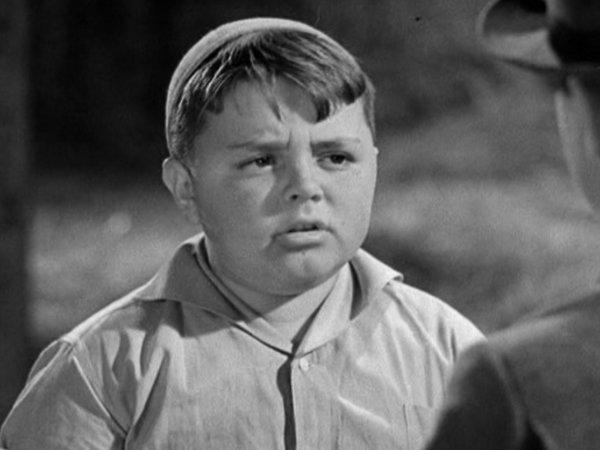
Thomas Ross Bond was born on September 16, 1926, in Dallas, Texas, to Ashley Ross Bond and Margaret Bond. His father worked as a commercial artist, focusing on ceramic art work. Young “Tommy” got his start as a child actor by the age of four, when a Hal Roach Studios talent scout encountered him as he was leaving a local cinema in Dallas with his mother. In 1931, after a long trek in the car with his grandmother to Hollywood, California, and with no guarantee of a role, he was hired at the Hal Roach Studios to appear in the Our Gang series.
Initially, Bond appeared as “Tommy,” a supporting character
with minimal lines. He eventually gained more screen time over a period of
three years until he left the series to attend public school.
Bond still continued to fulfill minor roles in other films, including Kid Millions(1934). He also found work as a voice actor, notably voicing the speaking parts for the jazzy “Owl Jolson” character in Tex Avery’s Merrie Melodies cartoon, I Love to Singa, in 1936. Hal Roach saw Bond portraying bratty characters in films and had a new idea for a character: “Butch,” the bully. In the same year, Bond returned to Our Gang, this time as Butch. He first appeared as Butch in Glove Taps(1937), bullying the neighborhood children and—to Alfalfa’s (Carl Switzer) dismay—vying for the affections of Darla (played by Darla Hood). Bond also worked alongside other Hal Roach Studios stars, including Charley Chase, Stan Laurel, and Oliver Hardy. In 1937, Bond was also among the charter members of the Screen Actors Guild.
Tommy Bond as Butch in an Our Gang short, Party Fever (1938)
Bond continued with Our
Gang on through its continuation at MGM studios in 1938. His last Our Gang appearance came in Building Troubles (1940) before Bond outgrew
the role and transitioned out of series, appearing in other MGM films but often
struggling to find roles as a young adult. In the end, Bond could be seen in 27
Our Gang shorts, appearing in 13 of
them as Tommy and in the remaining 14 as Butch.
Despite his tough and troublesome on-screen image, Bond was by all accounts a kind and gentle person off-screen. As the years went on, Bond served in the U.S. Navy, once again, returned to acting. He appeared in two Gas House Kids films alongside former Our Gang co-star Switzer. Though the two were on-screen enemies in Our Gang, they were actually good friends off-camera. Bond also appeared as young reporter Jimmy Olsen in Superman (1948) and Atom Man vs. Superman (1950).
Tommy Bond as Jimmy Olsen and Noel Neill as Lois Lane in Superman (1948)
Bond went on to marry Pauline “Polly” Francis Goebel,
otherwise known as Polly Ellis Bond and Miss California 1945. The two had one
son, Tomas Robert Bond, II, and remained married until Bond’s passing.
In the early 1950s, Bond attended Los Angeles City College
and earned a degree in theater arts from California State University, Los
Angeles. Though he stopped acting professionally, he continued to work in the
entertainment industry in television direction and production, including
working as a production manager for Rowan
& Martin’s Laugh-In. He was employed at KTTV in Los Angeles,
California, from the 1950s to the 1970s, and later at KFSN in Fresno,
California, from the 1970s to 1991.
Bond was also dedicated to his Lutheran faith, actively involved in the Emmanuel Lutheran Church community in North Hollywood, California. He and many of his friends worked on the production and presentation of the community’s Christmas Pageant, presented on the grounds of the church’s school. This was no ordinary production—the pageant included several hundred participants, Hollywood sets and lighting, the construction of grandstands, and live animals. Horses were contributed from Spahn’s Movie Ranch, which previously supplied horses for Ben-Hur (1959). Bond was also instrumental in having the production filmed and aired on KTTV in 1965. The pageant was presented annually on the school’s grounds from 1960-1971, with a set costing more than $65,000. One videotape documenting the broadcast was found in the church storage room years later. All color copies were destroyed in a fire.
An older Bond
Bond retired from television in 1991 and frequently reflected upon his life and career, including his time in Our Gang. He published an autobiography in 1994, entitled Darn Right It’s Butch: Memories of Our Gang/The Little Rascals. He and Tommy R. Bond, II, worked together in their family production company, Biograph Company, as his son became a film and television producer. Bond also hosted a documentary called The Rascals, focusing on the Our Gang stars and serial. His final film role was as a neighbor in Bob’s Night Out (2004).
Bond passed away on September 24, 2005, from heart disease
in Northridge, California. He was 79 years old. Bond was buried at Riverside
National Cemetery in Riverside, California.
Today, various points of interest relating to Bond’s life
remain. In 1926, he and his family lived at 4613 Gaston Ave., Dallas, Texas.
The home stands today.
4613 Gaston Ave., Dallas, Texas
In 1930, the family was living on Mockingbird Lane in
Dallas, Texas. Census records are unclear as to the home address but,
sequentially, his family was near 4452 Mockingbird Ln., Dallas, Texas.
4452 Mockingbird Ln., Dallas, Texas
In 1940, Bond resided at 5230 Zelzah Ave., Encino,
California. The original home no longer stands.
By 1950, Bond was living at 4742 Fulton Ave., Sherman Oaks,
California. The original home no longer stands.
Bond’s alma mater, Los Angeles City College is located at
855 N. Vermont Ave., Los Angeles, California.
Los Angeles City College, 855 N. Vermont Ave., Los Angeles, California
Likewise, California State University, Los Angeles, is
located at 5151 State University Dr., Los Angeles, California.
California State University, 5151 State University Dr., Los Angeles, California
Emmanuel Lutheran Church stands at 6020 Radford Ave., North
Hollywood, California.
Emmanuel Lutheran Church, 6020 Radford Ave., North Hollywood, California
Riverside National Cemetery is located at 22495 Van Buren
Blvd., Riverside, California.
Riverside National Cemetery, 22495 Van Buren Blvd., Riverside, California
Annette Bochenek, Ph.D., is a film historian, professor, and avid scholar of Hollywood’s Golden Age. She manages the “Hometowns to Hollywood” blog, in which she profiles her trips to the hometowns of classic Hollywood stars. She has also been featured on the popular classic film-oriented television network, Turner Classic Movies. A regular columnist for Classic Movie Hub, her articles have appeared in TCM Backlot, Silent Film Quarterly, Nostalgia Digest, The Dark Pages Film Noir Newsletter, and Chicago Art Deco Society Magazine.
That was me, giddy as a teen, just three years ago when it was announced that Ricou Browning would be appearing in my hometown of Buffalo, N.Y.
The idea of being in the room with Mr. Browning was unbelievable and was surely going to be a highlight of my life since I had loved classic horror films since I was a kid.
Ricou Browning in costume for Creature From the Black Lagoon.
He was the last of the Universal monsters, playing the underwater scenes as the title character in Creature from the Black Lagoon (1954) and its two sequels. It was hard to fathom how it was going to be possible to meet one of the original Universal monsters and I couldn’t help thinking about what I would say to him if I had the chance.
But that announcement was in January of 2020. Two months later, the Covid-19 shutdown began, canceling everything nationwide including Mr. Browning’s visit and the convention he was to appear in.
This was the announcement for Ricou Browning’s planned 2020 appearance in Buffalo, N.Y. It was canceled two months later when the pandemic shut down live events.
While we waited for events to return, Mr. Browning’s family reached out to fans in September of 2021, asking us to send him a physical card or letter because of his declining health. And we did.
Now we’ve sadly learned that Mr. Browning died of natural
causes on Feb. 27 in his Southwest Ranches, Fla. home at the age of 93.
“It is with deep sorrow I post the passing of a literal legend, Ricou Browning,” wrote family member Kristin LeFeuvre in a Facebook tribute. “TheCreature from the Black Lagoon was always a treat to be around. A man of little words, but a quick wit and a flashy smile.”
As we send our sympathy to his family and loved ones, we celebrate him not only as the Gill-Man but for his lengthy career as a director, writer, producer, stuntman and underwater coordinator and innovator.
Ricou Browning in a publicity shot for Creature from the Black Lagoon.
When Hollywood needed an expert for underwater footage and stunts, they called on him as a stunt diver/double for Disney’s 20,000 Leagues Under the Sea (1954), the Lloyd Bridges TV show Sea Hunt (30 episodes, 1958-61) and The Aquanauts (1960-61).
He was the co-creator and the driving force behind Flipper, the 1963 movie about a pet dolphin and the TV series that followed (1964-67), writing episodes, directing 37 of them, and overseeing all the underwater photography. He worked well on land, too, directing 14 episodes of the TV series Gentle Ben (1967-69).
And he had a humorous streak, as seen in the hilarious Jaws-inspired candy bar in the pool scene of Caddyshack (1980).
That’s a wonderful career by any measure. And it’s all owed to the Gill-Man.
Ricou Browning’s film legacy
“We liked the way you swim. How would you like to be the
creature of the Black Lagoon?”
Those were the words of director Jack Arnold in a phone call that changed the life of 23-year-old Florida lifeguard Ricou Browning, as Mr. Browning recalled during an interview in the fantastic David J. Skal documentary Back to the Black Lagoon: A Creature Chronicle (more on that later).
Ricou Browning wore a monster suit, but was still a graceful swimmer in Creature From the Black Lagoon.
He was working at Wakulla Springs, Fla. – one of the world’s
largest freshwater springs and a tourist attraction to this day – when he was
asked to help scout locations for Creature from the Black Lagoon.
Wakulla Springs looked like it had not been touched by time which was perfect for the film about a creature that could have been from another time. Filmmakers immediately liked what they saw and asked if the young Ricou would swim so they could film perspective shots showing the size of things like logs, fish and people.
Just a couple of weeks later, Jack Arnold made that call and his life would never be the same.
Ricou Browning in the first sequel, Revenge of the Creature.
Mr. Browning would also play the creature for the underwater scenes in the two sequels, Revenge of the Creature (1955) and The Creature Walks Among Us (1956). For the topside (land) scenes, filmmakers wanted a more menacing creature so other actors were used; Tom Chapman in the original film, Tom Hennesy in the second and Don Megowan in the third.
Here’s the sad part though: none of the men received film credit for their work. Even when Mr. Browning repeatedly requested credit for Revenge of the Creature (1955), the studio turned him down. Instead, he was given publicity chances like photo ops to help him “get other jobs.” (There was a time when studios didn’t like to credit an actor for a creature-type of role so as not to take away the mystery.)
In addition to his underwater creature scenes, Ricou Browning, right, made a cameo as a lab assistant in Revenge of the Creature. He is pictured with Lori Nelson and John Agar.
Despite the studio’s best efforts, we know their names
today.
People unfamiliar with Creature from the Black Lagoon may wonder what’s so special about a guy in a suit since movies are full of them. But Mr. Browning’s Gill-Man was special because it had character, personality and heart.
He was eloquent under the water despite the heavy suit and massive webbed hands and difficulty seeing because he couldn’t keep the water out of his eyes. He moved with long, graceful strides and effortlessly flipped and turned like he was dancing underwater.
And that brings us to one of the most iconic scenes in all of horror: The underwater ballet between the Gill-Man and the unknowing object of his affection Kay (played by Julia Adams, later known as Julie Adams). The pas de deux between the two was menacing, yet gorgeous. It could have been a scene from an Esther Williams film, if it didn’t involve a Universal monster.
In one of the most famous scenes in classic horror, the creature (Ricou Browning) mimics the motions of Kay who has no idea he is there in Creature From the Black Lagoon.
Who can forget the gracefulness of the scene as we watched the Gill-Man swimming within inches of Kay without her knowledge. Not me.
And not director Guillermo del Toro who saw Creature from
the Black Lagoon when he was only 6. He is on the record saying that that
he was charmed by the scene, as so many were, but was shocked when the creature
and his human lady love didn’t get together. He vowed to fix that someday and
he’s a man of word giving us his love letter to the creature in his Oscar
winning film The Shape of Water (2007).
That film is how del Toro celebrated Mr. Browning. While, I could never make such a grand gesture, nor did I ever meet him, I finally realized what I wanted to say to Mr. Browning. I put it in a card for him that I can sum up in two words: Thank you.
Ricou Browning as Creature From the Black Lagoon.
To learn more
To learn more about Ricou Browning and Creature from the Black Lagoon and its sequels, I highly recommend the documentary Back to the Black Lagoon: A Creature Chronicle,” written, directed and produced by horror expert and author David J. Skal.
The documentary dives into all three films and we get to hear Ricou Browning discussing his work in them. You can find the documentary on multiple home video releases of the movie and rent it through various streaming platforms.
Toni Ruberto, born and raised in Buffalo, N.Y., is an editor and writer at
The Buffalo News. She shares her love for classic movies in her blog, Watching Forever and is a
member of the Classic
Movie Blog Association. Toni was the president of the former Buffalo
chapter of TCM Backlot and now leads the offshoot group, Buffalo Classic Movie
Buffs. She is proud to have put Buffalo and its glorious old movie palaces in
the spotlight as the inaugural winner of the TCM in Your Hometown contest. You
can find Toni on Twitter at @toniruberto.
Over the past few months I’ve written about catching up with a trio of Barbara Stanwyck‘s ’50s Westerns, most recently The Furies (1950), which I covered in my column in early January.
This month I’ve caught up with another new-to-me ’50s Western featuring a notable actress, Marlene Dietrich. The movie is Rancho Notorious (1952), which was just released on a beautiful Blu-ray by the Warner Archive Collection.
Rancho Notorious was an RKO film directed by Fritz Lang, filmed in Technicolor by Hal Mohr.
As the film begins, cowboy Vern Haskell
(Kennedy) is romancing his sweetheart Beth (Gloria Henry), who will be his
bride is a little over a week.
Shortly after Vern leaves to return to his job Beth is cruelly assaulted and killed in a robbery of her father’s store. Vern makes it his mission to find the man who murdered his love. The only clue he has is the word “Chuck-a-Luck,” which was the dying utterance of the killer’s ill-fated partner (John Doucette).
The winding trail eventually leads Vern to the
Chuck-a-Luck ranch owned by Altar Keane (Dietrich). The ranch serves as a
hideout for robbers, including Altar’s longtime boyfriend Frenchy (Ferrer).
Altar gets a 10% cut for providing sanctuary and not asking questions.
Ferrer, Dietrich, and Kennedy
Vern believes Beth’s killer is at the ranch… but which man is it? One evening Altar wears a brooch which had been his gift to Beth, and Vern realizes she may hold the answer he’s looking for…
Like The Furies, Rancho Notorious called to mind the laterJohnny Guitar(1954), though I think in this case the comparison is even more apt. Like Vienna in the later movie, Dietrich’s Altar presides as queen over a bunch of rowdy men at a “palace” she owns in the middle of nowhere.
I was particularly amused to see Frank Ferguson as one of the crooks hiding at Altar’s ranch, dressed all in black and looking rather as he did in Johnny Guitar two years later.
Kennedy, Dietrich, and Ferrer
While Rancho Notorious lacks Johnny Guitar‘s notable location filming in Sedona – it seems to have been filmed on a backlot ranch, with perhaps some shooting at Iverson Ranch – it does share having some fake, almost surreal exteriors. It’s also interesting to note that despite the film’s vivid colors, this is quite a dark story.
The movie also features a curious throwback to Dietrich’s earlier Western, Destry Rides Again (1939), in which she played a character named Frenchy; the unusual name appears again here, but this time used by Ferrer’s character.
The same year Rancho Notorious was released Kennedy would play a morally ambiguous character in one of my all-time favorite Westerns, Bend of the River (1952), which I wrote about here in my very first column back in 2018. Here his Vern is equally troubled yet more admirable, and I really appreciated his character’s journey, from lighthearted romantic to bitter avenger to a spent man who completes his mission and, as the movie ends, must now face what to do with the rest of his life.
Some reviewers have complained Kennedy seems awkward romancing Dietrich late in the movie, but I think that was deliberate, and entirely the point – Vern didn’t love Altar as he did Beth, but was pursuing her to gain information. His discomfort as well as the falsity of his attraction comes through loud and clear. Kennedy is quite good throughout as the vengeful cowboy. As an aside, a couple times the thought crossed my mind that this was a part which also would have suited Van Heflin.
Dietrich’s Altar is a woman who’s essentially
had an empty life, save perhaps her relationship with Frenchy, and she’s just
facing up to that fact near movie’s end. One of the most vivid scenes is of a
somewhat raunchy saloon “race,” told in flashback, but while the
character is ostensibly having a great time, the sequence struck me as very
sad, illustrating Altar’s lack of self-respect or restraint.
Ferrer’s Frenchy is something of an anti-hero:
He’s clearly a bad guy, yet he is devoted to Altar and, compared to some of the
creeps who hang out at Chuck-a-Luck, he seems almost noble. The relationship
which develops between Frenchy and Vern is one of the more interesting aspects
of the movie — one good, one bad, seemingly in competition for Altar, but
ultimately they have each other’s back. And by movie’s end, Vern has gone
to such a dark place that perhaps there’s no longer a great deal of difference
between the two men.
Gloria Henry is onscreen only briefly, early in the film, yet her shadow hangs over the rest of the film, rather as Coleen Gray does as John Wayne‘s lost love in Red River (1948). Henry was in a number of “B” Westerns during her film career, including a couple with Gene Autry. She was best known for starring in TV’s Dennis the Menace (1959-63). Henry passed away fairly recently, in April 2021.
All in all, I found Rancho Notorious a very worthwhile 89 minutes. I’d go so far as to say it’s essential ’50s Western viewing, which should be seen alongside Anthony Mann‘s The Furies and Nicholas Ray‘s Johnny Guitar for an appreciation of notable women’s Western roles in what might be called the “stylized Western melodrama” subgenre.
Rancho Notorious (1952) on Blu-ray
The Warner Archive Blu-ray is a lovely print
which online sources say is a new 4K master from the original nitrate
Technicolor negative. The soundtrack is strong and clear. The disc contains
optional English subtitles, but there are no extras.
I recommend both the film and this Blu-ray
release.
Thanks to the Warner Archive for providing a review copy of this Blu-ray.
…
– Laura Grieve for Classic Movie Hub
Laura can be found at her blog, Laura’s Miscellaneous Musings, where she’s been writing about movies since 2005, and on Twitter at @LaurasMiscMovie. A lifelong film fan, Laura loves the classics including Disney, Film Noir, Musicals, and Westerns. She regularly covers Southern California classic film festivals. Laura will scribe on all things western at the ‘Western RoundUp’ for CMH.
What Laurents’s screenplay smartly does is to take its time in showing exactly how Hubbell begins to fall for Katie. Audiences know that with these two big stars front and center a love story will inevitably ensue, but they don’t know how and when it’s going to occur. Hubbell does not immediately tumble to Katie’s inner beauty, but instead, he is first intrigued by her at the moment of her greatest humiliation: the rally for peace at which she wins over the crowd until pranksters wave signs behind her that collectively read “Any peace by Katie’s piece.” Katie’s angry knee jerk response is to brand the students fascists, but as the crowd laughs, Hubbell does not join in. Pollack, in fact, felt that Hubbell was “disturbed when she is humiliated.” Hubbell is responding to her intensity and passion, and he silently appraises her – interested but non-committal. Said Barbra: “I liked that scene. I felt like I used to feel a lot, an outcast, people laughing at me. It felt natural.”
It’s a beautifully acted scene which plants the seeds for Hubbell’s growing interest in Katie. At the same time, the two characters seem to live at an overwhelming distance from each other, she with the masses, he with the detached elite who stand aside and observe. Indeed, the way Pollack shoots the peace rally further enhances their dissimilarities on a subliminal level: Katie is the speaker, dominant in the frame, while Hubbell, as spectator, stands lower in the frame, distanced from the speaker’s stage. Opposites in every way, Katie and Hubbell have still not held a direct conversation, a situation changed by the film’s cut to the restaurant where Katie works as a waitress. As Hubbell and gang enter, Katie, in a nice bit of sharp Laurents dialogue that keeps any sentimentality at bay, mutters to ever faithful boyfriend Frankie (James Woods) “Look who’s here – America the beautiful.”
Intrigued by Katie, Hubbell tries without success to make
her laugh while he orders hamburgers and cokes:
Katie:“Onions?”
Hubbell: “In the Coke.”
For his troubles Hubbell receives nothing but a sour look
from Katie. They continue to verbally spar:
Hubbell: “We weren’t making fun of you”-
Katie: “You make fun of everyone.”
The rhythm between Streisand and Redford, their different
styles and pace of speech as actors, all work to heighten the characters’
differences, even while establishing the glimmer of attraction. Streisand
thrusts, Redford effortlessly parries, both actors slipping into the
rat-a-tat-tat rhythm of the dialogue with ease. Said Pollack: “You couldn’t do
much improvisation here- the scenes were carefully written- one beat led to
another. It was all headed in a very certain direction.” James Woods
watched both stars carefully, saying of Redford: “He’s such a great film
actor. Bob slid into that character very well, and make no mistake, he may not
have wanted to rehearse as much as Barbra, but he worked very hard on his
approach.”
Audiences have sensed that underneath her surface disdain,
Katie has remained fascinated with Hubbell, and when the film cuts to a
nighttime scene in the library, she openly and repeatedly glances at him, even
as loyal Frankie McVeigh sits right next to her. (The first part of the
scripted scene was cut, a loss because of its delineation of character: when
Hubbell temporarily left his seat, Katie slid over to steal a look at his
notebook, one filled with drawings and the nicely prescient words: “And in the
end, would it be worth it?”). Katie simply can’t help but stare at Hubbell, and
it’s no wonder: as romantic music plays on the soundtrack, thanks to the
lighting by Stradling, Redford’s Hubbell actually seems to glow. Staring at his
pencil and oblivious to Katie, his thoughts are a million miles away, while
Katie’s are all but palpable.
The scene is granted extra texture by the presence of James
Woods’s Frankie, an outcast who jealously watches Katie eye Hubbell. Woods’s
presence in the scene was not planned, but was cleverly engineered by Woods
himself: “I was thinking about how I could be a part of the scene and realized
I could be a part of it by being an obstacle. So- I said to Sydney: ‘I have a
great idea.’ Sydney instantly said: ‘You’re not a part of the scene. We don’t
need you in there with the two biggest stars in the world.’ Then I said to
Barbra: ‘Let’s talk about acting for a minute- the library scene.’ Barbra
looked at me and kept her reply short: ‘The scene is with Bob and me.’ I kept
going- I told her ‘But isn’t it more interesting if Frankie is there in the
library, looking at Katie while she’s looking at Hubbell. Now the scene
wouldn’t be so simple- it’s more interesting.’ Barbra took a beat, thought
about it, and then said: ‘Sydney- the kid is in the scene!’” Such chutzpah came
readily to the Utah born Woods, who in 1970 had snagged a part in the award winning
Broadway play Borstal Boy by pretending he was British.
Woods appreciated Pollack’s openness to change: “He was open
to last minute improvisation. The great directors are because they know you can
often get things you wouldn’t otherwise. Yes, I was happy to have more screen
time, but I wasn’t hogging the camera- it was furthering my character as well
as Barbra’s. Having me in the library added to Katie’s emotional confusion
about Hubbell. She’s so committed to politics yet infatuated with Hubbell even
while she has this dorky but devoted boyfriend. It makes audiences wonder
‘What’s she going to do?’”
Thanks to his own unbridled ambition, James Woods was in the
scene, side by side with superstars Streisand and Redford and a presence to be
noticed. Said Woods of the experience of filming with the two stars: “I loved
working with both of them. They were so open to discussion. Barbra was great.
We talked and she said ‘Are you afraid of me?’ I said: ‘No. I can act- it’s
every man for himself.’ She wasn’t offended- she really laughed.
“Redford was terrific as well. He would sometimes come by my trailer, which was, needless to say, a lot smaller than his! We’d talk about acting- at that point I wanted to be a stage actor. I had just won a Theatre World Award, but he’s such a great film actor I knew I could learn from him. I proudly call myself a character actor, so it’s interesting to me that I think Bob and Brad Pitt, two classically handsome leading men, are at their best when they are being character actors.
“Having him stop by was a terrific opportunity to talk to
this big star. Redford was and is a great underactor- he conveys so much with
so little. I was, at that point, an overactor. He talked about how to convey
emotion on film. If you look in a mirror and your eyes change focus as you
start thinking about a problem, you should think the thought, don’t act it. You
see the eyes change.
“I learned from him and even though I was a complete unknown, both Barbra and Bob were good to me. It’s actually hard to explain the level of stardom they held at that time because it just doesn’t exist today. They were larger than life stars. The public’s fascination with them was extraordinary. That very short sequence at the beginning of the film where Hubbell throws the javelin? Women were standing around all day just to get a glimpse of him!”
Remembering Classic Movie Child Star, Ted Donaldson
I am so sad to report that Ted Donaldson passed away a few days ago, on March 1st. I typically don’t publish blog posts when someone passes, but this time I felt I must — as I had the honor of meeting and interviewing Ted a few years ago, and it is something that I will never forget. He was such a charming gentleman, and it was such a pleasure to be able to sit down and chat with him, and hear so many wonderful stories.
Here is a wonderful Hollywood Reporter article that was published yesterday, chronicling Ted’s career through Broadway, radio and film, including his big screen debut in Once Upon a Time with Cary Grant and, of course, A Tree Grows in Brooklyn.
As mentioned in the Hollywood Reporter article, Ted’s friends, Thomas and Heidi Bruno, have set up a GoFundMe page to help pay for Ted’s burial expenses, as Ted passed with very little cash and few possessions. I am sure that any donation, no matter how small, would be greatly appreciated by Thomas and Heidi — as they would like to provide Ted with a proper burial in Hollywood Forever Cemetery near many of his co-stars.
You can visit the Ted Donaldson Go Fund Me Page by clicking on this image
Again, I am so glad that I had the opportunity to spend some quality time with Ted. That was indeed a special moment for me.
Lastly, if you’d like to see my video interview with Ted, here is a link to it on YouTube.
“The Way We Were: The Making of a Romantic Classic” Exclusive Interview with author Tom Santopietro
I am happy to say that a new book about the film, The Way We Were was released in January — AND I am even happier to say that author Tom Santopietro has honored CMH with an exclusive interview about it!
Hard to believe, but the film was released 50 years ago, in Oct 1973. Wow. So, what better way to celebrate, than with The Way We Were: The Making of a Romantic Classic, a book that tells the story behind the film — the challenges, disputes and creative passions of those involved — complete with location anecdotes and first-hand accounts.
A big Thank You to Tom Santopietro for taking the time to do this interview!
CMH: Why did you decide to write a book about The Way We Were?
Tom Santopietro:I started thinking about The Way We Were as the subject of a possible book when I happened to hear two women quoting the entire last scene of the film by heart, re-enacting Barbra Streisand’s Katie Morosky murmuring “Hubbell, your girl is lovely” to the aging but still golden Robert Redford. This behavior wasn’t just liking the film- this was quasi-obsession. When I then happened to catch a re-run of “Sex and the City” where the four best friends decide that the entire world is divided into “Katie girls” and others, followed by Sarah Jessica Parker’s Carrie Bradshaw re-enacting The Way We Were’s finale in front of the Plaza Hotel, I was intrigued. Hooked. Why does this decidedly flawed film carry such romantic heft? After all, if the best movies form parts of our world views and shape our dreams, what did this hyper fandom for a fifty year old film say about the way we are today?
My first book, The Importance of Being Barbra, was published seventeen years ago and I thought it would be interesting to look at Barbra again, through the lens of what is arguably her most popular film. As I started to research the history of the film, my “possibly writing” became a definite “yes”; accelerating the decision was realizing that by writing about The Way We Were I was actually, if unconsciously completing my trilogy of books centering on films that people don’t just like, but actually obsess over: The Godfather Effect– drama, The Sound of Music Story–https://amzn.to/3IYPJRC musical, and now The Way We Were- romance.
CMH: Did you interview Barbra Streisand? Any others?
Tom Santopietro: I had a number of great interviews for the book – Lois Chiles, lyricist Alan Bergman- still going strong at age 97. James Woods – it was his first movie and he told me great stories about his interactions with both Barbra and Redford. He liked both of them a great deal.
The most fascinating interview was my written exchange with Barbra. I thought a long time about what questions to ask – I didn’t want this to be ‘Did you like Robert Redford”… I submitted them in writing and weeks later I received a lengthy email response to each question – a paragraph long answer to every question. The film is very important to her, she possessed total recall of the events, and it gave me a real sense of who she is – every word matters to her. No wonder she has been one of Sondheim’s foremost interpreters – she’s the embodiment of his dictum: “God is in the details.”
Redford and Streisand (Hubbell and Katie)
CMH: What most surprised you in your research?
Tom Santopietro: I spent several days at the Library of Congress reading through screenwriter Arthur Laurents’s papers, including a scorching eight page memo to producer Ray Stark that he wrote after seeing a rough cut – a memo in which he enumerated the film’s perceived flaws, flaws which he felt – and I’m translating politely here – were so egregious that they made him feel sick. Eleven different screenwriters had a hand in the script – no wonder Laurents was perpetually angry. His own life had inspired several key incidents in the screenplay and his life was now being re-written by eleven other people.
I was also intrigued by the fact that in the early going this now iconic film’s success was far from assured; as one studio executive only half kiddingly said to director Sydney Pollack: “Barbra Streisand doesn’t sing and she plays a communist — are you trying to kill me?!” The fact that no one expected a romantic classic made its now half century of success all the more intriguing. The film had received decidedly mixed reviews upon its initial release, although the stars were highly praised, and Streisand received an Academy Award nomination. (She lost to Glenda Jackson for A Touch of Class, and when was the last time anyone decided that they just had to watch A Touch of Class again…)
CMH: Why does the film have such a romantic pull that we’re still talking about it 50 years later?
Tom Santopietro: I think that there are four reasons for the film’s extraordinary 50 year hold on audiences around the world:
Star chemistry in spades. Redford and Streisand at their early 70s peak, looking great and throwing off sparks together, proving that opposites really do attract. Everything about them reads as a contrast – looks, acting styles, manner of speech – and it all blends beautifully.
Ill fated love affairs are universal. Like Katie and Hubbell, everyone in the viewing audience has loved the wrong person at one time. Or at several times. Everyone has loved passionately if not wisely. As film historian Jeanine Basinger put it: “Yes- everyone really has loved the wrong person at one point or another. Except for maybe 10 people- and who wants to know them…”
The uber romantic score by the then unknown Marvin Hamlisch, who composed the title song on spec, in hopes of scoring the entire movie. His reward? Two Oscars.
That killer ending in front of the Plaza Hotel. For the three people over 50 in the United States who haven’t seen the film, I won’t describe it- except to say that even critics who didn’t like the film fell for the ending – it’s an all time keeper.
It seems like critics had a hard time acknowledging the appeal of The Way We Were and other films like it. Why is that?
I think the best answer to that came from Robert Redford
himself: “Critics had trouble with The Way We Were because they won’t
own up to their own emotions. They figure that it’s got to be off center or
bold before they can accept it… Intellectually you know Katie and Hubbell
shouldn’t be together, but on a gut level you want them to make it because you
like them and because they like each other. That’s a fair emotion.”
CMH: Why wasn’t there a sequel?
As audiences clamored to know if Katie and Hubbell would ever get back together, the clamor for a sequel grew in volume. Talks were held. Screenplays were written. So what happened?
Well, to find that out you have to read the book. Besides, I have my own idea for a sequel!
…..
Thanks again to Tom Santopietro for this fascinating book and interview.
“Russian Roulette’s a very different amusement which I can only wish your father had played continuously before he had you!”
Preston Sturges’ career ran in conjunction with classic film noir. Both made their presence known in the early 1940s, and would go on to dominate the decade with their blend of acid-tongued banter and confusing stories. The big difference, of course, was tone. While film noir shined a light on human nature’s dark side, Sturges comedies like The Lady Eve (1941) and The Palm Beach Story (1942) were charming and upbeat. It would be difficult to imagine tones that were further apart, and yet, they crashed, spectacularly, into one another with Unfaithfully Yours (1948).
Sturges had actually penned the script for Unfaithfully Yours in 1932, but struggled to get it financed and eventually shelved it for more accessible material. By the late 40s, though, bleak stories were all the rage, and he saw an opportunity to make a full-fledged parody of the film noir while maintaining the absurdity of his original vision.
The film’s original lobby poster.
Unfaithfully Yours, for the uninitiated, is about a symphony conductor named Sir Alfred de Carter (Rex Harrison). He has it all: fame, fortune, and a doting wife named Daphne (Linda Darnell). Or so he thinks. Through a series of misunderstandings, Alfred comes to suspect that Daphne may be having an affair with his assistant, Anthony (Kurt Krueger). His paranoia reaches a fever pitch the night of an important concert, and he spends most of it contemplating the different ways he can confront Daphne. The film then plays out these different ways to disastrous effect.
The first scenario is the darkest, and arguably the best. Alfred returns home, masterminds a plan, then proceeds to slash his wife’s throat with a straight razor and frame his assistant for the murder. There’s a perverse glee in watching every single aspect of the plan go accordingly, and Sturges knows it too. He hits each beat as though we were watching a hero achieve a worthwhile goal, and the incongruity of the execution with the actions depicted make it just as shocking now as it was seven decades ago. The shock is elevated further when you consider that the film presents these actions as reality. The whole scenario is edited as though it occurs after the concert, therefore making the viewer think Alfred really did get away with murder.
Alfred (Rex Harrison) ponders his next move…
The dissolve back to the concert is both reassuring and structurally limiting. We’re shown that Alfred is still conducting and no such murder has taken place, which means there’s still time for him to change his mind. It also means the element of surprise has been removed. Part of what makes the first scenario such a mind-boggler is the aforementioned leap of faith the viewer had to take in believing it was legit. Once the gambit of a multiple choice outcome is introduced, “Unfaithfully Yours” settles into a safer, albeit entertaining groove.
The other scenarios are similarly macabre, though they take on more of the broad comedy appeal that Sturges is known for. The second one sees Alfred confront Daphne and Anthony by challenging them to a game of Russian Roulette. He proudly goes first, and promptly shoots himself in the head. The third one is longer and packed with more laughs, with Alfred looking for a recorder to fabricate his wife’s “last words.” The seemingly easy task becomes a tall order, as Alfred falls over, breaks furniture, and pesters phone operators in an attempt to be covert. What scenario does Alfred ultimately choose in the end? In an effort to draw more eyes to the film, that is the one thing I won’t spoil.
The slapstick is top of the line, which anyone familiar with Sturges can attest to. The dialogue is sharp as Alfred’s straight razor, with so many puns, references, and double meanings baked in that a single viewing won’t do them justice. A private detective crosses paths with Alfred at one point, and his musical fandom results in gems like “You handle Handel like nobody handles Handel. And your Delius – delirious!”
Daphne (Linda Darnell) sense a shift in behavior.
Of course, the manipulation that Unfaithfully Yours attempts would fail were it not for the talent of the cast. Rex Harrison is refinement personified in so many of his famous roles, but here, he drops the niceties and delivers a blisteringly funny performance. He does some absolutely heinous things in the film, as was previously stated, and yet, we feel for him and the predicament that he’s imagined for himself. A less charismatic actor would have crumbled. The supporting cast has less to do, but Rudy Vallee, Edgar Kennedy and Barbara Lawrence all serve as credible foils. Linda Darnell is given a particularly tricky assignment here, as she has to convince the audience she could be a saint and an adulterer at the same time. She nails it in every scenario, proving she had more range than she was often given the chance to explore.
Unfaithfully Yours was released to positive reviews and nonexistent box office in 1948. The subject matter was always going to be a tough sell, but the timing could not have been worse due to the personal life of its star. Harrison was reportedly having an affair with actress Carole Landis at the time, and her suicide was believed by many to be a result of his refusing to get a divorce. Harrison discovered Landis’ body, which made the notion of him as a snickering wife killer a little too grim for the general public. The failure of Unfaithfully Yours also signaled the end of Sturges’ career; he made only one more film in Hollywood before retreating to Europe.
Alfred’s entourage fawn over his seemingly perfect romance.
While not as famous as, say, Sullivan’s Travels (1941), Unfaithfully Yours has become something of a cult favorite among Sturges fans. It’s a deep cut, but those who have seen it can attest to its bold narrative shifts and how forward-thinking it was in terms of noir comedy. Quentin Tarantino has cited it as one of his favorite films, and given his penchant for genre fusion, I can’t think of a better endorsement.
TRIVIA: Carole Landis was briefly considered for the role of Daphne. Her volatile relationship with Harrison led Sturges to go with Linda Darnell instead.
Danilo Castro is the managing editor of NOIR CITY Magazine and a Contributing Writer for Classic Movie Hub. You can follow Danilo on Twitter @DaniloSCastro.
Silents are Golden: A Closer Look At – Our Hospitality (1923)
Buster Keaton
Buster Keaton’s classic feature The General(1926) has been rightfully hailed as a masterpiece, with its intelligent gags and exquisitely-rendered Civil War setting. Its authentic look has often been compared to Matthew Brady photographs. Keaton’s confident use of period settings can probably be traced back to his 1923 film Our Hospitality. Set in the early 19th century American south, it also had plenty of authentic period charm and is one of his most admired features today.
Keaton’s first foray into historical periods technically began with his first feature, Three Ages(1923). Inspired by the four interweaving storylines in D.W. Griffith’s epic Intolerance(1916), he told three tales set in the Stone Age, Roman Age, and modern day. The Stone Age and Roman periods were played more for laughs, however. Keaton’s followup Our Hospitality would be an opportunity to prove himself not just as a comedian, but as a mature, skilled filmmaker.
Francis X. Bushman Jr., Jack Duffy, Joe Roberts, Buster Keaton, Craig Ward, and Natalie Talmadge in Our Hospitality (1923)
Keaton and his team based the story of Our Hospitality on the famous feud
between the Hatfields and the McCoys. The original working title was Headin’ South, and the plot revolved
around two families (christened the Canfields and the McKays) who had been
feuding for generations. Keaton played Willie McKay, whose father dies after a
shootout with rival James Canfield while Willie is still a baby. Wanting her
son to grow up free of the bitter feud, Willie’s mother raises him in New York.
Once Willie comes of age, however, he learns that he’s inherited his father’s
southern estate.
While traveling by train to claim the estate, Willie meets the attractive southern belle Virginia (Natalie Talmadge). Unbeknownst to him, she’s a member of the Canfield clan. When they arrive at their destination Virginia’s greeted by her father and brothers. Willie asks one of the brothers for directions to the estate, alerting him to the fact that he’s a McKay. The estate turns out to be a rundown wreck, and Willie’s invited to dinner by Virginia–both of them have no idea that the Canfield men are now determined to kill him. While at her house Willie finally realizes his life is in danger. When he overhears the father telling his sons that southern hospitality prevents them from shooting a guest in their home, Willie quickly invites himself to spend the night. His subsequent attempts at escape result in a game of cat-and-mouse.
Keaton on a bench with Francis X. Bushman Jr. and Craig Ward
The decision to set Our Hospitality in the 1830s was based on the primitive train
recreated for a key early sequence. Once Keaton and his team decided to have
Willie travel by rail, they started researching the earliest trains and came up
with the rickety, eccentric-looking 1830 Stephenson Rocket. Although it was an
English train it was very funny looking, and they used available drawings to
make a full-size, five-car replica. Another early invention replicated for the
film was a “dandy horse,” a wooden bicycle propelled by foot instead of pedals,
which Willie gravely coasts around town.
The making of Our Hospitality was very much a family affair. Buster’s wife Natalie (they had been married two years) agreed to play Virginia, and they decided to have their baby Joseph appear in a scene as the infant Willie McKay. Buster’s father Joe would play the engineer of the Stephenson Rocket, and close family friend “Big Joe” Roberts was brought on board to play the Canfield patriarch. The Canfield sons were played by stage star Craig Ward and Ralph Bushman, the son of 1910s screen idol Francis X. Bushman. Many scenes would be shot in Truckee, a mountain town in the Tahoe National Forest, where the cast and crew spent their off time playing baseball or fishing in the Truckee River.
a picnic on set
They clearly had fun with the sequence where Willie travels by train, draping its little tracks over rocks and tree trunks and showing how it moves so slow that Willie’s loyal dog can trot along easily underneath it. The spectacular waterfall scene was filmed at Keaton’s studio, where the thundering fall was constructed over the pool he once used for his short Hard Luck(1921). Some shots also showed a surprisingly convincing miniature landscape.
Keaton hangs on a limb in the waterfall scene
Keaton was no stranger to risking life and
limb in the service of filmmaking, and had some harrowing experiences while
making Our Hospitality. While filming
the highlight of the waterfall scene, where Willie catches Virginia (rather, a
lifelike dummy of Virginia) as she’s about to go over the falls, hewas dangling upside down and was hit
with the roaring water right in the face. He had to be taken to the doctor to
drain out his sinuses and ear canals. But most dangerous of all was the
sequence leading up to the waterfall, where Willie falls into a rushing river
(the Truckee River). Three men held onto the end of a sixty-foot wire attached
to Keaton as he clung to a log drifting through the rapids. Suddenly the wire
broke and Keaton was swept away, crashing into boulders and fighting to keep
his head above the foam. Finally he managed to grab a dangling branch and
hauled himself onto the bank, exhausted. When his crew found him his first
question was, “Did Nat see it?”
Midway through filming, Big Joe Roberts
suffered a stroke. A doctor discovered he had late-onset neurosyphilis,
contracted decades earlier, and had only a short time to live. Keaton kept
filming while Joe spent some time resting, but was concerned enough for his
friend to consider shelving the picture. However, Joe insisted on returning to
the Keaton studio to finish his scenes, a professional to the end. After
attending a preview of the finished film, Joe had a second stroke at home and
passed away. He was 52 years old, and had deliveredsome of Our Hospitality’s
most touching dramatic scenes.
Big Joe Roberts as Joseph Canfield
Our
Hospitality was widely praised by critics and
audiences alike, and did very well at the box office, grossing even more than
Keaton’s anticipated Three Ages. It
was declared one of the funniest pictures ever made and admired for its
thrilling stunt work. Today, the opinion of this lovingly-shot period piece
remains unchanged. It’s a favorite of many Keaton fans, and is certainly one of
the greatest classics of silent comedy.
Lea Stans is a born-and-raised Minnesotan with a degree in English and an obsessive interest in the silent film era (which she largely blames on Buster Keaton). In addition to blogging about her passion at her site Silent-ology, she is a columnist for the Silent Film Quarterly and has also written for The Keaton Chronicle.
Silver Screen Standards: The “Rough Magic” of Forbidden Planet (1956)
The Tempest has always been my favorite Shakespeare play, so my love for the science fiction classic, Forbidden Planet (1956), shouldn’t surprise anyone who knows how much this iconic film owes to the Bard’s romantic tale of island castaways, magic, and romance. In spite of its futuristic trappings and CinemaScope imagery, Forbidden Planet remains, at its heart, a very old-fashioned story, from its depictions of patriarchy and gender to its vision of a spaceship crew. Those traits don’t make for very compelling speculative fiction, especially for a modern viewer of progressive sci-fi like the current crop of Star Trek shows, but they do help to bind Forbidden Planet to its Shakespearean source. The Tempest is really the story of Prospero, a powerful man facing the consequences of his past actions and his changing status as both ruler and father. In Forbidden Planet, Prospero is reimagined as Dr. Morbius (Walter Pidgeon), but the psychological and moral concerns of the protagonist remain the same.
As Morbius (Walter Pidgeon) reimagines Prospero, so Robby the Robot serves as a science fiction version of the bound spirit, Ariel.
Morbius doesn’t actually appear until the movie is well underway, but, he’s the central figure of the story, even if the spaceship crew don’t know whom they’re about to encounter when they arrive at Altair IV. The crew, led by Commander Adams (Leslie Nielsen), have come looking for a group of colonists who settled on the planet almost twenty years earlier, but only Dr. Morbius and his daughter, Altaira (Anne Francis), are still alive. Everyone else perished in attacks by a powerful, mysterious creature, who once again rampages after Adams and his men land on the planet. As Morbius repeatedly warns Adams to depart, the Commander and his officers begin to suspect that Morbius himself might be responsible for the deadly, invisible being.
Like Prospero, Morbius has a daughter, Altaira (Anne Francis), who has grown up isolated from all other human beings.
We might be tempted to view Leslie Nielsen’s handsome
young officer as the hero of this story, but, like Prince Ferdinand in The
Tempest, Commander Adams is just here to get the girl and deprive the aging
father of the total devotion he has previously enjoyed from his only child.
Both Prospero and Morbius have to adjust to the idea that their little girls
have grown up. In both cases, their total isolation means too many
daddy-daughter dances and not nearly enough opportunity for each of them to
build other relationships. Prospero’s daughter, Miranda, has known only the
monstrous Caliban as a playmate, while Altaira has made do with the company of
Robby the Robot, who functionally resembles Prospero’s spirit servant, Ariel, but
still lacks the necessary parts to be a potential mate. It’s little wonder that
both young women delight in the arrival of a ship full of actual men. “O brave
new world, that has such people in it!” Miranda exclaims, while Altaira
promptly begins a frank assessment of the physical charms of the trio of men
she first meets. They’re both primed to fall for the first handsome guy who
shows up, and Commander Adams doesn’t have to demonstrate much personality or
skill at romance to win Altaira’s heart.
Ripe for romance, Altaira quickly falls for the charms of the handsome Commander Adams (Leslie Nielsen).
Morbius, however, is a far more complex character, a
man accustomed to absolute obedience and authority in his castaway kingdom,
where he hasn’t had to consider the moral implications of his own choices.
After the deaths of the other Bellerophon colonists, Morbius has had no
one to challenge his rule or his motives. He considers himself a good man, a
benevolent ruler and father, and a singularly qualified controller of the
powerful alien technology of the long extinct Krell. Morbius is a man of
science, not magic, but Prospero’s magic and Morbius’ science are
interchangeable as powers too great for any imperfect man to wield without
danger to himself and others. Shakespeare didn’t have Freudian psychology to
articulate the idea of the id, but both Prospero and Morbius harbor destructive
darkness in their remote idylls; Morbius’ shadow monster is a bigger, scarier,
more relentless version of the laughable but still scheming Caliban, a “thing
of darkness” that Prospero acknowledges as belonging to him near the play’s
end. As Prospero abjures his “rough magic,” so Morbius must recognize and
reject his “evil self” in order to be reintegrated into humanity, whether
literally or symbolically. Prospero, having already paid a price for his
obsession by losing his title and home, voluntarily relinquishes his power as
his final act, destroying his staff and books so that others cannot be tempted
by them. Morbius must pay a steeper cost for his hubris in order to save
Altaira, but the final destruction of Altair IV accomplishes the same end as
Prospero’s drowning of his book. Neither man is a god, and both have seen
enough to recognize their acquired power as more dangerous than benign.
Morbius, of course, has many cinematic and literary brethren among the ranks
of overreaching scientists, but his deep
connection to Prospero reminds us how old and often repeated this story is,
even as each new generation fails to heed it.
Morbius finds that his power has come at a terrible cost; like Prospero, he must destroy the source of his superhuman abilities.
If you enjoy the marriage of Shakespeare and science fiction demonstrated in Forbidden Planet, be sure to check out other classic movies with strong Shakespearean roots, including Strange Illusion (1945), A Double Life (1947), Joe MacBeth (1955), and, of course, West Side Story (1961). Maurice Evans, Richard Burton, and Roddy McDowall starred in a film adaptation of The Tempest in 1960, and Sir John Gielgud played Prospero in a 1991 version called Prospero’s Books. For a delightful comedy treatment of Forbidden Planet and The Tempest, track down a recording of the 1983 jukebox musical Return to the Forbidden Planet. It’s delightfully silly and well worth it if you’re ever lucky enough to be able to catch a live performance.
Classic horror fans are forever grateful to the 1950s, a decade that birthed one of the greatest of all film genres: the big-bug movie.
Multitudes of giant ants, spiders, grasshoppers, shrews and scorpions all treated moviegoers to oversized terrors. Toward the end of the decade, there was a tweak to this formula when the big bug came in the body of a man/bug in the great 1958 film The Fly.
While The Fly deservedly remains in high regard today,
there were other films that explored the idea of a human turned killer bug that
aren’t as well remembered. These were true B-movies with very low budgets, very
fast production schedules and a feminine touch.
Susan Cabot is The Wasp Woman.
In Roger Corman’s The Wasp Woman (1959), a businesswoman goes to extremes to save her beauty empire. In Universal’s The Leech Woman(1960), a depressed wife yearns for her youth to win back her cruel husband’s love. The Snake Woman (1961) was born because snake venom was injected into her pregnant mother. The poor lass who becameThe Reptile (1966) was the product of a curse, courtesy of Hammer films.
While the age-old search for the fountain of youth is a
theme in two of these films, it’s not the driving force in all four. It is, however,
the unmistakable theme of The Leech Woman, and it is somberly put into
words for viewers in a soliloquy spoken by a 152-year-old character during a secret
tribal ceremony:
“For a man, old age has rewards. If he is wise his gray
hairs bring dignity and he’s treated with honor and respect. But for the aged
woman, there is nothing. At best, she’s pitied. More often her lot is of
contempt and neglect. What woman lives who is past the prime of life that would
not give her remaining years to reclaim even a few moments of joy and happiness
and know the worship of men.”
June (Coleen Gray) listens as Malla (Estelle Hemsley) explains her tribe’s secret to regaining youthful beauty in The Leech Woman. Soon, both women will look much different.
That’s heavy for viewers who sat down to watch a monster movie and there are a few other moments of unexpected depth in the script by David Duncan, who had a nice run writing the screenplays for such genre films as The Black Scorpion, Monster on the Campus, The Time Machine and Fantastic Voyage. I went into The Leech Woman expecting schlock – which I got – but I also left thinking about how society continues to put an unfair emphasis on youth and beauty even today.
The Leech Woman
Middle-aged June Talbot (played by Coleen Gray) is in a loveless marriage to her cruel husband Dr. Paul Talbot (Phillip Terry). He’s 10 years younger and takes delight in ripping her apart. The more he does, the more she drinks and falls into depression.
While he’s disgusted by his wife (he’s a super mean guy),
he’s also researching ways to stop the aging process for his own fame and
fortune. He seeks old women for his experiments and finds the perfect one in
Malla (played by Estelle Helmsley) who arrives looking like a “mummy” and tells
fantastic stories of a potion and secret ceremony that can slow death and –
with ingredients found only in her homeland – reverse aging.
She convinces Dr. Talbot to fund her trip to her Nando tribe in Africa where she’ll share the potion that can return her youth for one night before she dies. The doctor sees dollar signs and convinces his wife that he suddenly loves her again. Poor June is overjoyed, but her lying husband only wants to experiment on her. Joining them in Africa is a handsome jungle guide who comes in handy later.
June (Coleen Gray), left, tells the newly youthful Malla (Kim Hamilton) the name of man she has chosen to be sacrificed so she can regain her youth. Hint: That’s June’s cruel husband Paul (Phillip Terry) standing between the two women in The Leech Woman.
Now we know what happens to outsiders who watch a secret
ceremony – they will be killed to preserve the secret. But Malla isn’t
heartless as you can tell by that poignant speech she delivers and she offers
June the chance to undergo the same process and experience her youthful beauty
one more time.
In a wonderful twist, the magic elixir needs a man to be
sacrificed and Malla tells June to pick one guy – any guy. Yes, we’re all
thinking of the same guy to be sacrificed, aren’t we?
The transformations for Malla and June are breathtaking. It’s
joyful watching them as they see their younger faces in a mirror. Sadly, the
effect is only temporary and while Malla is at peace with that, June wants more
time.
That feeling grows after she spends a few romantic hours with the handsome jungle guide – enough time for the potion to wear off. The enticing lure of youth turns beautiful June into a murderous beast. Au revoir handsome jungle guide.
June (Coleen Gray) finds happiness where she can during her short bursts of youth in The Leech Woman. Will Grant Williams be her next victim?
June returns to the states posing as her beautiful young niece, leaving a trail of dead men along the way. When she falls for the handsome fiancé (Grant Williams, The Incredible Shrinking Man) of her husband’s nurse (Gloria Talbott, I Married A Monster From Outer Space), she has difficulty fending off her killer urges.
Because so much of the film built up to getting to Africa and back, the end comes much too fast and we don’t get enough of the monster (something these four films have in common). But there’s plenty of scary stuff in Africa, including some of my strange phobias like man-eating lions, killer crocodiles, suffocating quicksand and other gruesome ways to die.
In 1995, Corman would produce a very different – and much sexier – remake of The Leech Woman for his Roger Corman Presents TV series.
Let’s look at the other three films.
The poster image from The Wasp Woman.
The Wasp Woman
Janice Starlin (played by Susan Cabot) is a successful businesswoman whose company bears her name and likeness. For 16 years, her face has been the sole image of her beauty empire, Janice Starlin Enterprises, propelling it into a multimillion-dollar corporation.
She is smart, savvy and attractive. She’s also soft-spoken
yet firm when it comes to her company as we see in a board meeting called to
learn why her namesake business has lost 14 ½ percent in the last quarter. Only
one will tell her truth: profits have plummeted since she retreated into the
background, switching to an unfamiliar model in the company’s advertisements.
Loyal customers don’t know or trust this new, younger person.
Why did the formerly confident Starlin back away from the public? “Not even Janice Starlin can remain a glamour girl forever,” she says.
But she still needs to save her company and will do so at any
cost, even if it means becoming the title monster in Roger Corman’s The Wasp
Woman.
With impeccable timing, Dr. Eric
Zinthrop (Michael Mark), a chemist fired from a bee farm for experimenting on
wasps, is waiting in the reception room.
“I don’t have much time,” she tells him.
“It is I who give you the time … 10, maybe 15 years I give
you,” he tells her in a halting accent.
Susan Cabot plays a businesswoman will stop at nothing to save her company – including injecting herself with an extract from a queen wasp’s royal jelly in The Wasp Woman.
His anti-aging experiments have had limited success with enzymes from the royal jelly
of a queen wasp. When he injects two rabbits who turn into babies, Janice
practically yells “Sold!”
The doctor’s proposal: Help him complete his research and
the component can be added to Janice Starlin cosmetics if he gets full credit.
Her demand: She will be the guinea pig for the human trials
so she can save her company – and herself.
There will be secrecy over what he’s doing, her employees
will start skulking about for answers and Janice will be so impatient that she injects
herself without the doctor’s knowledge. She’ll get great results – her
secretary tells her she looks 22 – but the side effects are disastrous, even
tragic. As they get worse, the doctor can’t help because he’s conveniently been
hit by a car and has lost his memory.
From there, we remember the words from earlier in the film
when the company chemist tells Janice not to mess around with the dangerous queen
wasp, a lethal and carnivorous insect that stings, paralyzes and slowly devours
its victims. Janice does the typical queen wasp one better: She may have the
oversized head and furry claws of an insect, but otherwise sports a killer
fashion vibe with her high heels and stylish outfit.
The Snake Woman
This film suffers the most from a low budget. At times, it does pull you in with talk of a curse, terrified villagers, mysterious deaths and a voodoo doll but it’s too dark to see much. (This is an early film from Sidney J. Furie who directed a varied slate of films including The Ipcress File, The Entity, The Boys in Company C.)
It’s 1890 Northumberland and a doctor has been injecting his wife for years with snake venom to cure her insanity. About to give birth, she’s screaming for him to stop the injections, but he won’t listen. (Another doctor with delusions of grandeur.)
The wife dies after the baby is born ice cold and without
eyelids – just like a reptile. The midwife/local witch is shouting about the
“devil’s offspring” and rallies a torch-wielding mob to kill the baby. The
little one is temporarily hidden, but the mob kills dad and the child
disappears. Fast forward 20 years when the village is terrorized by deadly
snake attacks blamed on the curse of the serpent child.
A chance encounter on the moors introduces a Scotland Yard inspector (John McCarthy) to a mysterious young woman (Susan Travers) who likes snakes in The Snake Woman.
A respected villager contacts his friend at Scotland Yard who
sends a smug young investigator (John McCarthy) to find a scientific reason for
the attacks. On the moors while playing a snake charmer’s flute, he meets a lovely
young lady (Susan Travers) in a tattered dress named Atheris (the name for bush
vipers). He’s smitten, she’s oddly protective of lethal snakes. This relationship
clearly has no future.
Unlike the other films here, we are never treated to the image of a “snake woman.” There are snakes, there is a woman but there isn’t the snake woman of the title. However, there is a moment where we see that a “snake” has shed its skin – what it leaves behind doesn’t look like any snake we’ve ever seen. That image alone is worth watching this brief 68-minute film.
The Reptile lobby card
The Reptile
It’s a curse, not vanity, that turns a pretty young woman
into the killer title character of Hammer’s The Reptile.
Hammer fans will relax into the studio’s familiar washed-out color, gloomy 19th century setting and a small town in the British countryside with mysterious deaths. The “Black Death” has come to Cornwall where bodies are found with black faces and white lips. It’s so commonplace that at a burial, someone asks, “Who is it this time?”
Harry Spalding (played by Ray Barrett) and his wife, Valerie
(Jennifer Daniel), arrive after the unexplained death of his otherwise healthy
brother. Townsfolk aren’t happy and even the friendly barkeep Tom (Michael
Rippers) warns them off about moving into a quaint cottage owned by Charles.
(“He died there,” the barkeep says.)
The title character in The Reptile tries to take a bite out of a visitor.
The cottage is across the moors from a large estate owned by
Dr. Franklyn (Noel Willman) where strange happenings are occurring.
The Reptile moves at a leisurely pace, stringing us along with mysterious characters and lurking figures. (Love the atmospheric shots of a servant who is shown in shadow except for a light around his eyes!). It will be a while before we meet the stern doctor’s sad daughter, Anna (Jacqueline Pierce), and even longer before we see the title creature for far too little time. There is an underground cavern with bubbling sulfur springs, but even that is too little, too late.
One lesson I learned from watching these four films is that if you make a movie about women who become killer bugs, go for it. Make them strong and powerful and give us more – even if the she-bug is in high heels and jewelry.
If you want to learn more about big-bug movies of the 1950s, read my previous column for Classic Movie Hub and Monsters & Matinees, “All Bug-Eyed Over Big-Bug Movies.
Toni Ruberto, born and raised in Buffalo, N.Y., is an editor and writer at
The Buffalo News. She shares her love for classic movies in her blog, Watching Forever and is a
member of the Classic
Movie Blog Association. Toni was the president of the former Buffalo
chapter of TCM Backlot and now leads the offshoot group, Buffalo Classic Movie
Buffs. She is proud to have put Buffalo and its glorious old movie palaces in
the spotlight as the inaugural winner of the TCM in Your Hometown contest. You
can find Toni on Twitter at @toniruberto.